


Suncor, Canada’s second-largest oil company, wants to release treated wastewater from mining oil in Alberta’s tar sands into a drinking water source for the community of Fort Chipewyan. Investigative reporter Leana Hosea visited the community to learn more. She joins the Mongabay Newscast this week to detail what she found.
“This story is not about pro-oil and anti-oil. It’s about waste, not wanting toxic waste, which they don’t know how well it’s going to be treated,” Hosea says. “It’s never happened before. Being released into the Athabasca River, which flows into Lake Athabasca, which is where [the community] all drink from. And because treatment is difficult, it’s uncertain whether they’re going to be able to clean the water to those standards.”
While Suncor never responded to Hosea’s request for an interview, Chief Allan Adam of the Athabasca Chipewyan First Nation was told the treated wastewater, or tailings, was “too corrosive” to be used on the oil refinery machinery.
While the provincial government of Alberta backs the strategy to release the tailings without an environmental impact assessment, the federal government of Canada will have the final say. In August 2026, Chief Adam wrote to the federal government, urging it to intervene.
“When I ran for chief, I was given a mandate of what I needed to get accomplished. I was not given the mandate to agree to a treat and release of a tailings pond, which is deadly toxic. No, we don’t want it,” he told Hosea.
Independently, the federal government is currently investigating the link between potential health impacts of pollution from oil extraction on the community of Fort Chipewyan, which was previously noted by local physician John O’Connor, who noticed high rates of cancer in the community, including the rare bile duct cancer.
“The Alberta Cancer Board did a study, found 30% higher rates of cancer, including this rare bile duct cancer,” Hosea says. “In 2014, they did another follow-up study and found higher rates of cervical cancer than the rest of the province. But what they didn’t do and what they refused to do was look at the possible sources of these high rates of cancer.”
While the Alberta government said there are no links between oil extraction and the health impacts that the community of Fort Chipewyan is facing, a 10-year study backed by C$12 million ($8.4 million) in federal funds is set to commence.
“In September this year, it had been announced that the … federally funded health study would start to try and look at the connections between the environment and people’s health in Fort Chipewyan,” Hosea says. “But of course, 10 years is a long time, and they’ve been waiting for decades.”
The Alberta government recently voted on a referendum on whether to secede from Canada, in part due to public sentiment over wanting looser environmental regulations for oil extraction; voters ultimately rejected the measure. Still, the federal government under Prime Minister Mark Carney has so far shown support for Alberta’s oil industry, Hosea says.
“[Y]ou hear of the Alberta government making changes and making laws to accommodate oil and gas industry, and Canada trying to appease them in regards to making Canada’s rules lighter,” Chief Adam says. “[It] don’t help us in any way, form, or fashion whatsoever. And it’s unfortunate that our people have always been in the line of fire.”
Mike DiGirolamo is the host & producer for the Mongabay Newscast based in Sydney. Find him on LinkedIn and Bluesky.
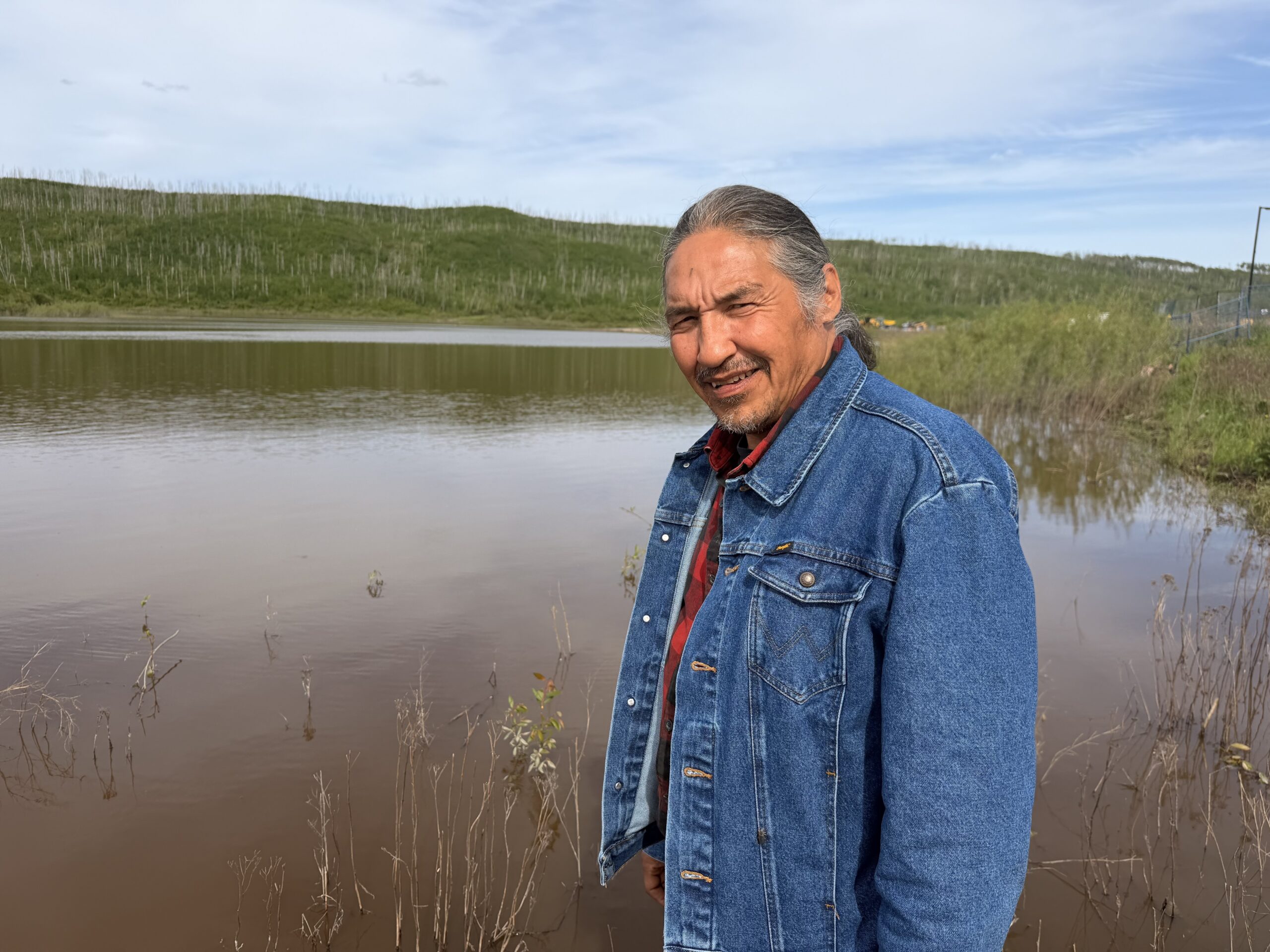
Banner image: Chief Allan Adam of the Athabasca Chipewyan First Nation. Image courtesy of Leana Hosea
Notice: Transcripts are machine and human generated and lightly edited for accuracy. They may contain errors.
Leana Hosea: This story is not about pro-oil and anti-oil. It’s about waste, not wanting toxic waste, which they don’t know how well it’s going to be treated. It’s never happened before, being released into the Athabasca River, which flows into Lake Athabasca, which is where they all drink from. And because treatment is difficult, it’s uncertain whether they’re going to be able to clean the water to those standards.
Chief Allan Adam: When I ran for chief, I was given a mandate what I needed to get accomplished. I was not given the mandate to agree to treat and release of a tailings pond, which is deadly toxic. No, we don’t want it.
Mike DiGirolamo: Welcome to the Mongabay Newscast. I’m your host, Mike DiGirolamo, bringing you weekly conversations with experts, authors, scientists, and activists working on the front lines of conservation, shining a light on some of the most pressing issues facing our planet and holding people in power to account. This podcast is edited on Gadigal land. Today on the newscast, we speak with Liana Hosea, an investigative journalist with years of experience with the BBC, now running her own nonprofit, Watershed Investigations. Her latest story looks at the community of Fort Chipewyan in Alberta, Canada. This community of roughly 600 people or so has been suffering for years from high rates of cancer, some of which are quite rare. They also live in what is called the Alberta Tar Sands. This is the world’s fourth largest proven oil reserve, bigger than the country of England. Oil company Suncor stores a lot of wastewater in what’s known as tailings ponds. Now, this is leftover waste from when an oil company separates the oil from the ground. Chief Allan Adam of the Athabasca Chipewyan First Nation has raised the alarm in the past about wastewater seeping from tailings ponds into his community. But today, Suncor wants to treat this water and release it into the Athabasca River, which feeds directly into Fort Chipewyan’s drinking water. The Alberta government has endorsed this strategy, but First Nations of Fort Chipewyan are largely worried. And Chief Allan Adam is appealing to the federal government to intervene, which has yet to decide. Under the Fisheries Act, Suncor cannot release the water yet, but there is a potential pathway for them to do so pending federal review. Liana Hosea visited this community and talked with them about how they feel about the situation, how Suncor could potentially release this wastewater, and what the potential environmental or health impacts could be.
Leana Hosea, welcome to the Mongabay Newscast. It’s great to have you with us
Leana: Hi, nice to be here
Mike: So before we dive into the story, I think it would be good to explain the context behind why Alberta was thinking of leaving Canada. We understand that ultimately voters voted to remain, but what is that context, and what does it have to do with the oil industry?
Leana: I would say that oil really fueled the separatist movement. Under the last government of Justin Trudeau, he had brought in a lot of environmental kind of rules and regulations were coming into play. And in Alberta is the– they’re the province in Canada where the tar sand oil fields are. This is the biggest reserve of oil in Canada. Canada’s the fourth largest oil producer in the world. It has the fourth largest oil reserves in the world. That’s because of Alberta’s tar sands. And in Alberta, they really felt that they were constrained. They wanted to increase oil production and expand their facilities. They wanted more infrastructure and so forth. So you had this separatist movement, which was also a base for the current conservative government. I mean, they lost in the end, but I think that’s because they had some other sort of extreme beliefs. You know, they– you know, the leadership had talked about feeling quite close to America, wanting to join America, you know, getting credit lines from America. They talked about it being a white movement. So I think there were elements which were a bit more extreme. And also, under Prime Minister Carney, who took power last year, he’s given many Albertans what they want. He’s taken away a lot of those environmental regulations that Justin Trudeau had, uh, introduced. And so you’ve got this new oil pipeline that will run from Alberta to the Pacific Coast that’s been fast-tracked, for example. So even though Carney was a UN climate envoy, I think he’s very much up for expanding the oil industry and expanding production as well.
Mike: So what brought you– What first caught your attention and brought you to Fort Chip One?
Leana: When I read about the– Obviously, I’m, I’m an environmental journalist, so I’m al-always looking for interesting environment stories. I have also reported on Indigenous American communities when I was living in America, and so it’s of interest to me. But when I read that they were talking about treating and releasing toxic tailings into the river system that flows right into the drinking water source of First Nations communities, I was very surprised. I wanted to learn more about this. I mean, the Alberta tar sands is a very kind of dirty form of oil extraction, one of the dirtiest in the world, most carbon-intensive. The area, the size is bigger than England. And the kind of oil is this very Sticky like tar substance, which takes a lot of chemicals, a lot of water, a lot of heat to separate. And so you’re left with– At the moment, they have about one point five trillion liters of toxic tailings waste that’s accumulated over the past six decades in these massive pits. These are like, they call them tailings ponds, but they’re really like the size of lakes, and they’re not treated and released like in conventional oil because the waste is so toxic. It’s so difficult to treat. So it’s been illegal until now the oil companies are saying, especially spearheaded by Canada’s second-largest oil company, Suncor. They’re saying that we’re running out of space. We want to expand. We want more oil extraction. What are we gonna do with this waste? Please give us a kind of a treatment standard so that we can treat and release it. But it’s been– it’s very opaque, the whole process.
Mike: And we’ll talk a little bit more about that in a second. But prior to this, this community in Fort Chipewyan has been dealing with– they’ve been dealing with very high rates of cancer for decades, it seems. And so even before the proposal to release these tailings, they have had environmental impacts, or at least there are links to environmental impacts on their health. Can you detail what you found when you visited?
Leana: The many of these tailings ponds are leaking millions of liters. These tailings ponds are not lined. And there’s also huge amounts of air pollution from the, uh, oil sands production as well. Scientific research recently found it was over six thousand percent higher levels of air pollution than the oil industry were actually reporting. So you’ve got massive amounts of pollution. And what happened with the– What I heard about the health impacts is I actually met Dr. John O’Connor, who was the family– been the family physician there for thirty years, and he said that back in two thousand and five he’d started work there, and he was getting all of these clients coming in with endocrine disruption issues, hypothyroidism. And Fort Chipewyan is a very small community of about six hundred and fifty people. It’s in a very remote part of the world. It’s in North Alberta, surrounded by the Boreal Forest. They’re living on Lake Athabasca. Many of them are still hunting, gathering, trapping. Fort Chipewyan was the birthplace of the center of the fur trade, the beaver fur trade back in the colonial days. So people, a lot of people are still living off the land, but they were talking about fish, deformities in fish, high levels of heavy metals in the animals that they’re eating. They’re still eating wild animals. And the other problem that Dr. John O’Connor found were he were getting people with bile duct cancer. This type of cancer is so rare that in a community that small, they shouldn’t have any cases of bile duct cancer. So he started to raise the alarm, try to get interest. You know, he heard nothing, tumbleweed. So he went to the press in two thousand and six and suddenly all eyes went on Fort Chipewyan, and he got a huge backlash. He, you know, got a letter accusing him of raising undue alarm in Fort Chipewyan. And he– There was an investigation out from the health board against him. He nearly had his medical license taken away. But it wasn’t until a couple of years later, in two thousand and nine, he was finally vindicated. The Alberta Cancer Board did a study, found thirty percent higher rates of cancer, including this rare bile duct cancer. And in twenty fourteen, again, they did another follow-up study and found higher rates of cervical cancer than the rest of the province. But what they didn’t do, and what they refused to do, was look at the possible sources of these high rates of cancer. So that’s never been done. In September this year, it had been announced that the first sort of ten-year, twelve million dollar federally funded health study would start to try and look at the connections between the environment and people’s health in Fort Chipewyan. But Of course, 10 years is a long time- Right … and they’ve been waiting for decades.
Mike: Did you ever query or ask why they had refused to investigate these claims back in 2009, 2006?
Leana: I didn’t get much luck speaking to anybody in the government. The government says that there are no links. The government of Alberta said there aren’t any links and between the oil extraction and health in Fort Ch- among people in Fort Chipewyan. And the oil industry says the same. They say that, that they are working within regulations. And so, and that has yet to be proven.
Mike: Leana did hear from the government of Alberta, and in a statement she shared with me over email, the government said, “Alberta is making strong progress in advancing the treatment of oil sands mine water by supporting both established and emerging technologies through partnerships with industry, academia, and Emissions Reduction Alberta. We are taking a flexible outcomes-based approach that recognizes the complexity of tailing wastewater and supports the development of fit-for-purpose treatment approaches, including combinations of technologies where needed.”
And yet, a 10-year study is now being commenced to investigate this. So if they were so certain there weren’t links, why then is this investigation now going forward?
Leana: It’s a federally funded, investigation that I understand was brought in, introduced by the last government under Justin Trudeau’s government. He’s, and by the environment minister at the time, who I heard was extremely unpopular in the province of Alberta. So it’s the province of Alberta and the oil industry based in Alberta, which says there are no links between these increased rates of cancer of the downstream community, and yet you do have leaking tailings ponds, and I can talk to you about exactly what kind of waste is in there and, um, as, as well as the air pollution.
Mike: Yes, please do. Detail the impacts that these tailings have had on wildlife in the studies that you’ve read.
Leana: It’s more looking at what is in these tailings ponds. Because what they found, what the main toxic sort of ingredient, ’cause as I was saying, it takes a lot of chemicals to separate the oil from the grains of sand. And then one of the main ingredients is this toxic, or one of the main substances in these, these large ponds are naphthenic acids, and this is a family of thousands of chemicals. They’re persistent, which means that they take a very long time to break down. they are toxic to aquatic life. Some studies have found that they are causing endocrine disruption in fish. But there have been sort of no investigation into possible human impact. But another thing about these naphthenic acids, which is interesting coming back to the treatment, is that they’re extremely difficult to treat, and they’re extremely difficult to find. There’s no kind of standard methods of measuring these a- naphthenic acids, ’cause there’s just so many of them. So the, the concern is that not enough testing and testing is not good enough to really prove that you’re, they’re gonna be able to remove these naphthenic acids, because this is what’s special as well about tailings ponds in Alberta. They’re particularly toxic. So this is why they’ve never been released into the environment.This is why at the moment it is not legal to do so.
Mike: Yeah, I found it quite alarming that even Suncor itself admitted that the wastewater is, quote unquote, “too corrosive” for them to use internally on their own machinery. And so it just makes me wonder what makes them think it would be safe to release it into an, a, a marine environment that is directly linked to drinking water.
Leana: This is something that both chiefs of the Athabasca, First Nations of the Chipewyan and the Mikisew Cree leaders told me. They had said to Suncor, “Why don’t you recycle this wastewater? You know, become a beacon of sustainability.” And that was their response, that it was too corrosive.
Mike: Here, Chief Allan Adam explains his interaction with Suncor, asking them about the wastewater.
Chief Allan Adam: Basically, looks like it, going through filters and everything, and they wanna put it out in a, a settling pond, and then slowly, gradually let that settling pond go into the Athabasca River. So it’s not gonna be a direct flow, but what we’re asking in return is that, “Hold off. Why don’t you just use that settling pond and recycle the water and use it for your oil plants?” And then they’re saying is that they can’t use it. The compounds that are inside there are too heavy, too corrosive, yeah. And over time it’ll just eat up the whole, uh, plant When I ran for chief, I was given a mandate what I needed to get accomplished. I was not given the mandate to agree to treat and release of a tailings pond, which is deadly toxic. No, we, we don’t want it I told them our position, but because, you know, it’s a business proposal from them and they want us at the table, so we’re looking at all the options because it’s better to look at the options instead of yelling and screaming from the outside. You know, you hear of Alberta government making changes and making laws to accommodate oil and gas industry, and Canada trying to appease them in regards to making, you know, Canada’s rules lighter don’t help us in any way, form, or fashion whatsoever. And it’s, it’s unfortunate that our people have always been in a line of fire.
Leana: Trying to get any information about the particular treatment that they are suggesting was im-impossible for me to find. It’s not, there’s nothing publicly available. There’s no pilot study data. They won’t say what kind of treatment they’re going to do. Nothing’s been peer reviewed by independent scientists. And so I did meet someone who actually managed to get invited to the Suncor site and went into this mobile laboratory that they have. They have this very small-scale filtration project, and what he said is that, uh, they’re using double filtration from Veolia, the wastewater treatment company. They’re not using reverse osmosis, which is kind of one of the most effective but expensive water filtrations. And so he said Suncor themselves said that they couldn’t remove all the salts. So it’s kind of a very opaque process, and when I spoke to First Nations leadership about it, they were all said they couldn’t tell me or give me any data or information that they had seen because they were forced to sign non-disclosure agreements before being able to take part even in any negotiations. Suncor, of… I, I, I probably should say what Suncor do say. They wouldn’t give me an interview, but they did send me a statement about their treatment.
Mike: Suncor did not respond to Liana’s requests for interview or comment, but in a statement from the Oil Sands Alliance, an industry representative said, “Water treatment and release is commonly and safely done by many other industries across Alberta and Canada, and we’re proposing to do the same for the oil sands based on the recommendation of the Oil Sands Mine Water Steering Committee formed by the Government of Alberta. We are pleased to see recent progress being made on an engagement process to share information and collaborate on plans for treated mine water release and progressive reclamation.”
I’m confused. Why would Suncor require them to s- to sign non-disclosure agreements about a matter affecting public health? Did the community members of Fort Chipewyan give you any more information about that?
Leana: They said it was quite standard that they had to be signing these non-disclosure agreements whenever it came to sort of matters with the oil industry. The oil industry is incredibly powerful in Alberta. As I said, it is the, it’s the fourth-biggest oil reserve in the world thanks to the tar sands, so it’s an incredibly powerful actor. And First Nations communities, they have had to just try to live alongside it, alongside the industry, because several of their leaders told me there was no way of stopping, uh, the oil sands production happening from the beginning. It was gonna happen with or without them. So what they’ve always had to do is to make the best out of it. They have to accept that. They said that they’ve managed to sometimes stave off a little bit of expansion, but most of the time they– it’s gonna happen. So what they’ve done is they have tried to take some benefits from it, and they’ve negotiated sort of agreements where they get some royalties, they get special training. Half the population of Fort Chipewyan work for the oil industry, and they get– that’s their source of income. So some people in Fort Chipewyan, nobody I spoke to really wanted this treat and release, but they were also quite wary about the– having that balance. We’ve got jobs from them, and they’re doing much better financially than other First Nations communities and also Native American communities in America. They’ve managed to negotiate kind of deals, and they’ve got their own businesses providing sort of services for the oil infrastructure. So it’s, it’s a difficult spot for them to be in, and they’re not in the powerful position. But Chief Allan Adams of the Athabasca First Nation has said that he would sue the government of Alberta over this, and he’s asked for the federal government to step in, enforce the Fisheries Act, which the Fisheries Act is basically you cannot dump deleterious substances in fishing waterways. So he’s asking for that because the government of Alberta have even waived the need for an environmental impact assessment before treat and release happens.
Mike: Yeah. So this is the part that I was curious to ask you about, is that Chief Allan Adam, in your reporting, you described him as somewhat in support of the oil industry historically, but appears to be, I don’t know a better way to say this, changing his tune a bit and speaking up against it and citing Treaty Number 8, which gives First Nations the right to continue to use their traditional way of life. But he’s been receiving death threats, and I wanted to ask you about that. Can you detail what he told you about his stance, why he’s holding firm, and the kind of threats he’s receiving?
Leana: When he first came to power, which was quite a long time ago, ’cause he’s run a few terms now. So when he first came to power, he came on an, on a platform of economic prosperity. He wanted to grow the economy. He wanted better material benefits for his nation. Uh, but what he found is that he has to start dealing with all of these people’s health problems, the high rates of cancers. Everybody in that community, obviously it’s a small community, but they all know people who’ve died and died young from cancers. So this is why he’s, he’s walking that line. He has boosted their nation’s coffers through these kind of agreements with oil companies, but it’s not a case– This story is not about pro-oil and anti-oil. It’s about waste, not wanting toxic waste, which they don’t know how well it’s going to be treated, it’s never happened before, being released into the Athabasca River, which flows into Lake Athabasca, which is where they all drink from. And because treatment is difficult, it’s uncertain whether they’re going to be able to clean the water to those standards. But his death threats came from people who may have been pro-separatist. So those were the kind of– And he had their version of the FBI trying to protect him. He was getting so many death threats about that. So it wasn’t directly linked to the oil extraction.
Chief Allan Adam: And right here in Alberta, they use immigration as a platform With a direct attack on our treaty, and they are not shy to say what they wanna do to us, especially to me anyway, that’s for sure, where I got multiple death threats and even got death threats to say that, “We’ll do to him what we did to Charlie Kirk.” So are they admitting that they took out Charlie Kirk? I don’t know.
Leana: Do, do you know who’s making these threats, or who do you think are threatening you?
Chief Allan Adam: Hooligans from down south sending emails
Leana: Mm-hmm. And what do the police do?
Chief Allan Adam: Well, the police pay them a visit, send a, make a phone calls and stuff like that. And they all deny sending these things, and because they’re all Facebook warriors, and they figure nobody’s gonna touch them whatsoever. Nobody knows, nobody knows their address whatsoever. And you know, you, you enter an email into a, a system, uh, you have to enter all kind of information to obtain an email, so regardless of what, you’re gonna be tracked. So people are not that smart after all here in this region, especially the separatists are not smart because, uh, they look at the dark web to, uh, determine what course of, of direction they’re gonna go in life.
Leana: But are the police taking these threats seriously enough?
Chief Allan Adam: Now they are because I, we showed them everything, and they looked at it, and it’s come to a point where even CSIS is involved.
Leana: Even what, sorry?
Chief Allan Adam: CSIS. CSIS is something like, uh, FBI intelligence- Oh … but Canadian f- form. It got to that point where we’re dealing with espionage because there are foreign governments trying to dictate where Alberta should go. Leave, leave Canada and be part of them. So we have foreign interference here. There’s billions of dollars at stake and everything, and what the hell am I doing here trying to hold it together when I had no interest of playing in espionage and everything and stuff like that? But I’m caught right in the freaking middle of it.
Leana: I think people do see First Nations as standing in the way of their prosperity and further oil extraction. And a number of First Nations people were saying to me that this whole separatist movement was heightening racism or heightening the outward racism against First Nations people. I think there’s also a bit of jealousy that these nations have financially managed to negotiate themselves some decent royalties and payouts and jobs, and they often get the priority on the jobs. That’s what they’ve negotiated because some of this is on their land, their treaty land. and that’s what, uh, those death threats are around.
Mike: So you mentioned earlier that the Albertan government is not going to require environmental impact assessments, which is quite shocking. But what about the federal government? Do they have any say in this situation?
Leana: Oh yeah, they have the final say because they are the ones who enforce the Fisheries Act, which is basically whether to treat and release waste into the Athabasca River. So they will have the final say. So Alberta, the province, has said, “Oh, we don’t need an impact assessment. We’re- we’ve visited Suncor. We’re happy with the treatment method.” They’ve done this. They’ve held a oil sands committee where they discussed all the, the treatment plans and the options. Now they want the federal government to set those standards. They say that they’ve been reaching out to First Nations communities about it because, getting consent is not necessarily– This is the point, whether getting consent from First Nations, how required that’s going to be, it’s not clear at the moment, and that’s probably what a court will have to decide if it gets to that. But Chief Allan Adams has written to the federal government and asked them to carry out a risk assessment, them to do the environmental impact assessment and to enforce the law and say they’re absolutely against it.
Mike: And has there been any response, or is that something we’re still waiting to hear back on?
Leana: That’s something we’re waiting to hear back on. I, I think they’re keeping their cards quite close to their chest, and I found it very difficult to get any answers actually from the Canadian government and the Alberta government. I found it very hard. I put in a Freedom of Information request about, maybe it was almost a year ago, and th- and then they sent me something which was pretty much all redacted just the other week. And I’ve never had such a terrible experience with trying to get, um, information from the authorities.
Mike: Hello, listeners, and thank you for tuning in. As I always like to mention, Mongabay is a nonprofit news organization. We rely on funding from listeners and readers like yourself. So if you enjoy this podcast and you wanna support us, I encourage you to go to patreon.com/mongabay, where you can pledge as little as a dollar per month. Even a dollar helps us offset production costs and hosting fees. So if you wanna support us, go to patreon.com/mongabay to learn more. If you’d like to read or listen to the investigation mentioned in today’s discussion, I have linked it in the show notes.
Ultimately Alberta voted to remain with Canada.How does this change the situation now, if at all?
Leana: As I said, I think people didn’t want to join America. I don’t think that was very popular as a platform. So I think there were some unpopular elements of the separatist movement, and so yes, they were completely trounced. But when it comes to the treat and release, when it comes to the expansion of oil and ramping up production, I- that’s not going to change. Premier Danielle Smith, uh, wants to double oil extraction in the next ten years, and Prime Minister Carney has fast-tracked infrastructure projects, and he wants to do that too. They’re feeling the sort of the Trump effect. They want to grow their own, um, you know, America is n-not necessarily a reliable trading partner anymore. So that’s why they want to expand their own fossil fuel economy because they see that a lot of Canada is really based on an extraction economy. Obviously, you’ve got certain provinces like Ontario, which they have a lot of services, they have a banking industry and a financial services, but, you know, in other parts of Canada, it’s either quite rural, quite poor, or you’ve got the cash cow, Alberta, which is oil revenues creating like seven percent of GDP. That’s what they want to double down on. But as I said, you know, you’ve got these First Nations leaders talking about taking them to court, so I have to see. Wait and see.
Mike: Before you started this story, were you expecting to see what you saw? W-what was the most surprising thing that came out of this story for you?
Leana: seeing the tar sand oil fields, I’d never seen them before, and, uh, it is a massive sort of scar on the landscape. I went to see one of the pits sort of thing, and then on my left is the boreal forest, thick, forest of poplars and conifer trees and beautiful lakes with beaver houses on them. And then on my right, it’s an absolute wasteland. No trees at all, cesspools, massive machinery. We’re talking about huge digger trucks. So it’s a huge operation. And when I mentioned, uh, tailings ponds as well, I had never seen one, so I went up to, to take a look. And when you go close, there’s often this gunfire cracking in the, um, as you go near it, ’cause it’s surrounded by sound cannons to scare away the animals because they can die on contact with this waste. So, when I was there, you know, there were several flocks of geese that had died. You know, 45 birds died on a tailings pond last year. The oil company was fined for 400 birds dying on the pond. That was a surprise, the size of these, these ponds.
Mike: Do you know how much that fine was, out of curiosity?
Leana: So the regulator fined Canadian Natural Resources $278,000 after 400 birds died on one of their ponds.
Mike: That’s quite a small amount of money for a company that probably makes somewhere in, in I would assume, billions of dollars, if not hundreds of millions of dollars.
(Canadian Natural Resources reported $7.74 billion USD in profit for the fiscal year ending in 2025. So this fine amounted to roughly 0.0036% of their profit.)
Leana: Yeah. And there was this other case a couple of years ago where the Imperial Oil coal mine, it’s, was leaking tailings waste. Uh, one of the, I think one of its berms had sort of broken. It was all just leaking through, and that, uh, continued for nine months. And no one, not the regulator, not the company, informed the c- the community of Fort Chipewyan, who are, as I said, right downstream. None of them told them that this was happening, and it’s only because apparently one of the community members was working there and flagged it up. And y- when they asked for data, they said that they didn’t get enough data to make them feel like, oh, the, the c- oil company said it wasn’t, we didn’t impact the waterways, but apparently there was a lack of, uh, data to really prove that one way or another. And this year, Imperial Oil was fined for that, and they were fined $120,000. That’s less than the dead birds. And I think that’s roughly 0.0025% of the company’s total net income in 2023.
Mike: Yeah. This is not uncommon in situations I see where environmental regulations are loosely enforced, and then when they are, the fines are so infinitesimally small compared to the revenue that the company makes that it almost, it almost, a lot of critics say, feels like a rent check i- in some situations, where this is just the price they pay for existing rather than seeing it as an actual deterrent from committing the environmental crimes. So cannons to keep animals away from tailing ponds, this is something I’ve never heard of before. So are they just firing all hours of the day?
Leana: They must be firing– I think their movement motion have got motion sensors, but, you know, I stood there on a hill looking down at another one. They were going off all the time. Yeah, I guess so. They are going off all the time.
Mike: (Okay, this one’s pretty complicated. Those noise cannons use a combination of timers and radar-activated long-range acoustic devices. It appears that when they are set to timers, it is usually around peak migratory periods for birds, and they go off every ten to thirty seconds, twenty-four hours a day, so around periods when the tailing ponds aren’t frozen over, for example. Canada’s nonprofit environmental newsroom, The Narwhal, which have actually been a guest on this show before, reported on this in 2021 about a buried report that calls into question the effectiveness of these devices. It’s pretty complicated, but the report appears to show that there are detrimental effects on wildlife while not actually keeping them away from the tailings ponds.)
Leana: I also took a trip up the Athabasca River, so right through the heart of the tar sands, so that I could really see the operations. And there were huge– You might think it was some kind of like mountain or like large hill, but no, they’re just piles of coking waste and piles of, uh, oil sands waste. Smelt pretty bad as well. And it had been raining very heavily, and so there were these sort of what I thought as a visitor, I was like, “Ooh, look at that beautiful waterfall.” And then the guy who was driving our boat, he’s a local guy, and he said, “Oh, no, that’s not usually there.” And when you get close, you can see it’s not a waterfall because it’s coming right through the trees. So it’s– it was runoff, and as you got near, it stank of bitumen. It stank of some sort of oil product, like really strong. So I don’t know If that was runoff from the ground, there was a tailings pond not too far and raised up. But it’s very hard to prove with tests and so forth what exactly that runoff, that beautiful waterfall really was. But it was definitely, I wouldn’t have thought that would be very good for the river. Although the oil companies say they have had no impact on the river. There’s a lot of monitoring, although these are very– They do produce these huge reports, but often they’re so huge and often you really struggle to find what’s really meaningful in the reports. But they say that they have– The report concluded that there was no really measurable impact from oil sands on the river or any of the tributaries.
Mike: I guess we’ll see with the federally funded, um, project that’s going forward. What do you plan on looking into next?
Leana: So I do a lot of work on forever chemicals and investigating forever chemicals and that pollution here in the UK and Europe. So I have some big investigations coming up on that. I’m also writing a book about plastics and forever chemicals and those impacts on our environment and health.
Mike: In regards to this story, though, do you plan to do any follow-up reporting?
Leana: I hope so. I did take samples along the Athabasca River, including of that waterfall. I’m working with some scientists in Canada to see what data we can analyze. We’ll see what those results come up with.
Mike: Before you leave, I would love to ask you about your nonprofit, Watershed Investigations. Can you tell us a little bit about it and what this nonprofit is for?
Leana: Uh, Watershed Investigations is me and another environmental journalist, Rachel Salvage, in the UK, and we launched in 2023, and we’re grant-funded to undertake investigations.
Not all are the watery focus, but all sorts of environmental public health investigations. I used to work for the BBC for 18 years and, um, kinda see, you know, investigative reporting getting defunded and just thought there was not enough investigative journalism, especially in the environment arena. So that’s why we launched, and we just publish in the mainstream media or we broadcast in the mainstream media, so we don’t really have our own kind of outlet. But please check us out because we– also, we gather a lot of data. We do a lot of our own kind of scientific testing. We work very closely with scientists. So we’ve got all these, um, open-source data maps. So we like mapping water resources or mapping pollution. We worked with a group, and we mapped PFAS pollution for the first time in the UK and across Europe. I’ve mapped all the land- well, no, not all the landfills. I’ve mapped more landfills than have been mapped before in the, in Europe and the UK. So we really want to empower civil society and other journalists and academics and, have open-source data out there.
Mike: Leana Hosea, thank you so much for joining me today. It’s been a pleasure speaking with you.
Leana: Thank you, Mike.
Mike: As always, if you’re enjoying “The Mongabay Newscast” and you wanna help us out, please spread the word about the work we’re doing by telling a friend and leaving a review on the platform you’re tuning in on. This is one of the best ways you can help expand our reach and keep the show growing. But I also encourage you to read our news and inspiration from nature’s frontline at mongabay.com, or you can follow us on social media. Find Mongabay on LinkedIn at Mongabay News and on Instagram, Threads, BlueSky, Mastodon and Facebook with our handle at Mongabay and on YouTube at Mongabay TV. Thank you as always for listening.
