


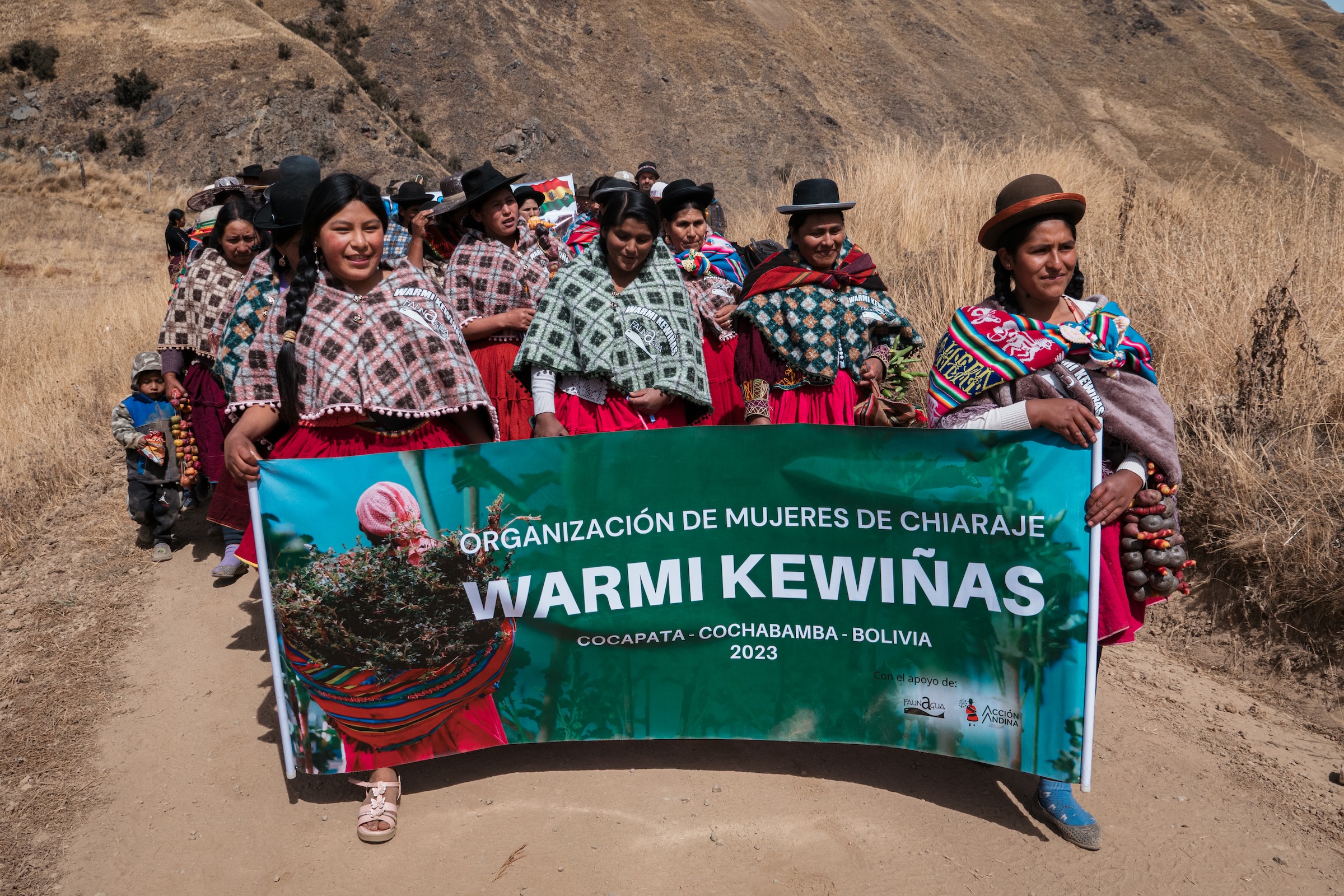
- In Bolivia’s highlands, native Polylepis forests have declined dramatically, the result of demand for firewood, urban expansion and small-scale agriculture.
- Polylepis trees create microclimates that provide water far beyond the forests themselves, unlike non-native species that drain aquifers.
- A nonprofit-led initiative is working with Indigenous communities to plant hundreds of thousands of the slow-growing trees, though the scale and sustainability of the impact remains to be seen.
- The reforestation initiative prioritizes women’s empowerment, bridging gender divides through education in a bid to make the project more durable.
The bare ridges of the Tunari mountain range rise high in Bolivia’s central Cochabamba department. Only the occasional stand of squat, shrubby trees and rust-red potato crops dot the slopes.
It wasn’t always this way. The high-elevation landscape was once filled with native Kewiña (Polylepis sp.) trees, a slow-growing tree belonging to the rose family that thrives well above the typical tree line, at up to around 4,450 meters (14,600 feet) above sea level. Today’s lack of vegetation reflects decades of clearing for firewood, construction and small-scale potato agriculture, as well as drier and warmer weather in the area linked to forest loss and climate change.
Only 10% of the region’s original Kewiña tree coverage remains, biologists estimate. The trees were also decimated by urban expansion, intensifying wildfires and habitat fragmentation. In 2023, the IUCN listed one Polylepis species endemic to central Bolivia as endangered.
Tunari National Park, covering about 309,000 hectares (763,500 acres), is home to a large, albeit much reduced, Kewiña population, which provide vital habitat for the near threatened Cochabamba mountain finch (Poospiza garleppi) as well as critical ecosystem services for the Cochabamba metropolitan area and beyond, to the nearby Amazon basin. Today, however, the region faces both chronic drought and increasing erosion on the mountain range’s slopes.
“We used to harvest firewood from the Kewiña without replanting,” Andrea Vicente, a potato farmer in Chiaraje, a village perched at some 3,780 m (12,400 ft) in the Tunari mountains, told Mongabay in person. “But the forest was diminishing.”
With support from conservation groups, Vicente’s community, along with other Indigenous Quechua villages, is reforesting endemic Kewiña forests across the Tunari mountains, rejuvenating water systems while supporting women to become financially independent. But while the initiative marks an important success in the face of growing deforestation, its impact is limited by its scale and its long-term impact remains to be seen.
Reforesting the Bolivian headwaters
Efforts to mitigate deforestation in the Tunari range have a complex history. In response to severe erosion in the 1960s, the Swiss Technical Cooperation financed the mass plantation of non-native pines (Pinus radiata) and eucalyptus (Eucalyptus globulus). The project ultimately degraded local ecosystems, exacerbated water scarcity and caused conflict with communities when promises to allow them to harvest the wood were broken, Jennifer Cahill, a research scientist at the Center for Biodiversity and Genetics at the Universidad Mayor de San Simón in Cochabamba, told Mongabay in a video call.
In Chiaraje, Vicente and other residents are reversing that legacy. Their work is part of an initiative launched in 2022 by Bolivian nonprofit Faunagua to restore degraded watersheds in six communities in the Tunari mountains. Since the beginning, the organization has worked with communities to build shade houses where they grow Kewiña saplings before transplanting them in the surrounding hillsides. To date, they have planted nearly 500,000 seedlings, according to Rosmery Ayala, a biologist and the executive director of Faunagua.

Community members are already noticing subtle shifts in the microclimate. “Now that we’ve been at this for four years, there’s more rain and humidity in the air,” Irma Vicente, Andrea’s sister, told Mongabay.
Research shows that Kewiña trees both sow and harvest water: Their small, dense leaves intercept droplets of high-altitude fog and channel them into the soil. This is especially important in Tunari National Park, as parts of the forests sit above aquifer recharge zones. Because Kewiñas keep their stomata (microscopic pores in the leaves’ undersides) mostly closed in the harsh alpine conditions, they transpire minimal moisture, preserving groundwater rather than depleting it.
The water retained by these native forests “supports both the tropical and the Andean parts of the Cochabamba department,” Ayala told Mongabay in person. Studies indicate that 80% of the water consumed in the Cochabamba metropolitan area originates directly or indirectly from catchment zones inside Tunari National Park.
“What needs to be done is to plant massive numbers of Polylepis trees to contribute to the water supply,” Milton Fernández, another research scientist at the Center for Biodiversity and Genetics at the Universidad Mayor de San Simón, told Mongabay via video call.
Yet reaching that scale requires long-term community organization, which involves much more than just planting trees.
Reforestation as empowerment
When Faunagua began reaching out to communities for its reforestation project, the team recognized a need to address local gender divides: While men often gathered for local union meetings, the women, living in homes dispersed over a vast area, had few shared social spaces.
“Before, each woman lived in her own world – focused on her home, her family, and her daily work,” Norma Achocalla, the social technician at Faunagua who leads the project in Chiaraje, told Mongabay in person. Now, “solidarity has grown because there is a dedicated space where they can exchange ideas and share their experiences as women,” such as tips for natural remedies when their children are sick, she added.

That shared space soon brought to light another need: basic literacy. “Many women had never had the opportunity to complete primary school,” Achocalla said. “[Some of them said] ‘we don’t know how to write our names, why don’t you teach us to read and write?’”
In response, Faunagua integrated literacy classes into the program. For a village of around 300, the gatherings to both expand literacy skills and tend to Kewiña saplings became popular, drawing a core group of around 25 women. In 2023, they formalized their group, calling it the Warmi Kewiñas, meaning “Kewiña Women” in Quechua. While men also work on the Kewiña project, a dedicated group for women has been important to begin bridging the gender gap.
“Now we women can read, write, and sign our names – we’ve all learned through the Kewiña project,” said potato farmer Andrea Vicente, who serves as the group’s president.
The program has also organized environmental education and organizational strengthening classes, and Faunagua and its partners – along with Chiaraje residents – recently finished constructing a small building that will serve as a daycare center while the women work in the nearby shade house, the protective nursery for the saplings.
Long-term sustainability
While the Kewiña reforestation project has made substantial progress, with 110,000 seedlings grown this year, according to Ayala, questions about its long-term sustainability remain. Rosario León, a sociologist at CERES, a Cochabamba-based think tank, has worked on Indigenous political participation and communal forest management projects since the 1970s. Most, she said, have failed to have long-term impacts.

“As long as there’s money, everything is great,” León told Mongabay in person. “But once the organization leaves and the funding disappears, you’re right back to square one.”
For Ayala, expanding community literacy is key to breaking that cycle. “We can’t just expect a community to say ‘yes’ to everything, because then they’re just repeating what we tell them,” she said. “Knowing how to read and write gives you the chance to read other things, rather than just relying on what you’re told.” Andrea Vicente said she feels that the education is already paying off, “Now, us women are stronger and more empowered.”
For slow-growing Kewiña trees that take decades to mature and live for hundreds of years, community ownership is vital. “We have to ensure that in 30 or 50 years, the local community remains fully committed to protecting these forests, and that they have their own funds to sustain that conservation,” Ayala said. “They need to understand that this forest is their safety net.”
Research scientist Cahill said she believes “this work will endure” because it relies on endemic species and respects community land-allocation decisions, minimizing the possibility of future land conflicts.

Ayala said she also hopes that healthier microclimates will keep high-altitude agriculture viable, and that other economic activities, like ecotourism, can emerge, slowing migration to cities. Keeping people in villages like Chiaraje is crucial to continuing reforestation programs.
Still, it will be years before the reforestation efforts can deliver substantial benefits to the region. Meanwhile, with both droughts and flooding linked to El Niño hitting Bolivia, research scientist Fernández warned that treelines across the Andes are rising in a phenomenon known as the “escalator to extinction.” “There will come a point when they can’t climb any higher because the mountain runs out,” he said.
While reforestation in the Andean headwaters is important, the scale of highland deforestation is dwarfed by the destruction in Bolivia’s lowlands, driven by drought, agribusiness expansion, and wildfires. According to data from Global Nature Watch, 70% of Bolivia’s tree cover loss between 2001 and 2025 occurred in Santa Cruz, the lowland department most affected by agricultural expansion and wildfires more than 23 times the area of forest loss in Cochabamba over the same period.
Unlike smallholder Quechua farmers, industrial agriculture and Mennonites often “choose a strategy of immediate financial gain regardless of the cost,” Cahill said, adding that they can simply relocate when resources are depleted. This reality makes it difficult to translate the community-based reforestation model to a lowland context.
Despite the broader challenges, the Warmi Kewiñas remain dedicated to restoring native forests in their own territories. “When my children are grown, I want these forests to be fully grown, too,” Andrea Vicente said. “These Kewiñas will bring them happiness.”
Banner image:
Citation:
Oelkers, R., Andreu-Hayles, L., D’Arrigo, R., T. T. Nguyen, H., Pacheco Solana, A., Rodriguez-Caton, M., … Ruiz-Carrascal, D. (2026). Radial growth decline in a tropical andean treeline in Bolivia. Biogeosciences, 23(13), 4641-4665. doi:10.5194/bg-23-4641-2026
FEEDBACK: Use this form to send a message to the author of this post. If you want to post a public comment, you can do that at the bottom of the page.

