


The youth of this era, both Gen Z and Gen Alpha, are often described as the “climate generation,” in part because climate change is already shaping how this generation (which also happens to be my generation) lives and what our futures will look like. Researchers have linked climate change to shifts in where Bangladeshi children live and learn, girls dropping out of school in Kenya during droughts or floods and declining the mental health of students.
But we are also the generation that has learned to push back: taking to the streets, as millions did worldwide during the global climate strikes inspired by Greta Thunberg’ in 2019, and to the courts, where 27 students from the University of the South Pacific launched the campaign that ultimately led to the International Court of Justice’s 2025 climate opinion. At this year’s COP31, the United Nations’ 31st climate summit in Antalya, Turkey, the climate generation was back.
The draft texts: The cover decision serves as the closest thing to a final summary of the agreements reached by nearly 200 countries in Antalya to advance the goals of the Paris Agreement. The first draft was released on Nov. 16, a week into the proceedings, and called for countries to treat climate impacts on children “as a primary consideration in national planning.” On Nov. 19, a shorter second draft was released. A paragraph recognizing the “meaningful participation of children and youth” in climate decision-making survived. Language on how climate change harms children, direct mentions of gender and education, a $120 billion target for adaptation finance and a reference to fossil fuels were cut. When I compared the two drafts, what stood out the most was that agriculture, the sector that employs 44 percent of working youth ages 15 to 24 worldwide, appeared in neither.
A third draft, released on Sunday, restored much of what had been cut, including language on the “disproportionate impacts of climate change on children” and their access to health and education. But the European Union, small island states, the U.K., Norway, and others rejected the cover decision due to a lack of mention of fossil fuels and no final decision was adopted in the end; you can read more on the breakdown from my colleague Bob Berwyn. This year’s talks were the longest COP in history and the first major breakdownin negotiations since COP15 in Copenhagen in 2009.
Before the summit, the food and agriculture working group of YOUNGO, the official youth constituency in U.N. climate talks, called for grant-based adaptation finance that young farmers could access directly. The Nov. 19 draft does mention grant-based adaptation finance, but it reserves the “direct access” language for national development banks, not young people.
The one finance decision that appears to have survived the summit is on the loss and damage fund. It calls for the board to “enhance engagement” with the youth and to “take into account their perspectives, as appropriate.”
Did you also spend your free time reading the draft decisions? Email me at [email protected] to share what you noticed in the texts.
Inside the venue: The climate generation also had a dedicated physical space in Antalya. The Children and Youth Pavilion is in its fifth consecutive year as the only fully youth-led space at the official climate summit, opened with Sally Higgins, the COP31 Presidency Youth Climate Champion, in attendance. Higgins’ responsibility is to connect the voices of the global youth to the COP presidency. At the U.N. Secretary-General’s youth roundtable, Jayanti Bam, UNICEF Nepal’s youth advocate for climate action, asked that leaders “protect children. Listen to children. And act for children.”
On Nov. 19, Higgins said in a video published to the UN Climate Change Facebook account that “farming practices are really under threat from climate change,” the same concern YOUNGO expressed.
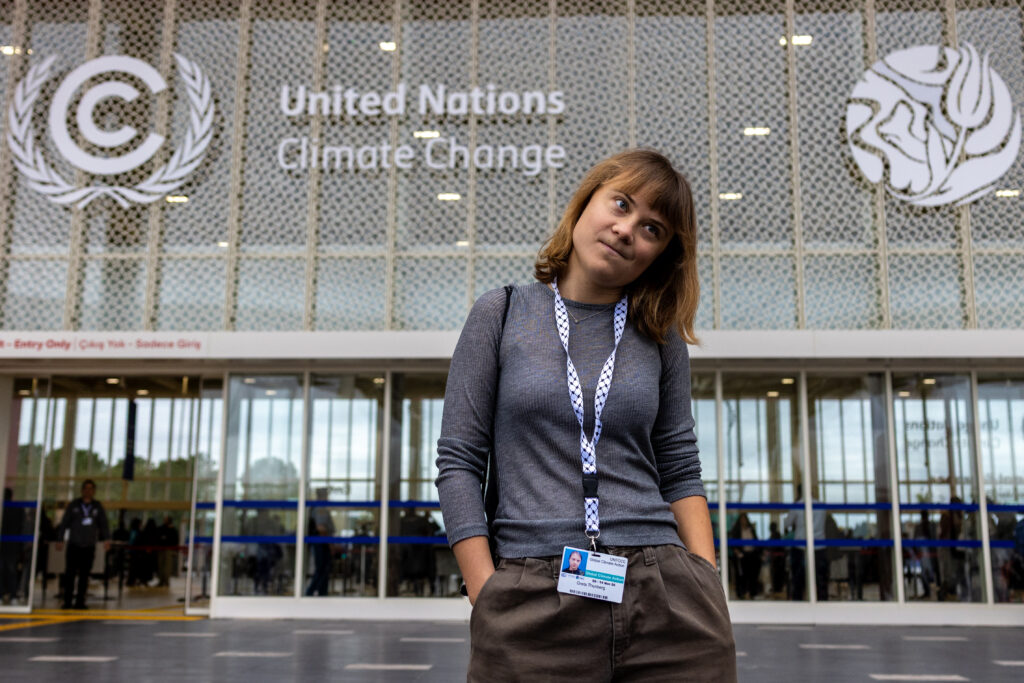
Outside the venue: One of the most prominent voices in the climate generation finally returned to the COP proceedings this year. On Nov. 10, Greta Thunberg, now 23, arrived at the Antalya Expo Center. It was her first U.N. climate summit since the 2021 COP in Glasgow, where she dismissed global leaders’ promises as “blah, blah, blah.” She’s continued that thread. This year, she said that host governments use the summit to “whitewash themselves,” adding that the negotiations are full of lobbyists that are paid by industries profiting from fossil fuel dependence. Thunberg’s criticism of fossil fuel interests and lobbying proved prescient, as they contributed to the breakdown of the agreement.
Addis Ababa, Ethiopia will host the next COP next November. The climate generation, who came to Antalya asking for more support, now have a year to regroup and try again. United Nations Secretary-General António Guterres said in a Facebook post describing their work in Turkey that “the activism of young people today is what gives [him] hope for the future.”
This Week on Earth
Last week, the Senate passed the Bipartisan American Affordability and Jobs Act, or BAAJA, 62–33. The contentious permitting bill has the potential to lower energy costs for consumers, but as currently written, it weakens some environmental laws to speed up the permitting process.
Here are some stories that stood out to me outside the coverage of BAAJA:
Just in time for Thanksgiving, The Guardian and Climate Central reported that cranberry-growing regions now see an average of 14 more warm winter days than in 1970. In Wisconsin, which grows more than 60 percent of the U.S. cranberry supply, early thaws are melting the ice that protects the vines.
On Friday, at the EU-UK summit in Brussels, the U.K. and the EU agreed to link their carbon markets beginning in 2028, which would exempt British clean-energy exports from the EU’s carbon border tax, and to let 100,000 young people live, work or study on either side of the English Channel for up to three years, Politico reported. Whether the deals are final, or if they depend on a tuition fee agreement that’s still to be negotiated, remains disputed.
Last week, Anthropic went public with the biggest IPO ever, raising around $81 million. The pre-IPO filing mentioned that the AI company will build its own data centers and power supply, noting that natural gas would play a role. However, no information was provided about its emissions, TIME’s Justin Worland reported.
This story is funded by readers like you.
Our nonprofit newsroom provides award-winning climate coverage free of charge and advertising. We rely on donations from readers like you to keep going. Please donate now to support our work.
From our Bureaus: Nicholas Kusnetz on BAAJA
COP isn’t the only thing perpetuating fossil fuels—they’re here to stay, both internationally and domestically, with BAAJA passing the Senate. For this week’s Q&A, I asked my colleague Nicholas Kusnetz about the permitting bill and natural gas exports. He’s been covering oil, energy and gas for Inside Climate News for just over 10 years. Most recently, he wrote about how BAAJA could strengthen liquefied natural gas usage.
KATE WAXMAN: Can you tell me more about LNGs and how they relate to BAAJA?
NICHOLAS KUSNETZ: So liquefied natural gas is really just the way that the country is able to export natural gas, because when you supercool it and make it into a liquid, you can make it dense enough to put onto a ship. And until this country started doing that, there was no real way to export gas beyond like, Canada or Mexico … BAAJA, at its core, would make it easier to build all kinds of energy projects, including pipelines. Liquefied natural gas has become the most important part of the United States fossil fuel sector because it is the fastest growing. The United States has tons and tons and tons of gas, but the domestic market, until recently, was not really growing, and even now the growth is somewhat limited. But the global market is huge.
WAXMAN: And if BAAJA passes, what is your biggest concern in relation to LNGs?
KUSNETZ: I would say that, what sources told me for this—and I was surprised by—was that in modeling from one group, the Rhodium Group, LNG was the biggest winner in fossil fuels. And that was largely because new pipelines would be built more easily, more quickly. The biggest market for that is overseas, and so LNG exports are already expected to grow really substantially, like double, essentially over the next 15 years. That’s even without this bill. This bill would just potentially add more on top.
WAXMAN: You mentioned that overseas nations are a really big proponent of LNG. Who’s the biggest client overseas?
KUSNETZ: So in recent years, European countries have been the biggest buyer of U.S. LNG. That shifted a little bit with the war in Iran and the Strait of Hormuz being shut down. More gas was going to Asia, and longer-term buyers see Asia as the bigger growth market because Europe is trying to reduce its use of natural gas. There are a lot of countries in Asia that currently use a ton of coal, and so the big LNG companies are looking to Asia as their growth market, and so one of the big questions is: As Asian economies, particularly emerging economies like Indonesia or Vietnam, use more energy, what will that energy be? And so U.S. LNG exporters want it to be American gas, and so they want to build as much capacity as they can to make that gas cheaper. And if that gas is not cheaper, and there’s a lot of environmental advocates who are concerned, that will shift those economies towards depending more on gas than they would otherwise.
WAXMAN: I know that you’ve been reporting on energy for a long time, but what would you say is the biggest thing you learned from reporting on this story?
KUSNETZ: This year in particular, I’ve done a number of stories on LNG. And so I was beginning to learn about this over the course of the year, and this was already somewhat clear, but I think this really underscored for me how central the LNG sector is to the U.S. oil and gas industry, how critical it is to its finances and its growth.
News From Us and Our Partners
Deep-sea mining: The Trump administration awarded the first-ever federal leases for deep-sea mineral exploration, opening more than 31 million acres of Pacific waters off of American Samoa, Teresa Tomassoni reported this week. The winning bid of $6 million comes just days after a federal judge ruled that the Interior Department violated the Endangered Species Act by approving the sale.
Why it matters: The leases only allow for exploration, but critics have said they are a first step toward commercial mining in waters that house many endangered species, including blue whales.
Detonating unstable lead: Last week, a federal appeals court temporarily blocked the Army’s plan to detonate about 10,000 pounds of unstable lead at the Iowa Army Ammunition Plant, Anika Jane Beamer reported.The block was then lifted on Monday, clearing the way for a detonation the Army now has scheduled for Wednesday. Most state officials learned about the plan only days before the scheduled event.
Why it matters: Lead is a neurotoxin that is dangerous to young children and contaminated fields and topsoil can’t just be wiped clean.
Chemically fueled fires: Last week in Alabama, a massive creosote-induced fire broke out, Lee Hedgepeth and Dennis Pillionreported. Creosote is a term used for a variety of products that are typically used to protect wooden railroad ties from rot. Public officials said that there didn’t appear to be much danger to the surrounding areas, but the CDC claims that exposure to these chemicals can lead to cancer and worsen asthma symptoms.
Why it matters: Fires of this magnitude have broken out around the nation and are exacerbated by extreme heat and strong winds driven by the super El Niño.
Thanks for reading this edition of Today’s Climate, a newsletter dedicated to highlighting the latest essential climate news.
Loved (or hated) this new edition? Tell me so at [email protected]
For conversations with ICN reporters about the stories behind the headlines, you can listen to Inside Climate on YouTube, Spotify,Apple Podcasts, Amazon Music and iHeart.
About This Story
Perhaps you noticed: This story, like all the news we publish, is free to read. That’s because Inside Climate News is a 501c3 nonprofit organization. We do not charge a subscription fee, lock our news behind a paywall, or clutter our website with ads. We make our news on climate and the environment freely available to you and anyone who wants it.
That’s not all. We also share our news for free with scores of other media organizations around the country. Many of them can’t afford to do environmental journalism of their own. We’ve built bureaus from coast to coast to report local stories, collaborate with local newsrooms and co-publish articles so that this vital work is shared as widely as possible.
Two of us launched ICN in 2007. Six years later we earned a Pulitzer Prize for National Reporting, and now we run the oldest and largest dedicated climate newsroom in the nation. We tell the story in all its complexity. We hold polluters accountable. We expose environmental injustice. We debunk misinformation. We scrutinize solutions and inspire action.
Donations from readers like you fund every aspect of what we do. If you don’t already, will you support our ongoing work, our reporting on the biggest crisis facing our planet, and help us reach even more readers in more places?
Please take a moment to make a tax-deductible donation. Every one of them makes a difference.
Thank you,
