


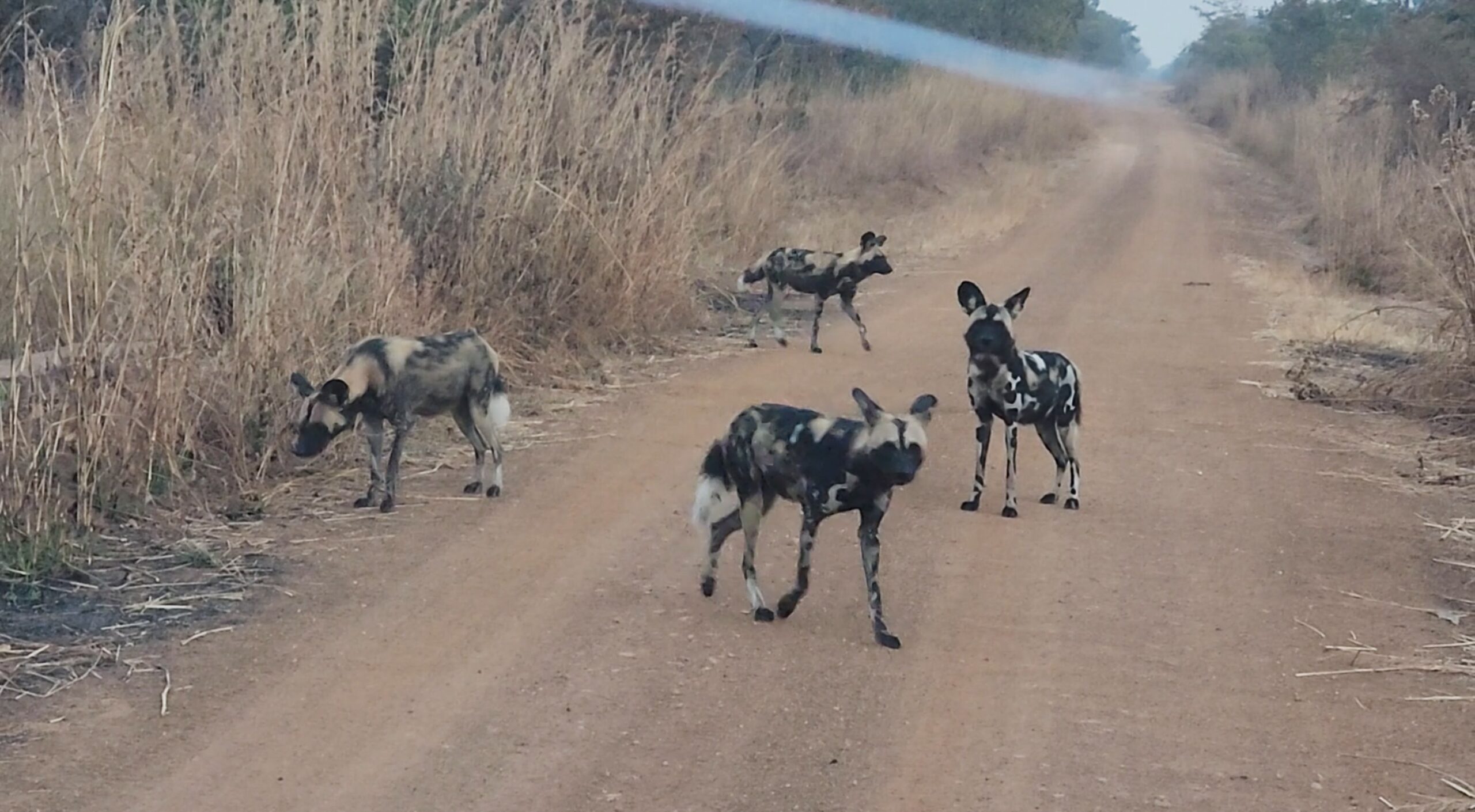
Four African wild dogs were recently spotted in Kasungu National Park in Malawi, making it the first confirmation of the endangered species in the park in more than a decade. The wild dogs appear to have travelled hundreds of kilometers from a park in eastern Zambia to reach Kasungu.
Matthew Becker, chief executive of the Zambian Carnivore Programme, told Mongabay his team recognized the four African wild dogs (Lycaon pictus) from a database of known wild dogs collected in South Luangwa National Park and the Luangwa River valley as part of a long-term study. South Luangwa is located around 300 kilometers (186 miles) to the west of Kasungu. The four dogs had been recorded in May near a school in Mfuwe village, just outside South Luangwa, Becker said.
The wild dogs may have traversed parts of the Malawi-Zambia Transfrontier Conservation Area (TFCA), Becker added. The TFCA connects Malawi’s Kasungu to Zambia’s Lukusuzi National Park adjoining the Luangwa Valley, through a long narrow region of densely packed villages, farms and homesteads,
“I suspect they would have used the areas that were least impacted by development and (with the) least amount of threats, but one never knows with dogs,” Becker said.
He added that “it’s very promising” the wild dogs were able to move from South Luangwa all the way into Malawi. “I think hopefully this signals more dogs in the future exchanging between the countries through dispersal,” he said, adding that the journey of the four dogs to Kasungu shows that South Luangwa should be integrated into the TFCA.
Gervaz Thamala, Kasungu field operations manager for the NGO International Fund for Animal Welfare (IFAW), told Mongabay he spotted the four wild dogs a few hundred meters from the park’s main gate, along its eastern boundary, early on July 17.
“They were so relaxed,” said Thamala, who photographed the dogs from his vehicle. “I didn’t want to leave them, but I thought it wasn’t fair to stay too long.”
Former den sites in the south and north-west of Kasungu have lain dormant for years, said Thamala.
In 2022, the Malawian government, IFAW and African Parks introduced hundreds of animals, including impalas (Aepyceros melampus), warthogs (Phacochoerus africanus) and elephants (Loxodonta africana) to Kasungu. Impalas, which are common prey for wild dogs, are now plentiful in a part of the park south of where the dogs were spotted, Thamala said. “I wouldn’t doubt if [the dogs] are going to stay.”
In a statement sent to Mongabay, Bruce Sosola, IFAW Malawi’s country director, said his organization’s work to protect and reconnect wildlife habitats and avoid human-wildlife conflict within the TFCA helps wild dogs and elephants move safely between the two countries.
“The natural return of African wild dogs to Kasungu National Park after a decade isn’t just an extraordinary sighting, it’s proof that our ecosystem is truly healing,” he said.
Banner image: Four African wild dogs were spotted in Malawi’s Kasungu National Park in July after more than 10 years. Image courtesy of the International Fund for Animal Welfare.
