


Reading Time: 8 minutes
The stakes are high for Wisconsin Democrats to deliver on key policies and promises when new leaders take over both the executive and legislative branches at the state Capitol in January.
They need only look to the last time the party held complete control of state government between 2009 and 2010 to see how challenging governing could be in the months ahead.
Amid a historic 2008 presidential election, Wisconsin Democrats flipped the Assembly for the first time in more than a decade and acquired power in both legislative chambers for the first time in then-Democratic Gov. Jim Doyle’s tenure as governor.
But the party came into power in the midst of the Great Recession, when the state faced an unprecedented $6.6 billion budget deficit and the unemployment rate in January 2009 was above 7%. In contrast, Wisconsin Democrats at the start of next year will inherit a projected $4.18 billion surplus and a state unemployment rate at 3.3%.
Both the economic challenges and ideological differences within the Democratic Party doomed the opportunity to pass major policies, former lawmakers and political watchers said.
“We had a couple Assembly members who were really almost Republican,” said former state Rep. Spencer Black, who served in the Assembly from 1985 through 2011. “One eventually became an independent and the other one voted with Republicans, so getting a majority was always very tricky. We did have one Republican who we could get to vote with us on occasion, so it doesn’t mean we weren’t able to pass things, but it was definitely a case where we didn’t have a solid working majority.”
Former Janesville state Rep. Mike Sheridan, who served as Assembly speaker in the 2009-2010 session, recognized there were policy areas where Democrats could have gone further, but the support often was not there in the Assembly. Sheridan said he sees more opportunities for common ground in the new makeup of the Legislature starting next year.
“They’re going to have to be courageous, and there’s going to be some decisions that need to be made. The good news for them is they’ve got a bigger margin,” Sheridan said. “If people just can’t support a certain bill or an issue, they have some wiggle room there. We didn’t have any wiggle room.”
Black recalled the frustration of not having the votes to pass a renewable energy bill that he believes would have created green jobs.
State Rep. Chris Sinicki, D-Milwaukee, who led the Assembly’s labor committee at the time, said she remembered members who would not vote to raise the minimum wage in the wake of the financial issues stemming from the Great Recession.
Gov. Tony Evers earlier this year lamented nonpartisan redistricting as a missed opportunity during Democratic control of the Legislature. It was an effort that Black helped lead at the time, but saw “lukewarm” support from Democrats, he said.
“We should have done something about nonpartisan redistricting,” said Sinicki, who was elected to the Assembly in 1998 and will begin her 15th term in January. “That was a huge, huge mistake we made. We had the chance to do it and I guess we didn’t think that no Republican caucus would be as nasty as this one was.”
As their power ran out in late 2010, Democrats missed an opportunity to sign off on retroactive union contracts for state employees before Republicans took over state government. Senate Majority Leader Russ Decker voted with Republicans against approving the contracts. That paved the way for Republicans to pass the anti-union 2011 Act 10 law and have the negative effects on union organizing take hold more quickly.
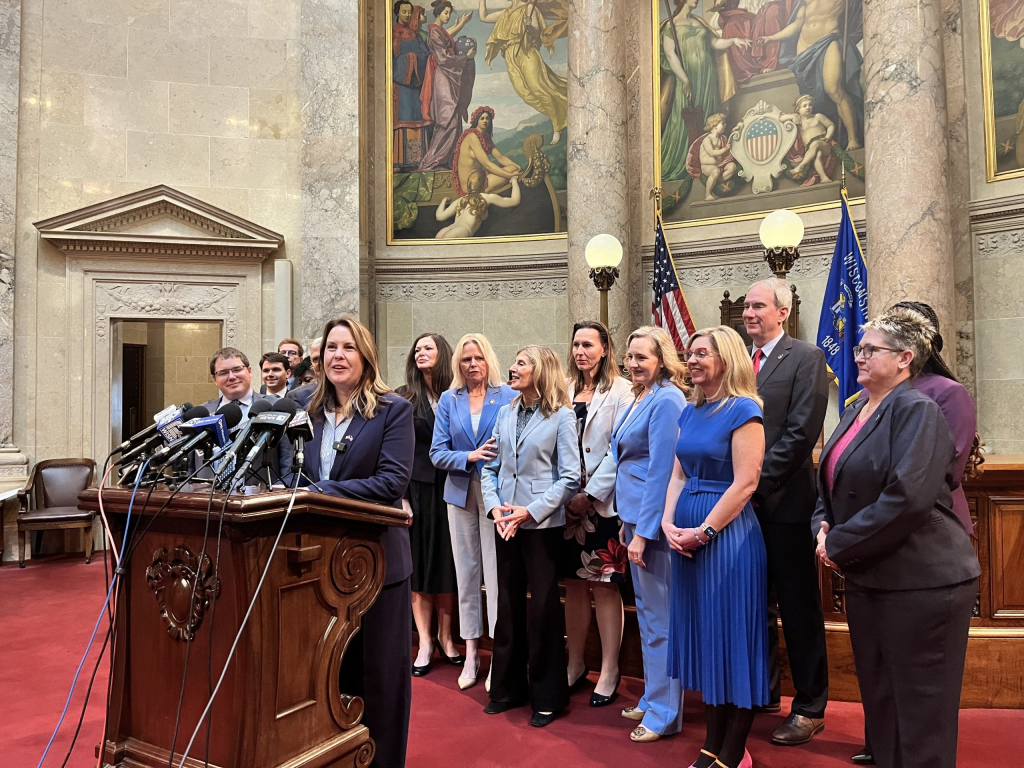
Senate and Assembly Democrats will have similar numerical majorities when they come into power in January as they did in 2009, but incoming Senate Majority Leader Dianne Hesselbein and Speaker-elect Greta Neubauer in remarks to reporters after the election emphasized unity among the chambers as they prepare to govern alongside Democratic Gov.-elect David Crowley.
“We have traveled a long road to get to this moment and now stand on the cusp of what will be a transformative session, one where we will take long overdue action to fulfill our promises and make life more affordable for people in Wisconsin and ensure that everyone can thrive in our state,” Neubauer said. “We are united and we are ready to govern.”
Here is more on the key differences between the last time Democrats controlled the Capitol in Madison and what we might see in January.
What’s different: A billion-dollar deficit to a billion-dollar surplus
Crowley and legislative Democrats are preparing to take office on Jan. 4 with a $4.18 billion state surplus. Doyle and legislative Democrats heading into 2009, during the Great Recession, did not have the same luxury.
The $6.6 billion deficit was the largest in state history. The state budget that year included more than $3 billion in spending cuts and furloughs and layoffs of state employees.
“The economic conditions facing our state are not the fault of state workers or Wisconsin citizens,” Doyle wrote that June as he signed the biennial budget. “Unfortunately, we must now all make sacrifices due to reckless behavior on Wall Street and in real estate markets.”
Hesselbein and Neubauer have said they intend to pursue policies that have been put on hold under years of Republican control and will have the surplus to back up their priorities. Those funds have remained untouched following the failed surplus deal negotiated between Evers and outgoing Republican legislative leaders that Democrats largely voted against earlier this year.

A surplus is easier to work with than a deficit, but there are challenges in figuring out how to use the funds, Black said.
“There’s a lot more who want what’s there than there is in the surplus,” he said.
It would be wise for Democrats to be cautious about the surplus and the state’s financial position as they determine their legislative priorities around taxes and spending, said Bill McCoshen, a Republican strategist who worked under former Gov. Tommy Thompson. Big swings that might increase spending could result in another change election like the one that swept Republicans into power in 2010, he said.
“Their patience grew thin with a state heading in the wrong direction,” McCoshen said of 2010 voters. “They were willing to make changes, and it swept in a Republican trifecta and then Republicans secured that with new maps for another decade.”
What’s different: Democrats had controlled the Senate, governor’s office for years
Between the governor’s office and the majority leadership in the Senate and Assembly, Democratic leaders at the Capitol in Madison across the legislative and executive branches of government will be brand new to their roles when they are sworn in on Jan. 4.
Democrats will also have complete control of statewide offices, whereas in 2009 Republicans had representation in former Attorney General J.B. Van Hollen.
Then-Gov. Doyle was halfway through his second term in office at the start of the last Democratic trifecta in 2009. Senate Democrats had controlled the chamber after the 2006 midterm elections and saw on and off majorities throughout the 1990s and into the early 2000s.
The Assembly Democrats had not experienced the majority in years. Assembly Republicans had held the majority in the chamber since 1995.
Sheridan, who was still fairly new to the Assembly at the time, was tapped as speaker when former minority leader and state Rep. Jim Kreuser decided to leave the Legislature.
“At that time I was only four years into the Legislature, and so I had no intention of running for speaker,” Sheridan said. “I was encouraged by a number of people to throw my hat in the ring, and so I did.”
The Assembly dealt with ideological splits and a lack of preparation for life in the majority, Sinicki said. Sheridan said tapping now-U.S. Rep. Mark Pocan as a co-chair of the Joint Finance Committee was a good decision and helped the Legislature pass the biennial budget on time for the first time in years.
“When we took the trifecta back in 2008 for that 2009 session, we were not prepared back then,” Sinicki said. “Legislators needed training. We were just kind of thrown into it. None of us were trained in how to be a committee chair. We didn’t know what to expect, and I think this time around, we are doing a lot of work on getting our agenda together, talking about how we do it.”
Black said that he sees strong leadership in Hesselbein and Neubauer and that the current caucuses seem more inclined to work together.
“I think that they are much better positioned both with the surplus and with the nature of their majority to accomplish quite a bit,” he said.
What’s different: A liberal-majority Wisconsin Supreme Court
Between 2009 and 2010, the Wisconsin Supreme Court had a conservative majority that included Justices David Prosser, Patience Roggensack, Annette Ziegler and Michael Gableman. Ziegler and Gableman were the most recent additions to the court with elections in 2007 and 2008. Justices Shirley Abrahamson and Ann Walsh Bradley were the liberal members of the court while Justice N. Patrick Crooks was a conservative-leaning independent.
It’s a different environment for the current makeup of the high court. With the election of Justice Chris Taylor earlier this year, the court has a 5-2 liberal majority that could grow to six justices depending on the outcome of the Wisconsin Supreme Court election in April. Ziegler, the lone staunch conservative on the bench, is not seeking reelection next year.
“They had a Republican-controlled Supreme Court that (Wisconsin Manufacturers & Commerce, the state’s largest business lobby) had bought and paid to be that way,” said Scot Ross, a Democratic strategist who previously worked in the Legislature. “We have a five-two and maybe six-one coming in August, a court that seems very interested in making sure people’s rights are protected and at times expanded.”
As of November, only Democratic Clark County Judge Lyndsey Brunette and Milwaukee-area Court of Appeals Judge Pedro Colón have announced plans to run. It’s not clear if a conservative candidate will launch a campaign, which could trigger a primary in February. The deadline to file for the spring election is Jan. 5.
The 2009-10 term court faced its share of higher profile cases, including upholding a 2006 constitutional amendment that banned gay marriage until the U.S. Supreme Court nullified it and a split decision on whether to discipline Gableman for a controversial ad his campaign ran during the 2008 Supreme Court race against former Justice Louis Butler.
The court, however, played less of a role of final decision maker as it did during the years of split government between the Republican-controlled Legislature and the Democratic Evers administration.
It’s possible that a Democratic governor and majorities in the Legislature could alleviate the pressure on the high court, especially on political issues that could be sorted out in the executive and legislative branches, Marquette University Law School Professor Chad Oldfather said.
“When you’ve got alignment across all three branches of government, you’re much less likely, I think, to end up in a situation where somebody who doesn’t like what the Legislature has done and the governor has signed into law, they’re much less likely to be in a position where they say, ‘Well, let’s take it to the courts because we might win there,’” Oldfather said. “Because they look at the end of the road and they think to themselves, ‘Well, we probably won’t win there either.’”
What’s different: Legislative experience in the governor’s office
While Doyle had spent several years as governor when Democrats last controlled state government starting in 2009, he had never been a member of the Legislature. Doyle served as attorney general prior to winning his first term in 2002.
Sinicki said it was not easy to work with a governor who had never experienced the legislative side of state government.
“He honestly didn’t know how to play nice with the Legislature,” Sinicki said of Doyle.
Doyle didn’t respond to a request for comment. He told the Milwaukee Journal Sentinel he has heard criticisms that the party didn’t do more when they were in power, but highlighted legislative accomplishments such as an indoor smoking ban.
In August 2009, Doyle announced he would not seek a third term as governor, which left a wide-open race heading into a challenging midterm year for Democrats. Crowley won’t have that kind of lame-duck period next year.
Crowley was elected to the Assembly in 2016 and served nearly two terms before his election to Milwaukee County executive. He was the lead author on just one bill that became law in that time period when the Legislature was under Republican control.
Sinicki says she can see that things will be different under Crowley in how he speaks about how the legislative branch will have to be involved in passing policies he ran on during the governor’s race. Crowley met with both Democratic caucuses one week after Election Day.
“I think that’s going to make a big difference in how we get things done,” she said.

Wisconsin Watch is a nonprofit, nonpartisan newsroom. Subscribe to our newsletters for original stories and our Friday news roundup.
The last time Democrats controlled Wisconsin state government, it was very different. As in, $10 billion different. is a post from Wisconsin Watch, a non-profit investigative news site covering Wisconsin since 2009. Please consider making a contribution to support our journalism.
