


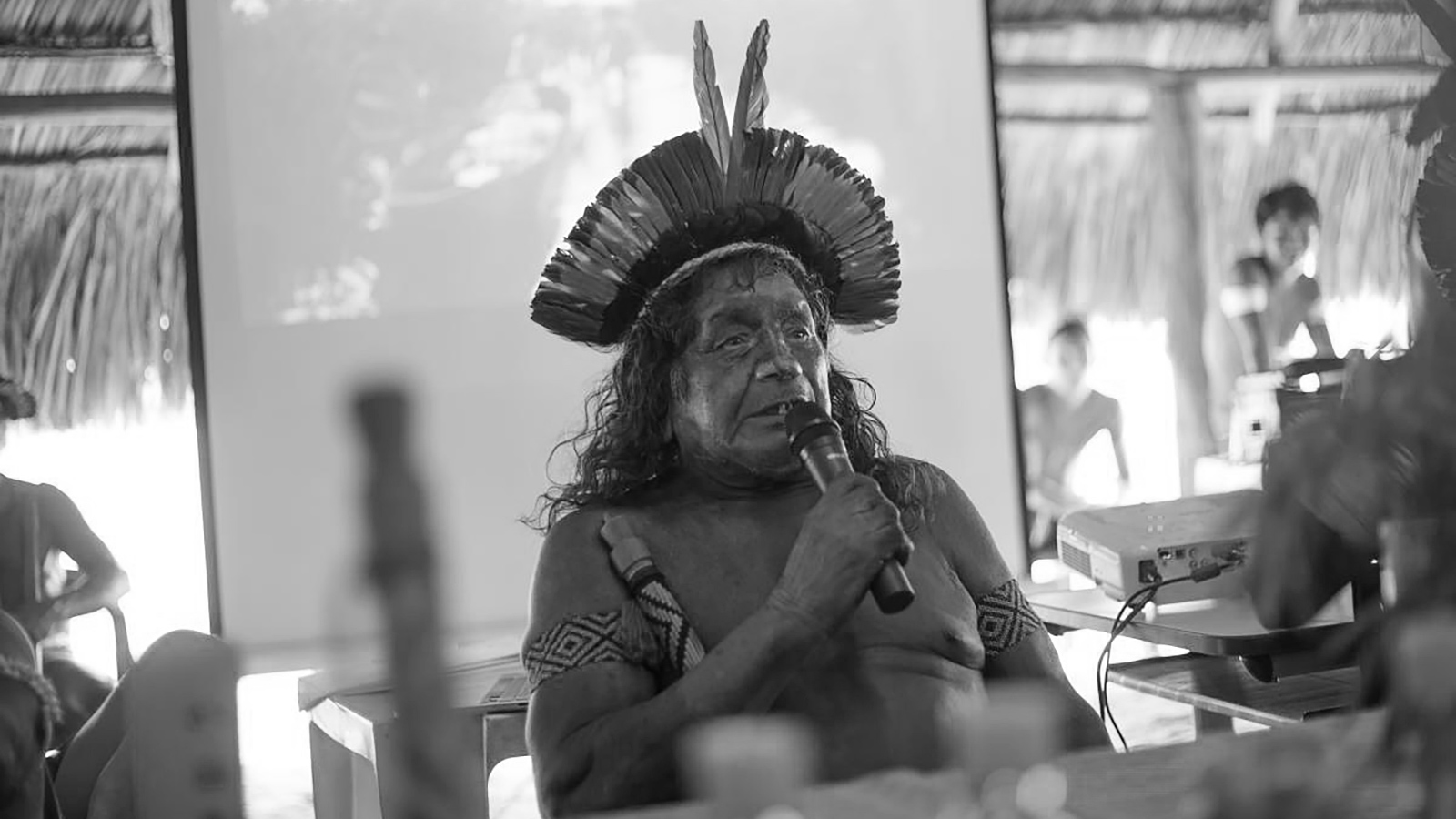
- Khuiusi Khisêtjê assumed leadership after disease and violence reduced his people to around 50 and killed many of their elders.
- He helped recover the Wawi Indigenous Territory, which contained ancestral villages, sacred places, and the graves of Khisêtjê relatives.
- He worked to preserve Khisêtjê songs, language, oral history, and cultural knowledge while preparing younger leaders to navigate Brazilian institutions.
- As soy farms and pesticide use expanded around the territory, he continued defending the land and, in 2018, led his community deeper into the forest.
The plane sprayed the soy fields beside the forest.
Residents of Khikatxi said the single-engine aircraft appeared several times during each harvest and passed over Wawi Indigenous Territory. They worried about pesticides reaching their water, gardens, animals, and homes. People reported itching and diarrhea. Crops weakened, streams grew cloudy, and some game animals seemed to smell of agricultural chemicals.
For years, Khuiusi Khisêtjê watched the farms advance around his people’s land. In 2018 he made a decision. The community would rebuild its village ten kilometers deeper in the forest.
Leaving a village is difficult. Houses must be rebuilt, paths cleared, gardens planted, and daily routines restored. The old place contained years of work and memory. Khuiusi Khisêtjê had already lived through several such upheavals. He knew what was lost when people were forced from their land. He also knew when it had become unsafe to remain.
The move took the Khisêtjê farther from the expanding agricultural frontier. It was one more decision in a life devoted to the survival of his people.
Khuiusi, who died in Goiânia on July 3rd, at about 80, belonged to a generation that saw the Khisêtjê come close to extinction. He was born when his people still lived beyond the settled frontiers of central Brazil. Their villages lay among rivers, forest, and savanna in a region that would later form part of the Xingu Indigenous Territory and the adjoining Wawi Indigenous Territory in Mato Grosso.
Contact with outsiders brought disease, violence, and displacement. Epidemics killed older people who held knowledge of the land, ceremonies, songs, and family histories. Khuiusi lost his father and many of the men who would normally have guided him into adulthood. The Khisêtjê population fell to around 50.
There were few adults left to carry the responsibilities of the community. Khuiusi assumed them while still young.
He did not read or write Portuguese and never became fluent in it. He still learned how to deal with the political world around his people. He judged visitors, institutions, officials, researchers, farmers, and activists by what they did. He became an effective leader in negotiations conducted in a language that was not his own and within institutions that had often failed Indigenous communities.
His authority came from what he knew. He understood Khisêtjê history, the locations of old villages, the paths through the forest, the names of ancestors, and the meanings carried in songs. He had listened to the elders who survived. As their numbers declined, he became one of those responsible for passing that knowledge on.
Anthropologist Anthony Seeger, who worked with the Khisêtjê for decades, described him as a strategic thinker. Khuiusi understood that the community would need to preserve its knowledge while also learning how to operate in the institutions surrounding it.
He worked with outsiders when he believed the relationship would help his people. He built long associations with researchers and Instituto Socioambiental (ISA). He supported the recording, transcription, and translation of songs, narratives, and oral histories. He encouraged schooling, provided it remained grounded in Khisêtjê knowledge. Teachers, he said, should teach the “true songs.”
The phrase reflected a practical concern. Songs carried knowledge, social obligations, memory, and history. They had to be taught accurately, by people who understood them.
He also understood the value of public performance. The Khisêtjê sometimes sang and danced before politicians, officials, or non-Indigenous audiences. Some Indigenous communities were uneasy about being asked to perform in this way. Khuiusi said that the Khisêtjê were not ashamed to remove Western clothes, apply body paint, and present their ceremonies. They knew who they were. Public performances could make them visible to people who might otherwise ignore their rights.
For Khuiusi, culture could also serve a political purpose.
He could be skeptical about the society beyond the forest. In one recollection, he listened to outsiders explain a conservation campaign and responded with dry doubt about whether white people were capable of changing their ways. Governments promised protection and allowed encroachment. Officials spoke of Indigenous rights while delaying the recognition of Indigenous land.
Even so, he continued to negotiate with them.
The central struggle of his life concerned Wawi, part of the Khisêtjê ancestral territory that had been left outside the original boundaries of the Xingu Indigenous Park. The area contained old villages, hunting grounds, rivers, sacred places, and the graves of relatives. Settlers and landowners treated it as land that could be occupied, divided, or sold. For the Khisêtjê, it was part of their history and identity.
Khuiusi helped lead the long effort to recover it. The campaign required travel, meetings, pressure, alliances, and years of persistence. Territorial claims could be postponed for decades, and many were never recognized. Wawi was eventually demarcated in the 1990s.
At a meeting in 2008, Khuiusi explained why the struggle had mattered. The land was sacred, he said, because their relatives were buried there. Many people thought the Khisêtjê wanted money. They wanted the land.
The territory, he said, held their ancestors and gave the community a place in which to continue living as Khisêtjê.
After Wawi was regained, the Khisêtjê rebuilt villages there. The community had changed since it had last lived on the land. Its members used cameras, radios, boats, schools, and legal institutions. Young people traveled and spoke Portuguese. Khuiusi’s concern was that they remain grounded in Khisêtjê knowledge while taking part in the wider world.
He supported Indigenous filmmakers and educators. He worked with people who documented ceremonies and environmental threats. He encouraged younger leaders to learn how the surrounding political system worked. Songs had to be sung, the language had to be spoken, and the territory had to be lived in and protected.
By then, the Khisêtjê population was recovering. From around 50 people, it grew to more than 700 living in 11 villages. The increase did not repair the loss of those who had died, but it reduced the fear that the community itself might disappear.
The threats changed. Epidemic diseases receded, while roads, cattle, soy, logging, fire, and pesticides advanced around the headwaters of the Xingu. Forest clearing outside Indigenous territories altered streams and wildlife. Agricultural chemicals entered the air and water. Legal recognition did not shield the community from everything that happened beyond its borders.
Khuiusi met with neighboring farmers and kept open channels of communication. He could be firm while continuing to talk. He knew that some disputes required confrontation and that others could be managed through negotiation. Those who worked with him described a direct and patient leader who paid close attention to consequences.
His courage and judgment were evident in the decisions he made. He helped lead a severely reduced people through demographic recovery. He defended land when success was uncertain. He retained detailed knowledge after many older custodians had died. He worked with researchers while insisting that the Khisêtjê determine how their knowledge was recorded and taught. When pesticides threatened the village, he moved it.
Across these decisions ran the same concern: the Khisêtjê should remain able to determine how they lived.
Near the end of his life, Khuiusi had seen changes that would have seemed unlikely in his youth. His people had regained Wawi. Their population had multiplied. Khisêtjê teachers taught Khisêtjê children. Their filmmakers recorded ceremonies and threats from within the community. Their leaders spoke before national and international audiences. The songs were still being taught.
The future remained uncertain. Forest continued to fall outside the territory. Political protections could weaken. Young people faced pressures unknown to their grandparents. Each generation would have to decide how to protect the land and knowledge entrusted to it.
Khuiusi had spent much of his life preparing them to do so. Having learned from the few elders who survived, he eventually became the primary anchor for the generations that followed.
Banner image: Khuiusi Khisetje. Photo by Christian Braga / ISA
