


- Hong Kong, a major entrepôt in the Asia-Pacific region, has an outsized role in the illegal trade of native Australian reptiles.
- According to the Australian government’s records, 99% of more than 270 seizures between 2018 and 2025 were Hong Kong-bound.
- The Hong Kong Agriculture, Fisheries and Conservation Department’s figures from 2021 to October 2026 show a sharp rise in trafficked Australian reptiles, with more than 78% of the animals seized since 2025.
- After Hong Kong, the top three known destinations of native Australian reptiles are the United States, Germany and Japan, but experts believe a substantial number also end up in mainland China.
HONG KONG — Two days after Christmas last year, customs authorities at Hong Kong International Airport intercepted a consignment from Australia and found 13 live lizards bound and stuffed inside sheepskin winter shoes, popularly known as ugg boots.
The air cargo was falsely declared to contain snacks, Hong Kong’s Customs said in a press release in late December 2025. But instead, inside were assorted lizard species, including the shingleback skink (Tiliqua rugosa).
Between March 2025 and July 2026, Customs announced at least three other seizures of live reptiles found in consignments from Australia. In the four cases, customs officers confiscated 98 live animals — 74 lizards and 24 snakes — with the total value exceeding 1.1 million Hong Kong dollars ($141,100). All but one lizard were believed to be listed in the global wildlife trade convention CITES appendices.
According to Hong Kong authorities, most of these seizures are under investigation, and one was dropped. No arrests have been made.
Despite Australia’s comprehensive ban on commercial exports of live native species since 1982, the rarity and unique looks of its reptiles have made them coveted in pet markets around the world.
And Hong Kong, a major entrepôt in the Asia-Pacific region, has an outsized role in the illegal trade of Australian reptiles.
“Hong Kong is a major trafficking hub or destination for Australian reptiles,” said Sam Inglis, wildlife program manager at ADM Capital Foundation (ADMCF), a Hong Kong-based environmental nonprofit that tracks wildlife crime.

Researchers at Adelaide University’s Wildlife Crime Research Hub in Australia agreed, saying in an intelligence briefing paper that Hong Kong “functions as both a destination and a potential transit hub within broader trafficking networks.”
According to ADCMF’s tally of the Australian government’s records, 99% of more than 270 seizures of its native reptiles between 2018 and 2025 were Hong Kong-bound. Among the 1,800 live animals seized during the seven-year period, there were 250 blue‑tongued lizards (Tiliqua spp.), making them a frequent trafficking target.
Figures from Hong Kong’s Agriculture, Fisheries and Conservation Department (AFCD) show a sharp rise in trafficked reptiles from Down Under. The AFCD recorded that 382 live native Australian reptiles — many lizards belonging to the genera Tiliqua and Egernia — were seized for illegal import between 2021 and October 2026. More than 78% of the animals have been confiscated since 2025.

‘Puppies’ of the reptile world
Australia has more than 1,000 endemic reptile species, but only 165 are listed in CITES appendices. The latest addition was in 2022, when 127 native species, deemed at risk from wildlife trafficking, were included in Appendix III to combat trafficking.
According to experts, there have been known instances of illegally sourced animals, including those smuggled from abroad, “laundered” in Hong Kong’s legal trade through traders.
Proving provenance is difficult, Inglis told Mongabay, adding that without individualized IDs, “verification would be challenging.”
The top three known destinations are the United States, Germany and Japan, he said.
Researchers also suspect a substantial number also end up in mainland China, as indicated by seizures at border checkpoints. In March and September 2026, for example, Chinese customs officers confiscated a total of 23 live Tiliqua lizards at Huanggang and Shenzhen Bay immigration checkpoints, which border Hong Kong.

In Australia, native animals, including smaller-sized lizards, are not typically considered companion animals. Keeping them as pets is strictly regulated and requires a license. However, similar restrictions do not exist in Hong Kong or mainland China, where possession of such animals generally does not require documentation.
Chinese reptile lovers call native Australian lizards “puppies” of the reptile world because their “docile” character is said to make them ideal indoor pets.
“Reptiles gained immense popularity during Covid lockdowns as low-maintenance pets, with buyers drawn to unique color morphs and exotic features — almost like collecting Pokémon,” Dylan Chadwick, a researcher at the Wildlife Crime Research Hub, told Mongabay, referring to the 2020-22 coronavirus global pandemic.
According to his research, it is estimated that more than 15% of Australia’s endemic reptile species have entered illicit international trade.
Chadwick said that the most trafficked species belong to the genus Tiliqua. These include the blue-tongued skink, typically around 30 centimeters (1 foot) long, and the shingleback, whose dark, rugged scales earned it the Chinese nickname “pine cone lizard.”
Australian federal data on reptiles rescued from trafficking to different overseas destinations from 2018 to 2025 included over 370 shinglebacks, followed by 215 blue tongue variants and 75 spiny-tailed skinks (Egernia spp.), the researcher said.
Hong Kong’s status as a free port and proximity to mainland China have made it a strategic hub in wildlife trafficking. Between 2015 and 2025, the city’s authorities made 4,960 seizures of endangered species, worth nearly 1.2 billion Hong Kong dollars ($153,000), according to ADMCF.
The NGO previously warned: “While some wildlife crime is indisputably perpetrated by opportunistic individuals, the scale of the trade through Hong Kong appears to have attracted organised syndicates and networks.”


Hong Kong amended its laws in 2021 to include wildlife trafficking in its Organized and Serious Crimes Ordinance. Despite some prosecutions resulting in jail sentences, wildlife crime researchers say it is not enough.
The Hong Kong ordinance’s powers remain underutilized, with penalties from prosecutions far below the legal maximum of a 10-year prison sentence or a 10 million Hong Kong dollars ($1.3 million) fine, Inglis said.
In response to Mongabay’s questions, Hong Kong’s Agriculture, Fisheries and Conservation Department said it would seek assistance from customs and police to conduct joint investigations, and seek enhanced sentences for cases charged as organized crime.
Social media trend
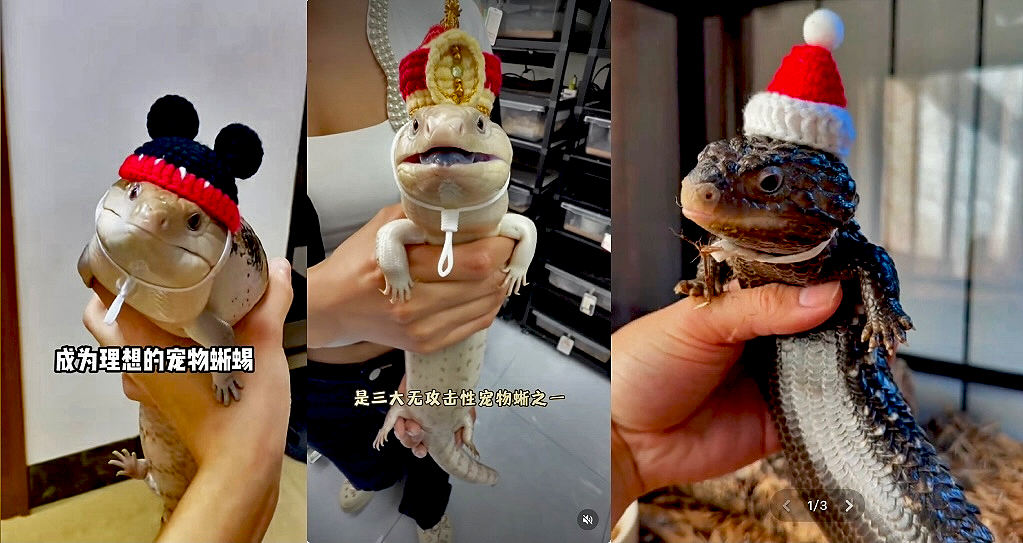
Showing off pet lizards in crocheted headdresses is a trend on Chinese social media.
A video on Douyin, the Chinese version of TikTok, shows a blue-tongued lizard wearing Mickey Mouse ears; while an Instagram clip features an albino variant sporting a crocheted crown staring into the camera. Another Douyin video shows a rugged-looking shingleback lizard in a mini Christmas hat.
An anonymous user searched publicly for a partner who could courier reptiles from Australia to Hong Kong, according to a 2024 post in a Facebook group dedicated to blue-tongue lizard keepers in the city and in Taiwan.
Keeping lizards and snakes as pets is a relatively recent phenomenon in China that began almost two decades ago, people in the country’s reptile trade said.

Early Chinese reptile enthusiasts kept large lizards and dangerous snakes, but they moved to keeping smaller species such as crested geckos (Correlophus ciliatus), which are native to New Caledonia and Australian lizards around 2019, after the government tightened its laws against dangerous reptile species and cranked up enforcement, said Charlie Zhu, a reptile seller based in Changzhou, a city in eastern China.
There is also a growing market for breeding Australian reptiles in the country, he told Mongabay.
The majority of shinglebacks, however, are imported to China because they are harder to breed in captivity, Zhu said, adding that their prices start at around 20,000 Chinese yuan ($3,000).
Australia has also intercepted reptiles before they were smuggled to Hong Kong, with smugglers receiving jail sentences. One was sentenced in May 2026 and another in September 2025 to more than two years in prison. The maximum penalty for illegally exporting native wildlife is 10 years’ imprisonment, a 330,000 Australian dollars ($224,200) fine, or both.
In a recent case in September, federal authorities charged and remanded in custody a 21-year-old Chinese national on accusations of attempting to smuggle 163 native reptiles, including shingleback lizards, blue-tongued lizards, eastern hooded scaly-foots (Pygopus schraderi) and Cunningham’s skinks (Egernia cunninghami), as air cargo from Sydney to Hong Kong on multiple occasions.

The Australian government warns that criminal syndicates are increasingly recruiting international students to smuggle native reptiles out of the country. One student from China was sentenced to 18 months in jail in March 2025.
Despite criminal convictions, those jailed are usually foot soldiers of the trafficking networks, experts say.
“What is missing is the systematic dismantling of these networks,” Inglis said. “Smugglers consider a one-year prison sentence just a cost of doing business.”
Banner image: Screenshots of videos showing pet lizards in crocheted headdresses shared by Chinese social media users.
Reptiles, gold and money: How Australia is cracking down on wildlife trafficking
Australia hands record prison sentence to reptile smuggler in trafficking crackdown
Citation:
Chekunov, S., Stringham, O., Toomes, A., Prowse, T., & Cassey, P. (2024). Scale of unregulated international trade in Australian reptiles and amphibians. Conservation Biology, 38(5), e14355. doi:10.1111/cobi.14355

