


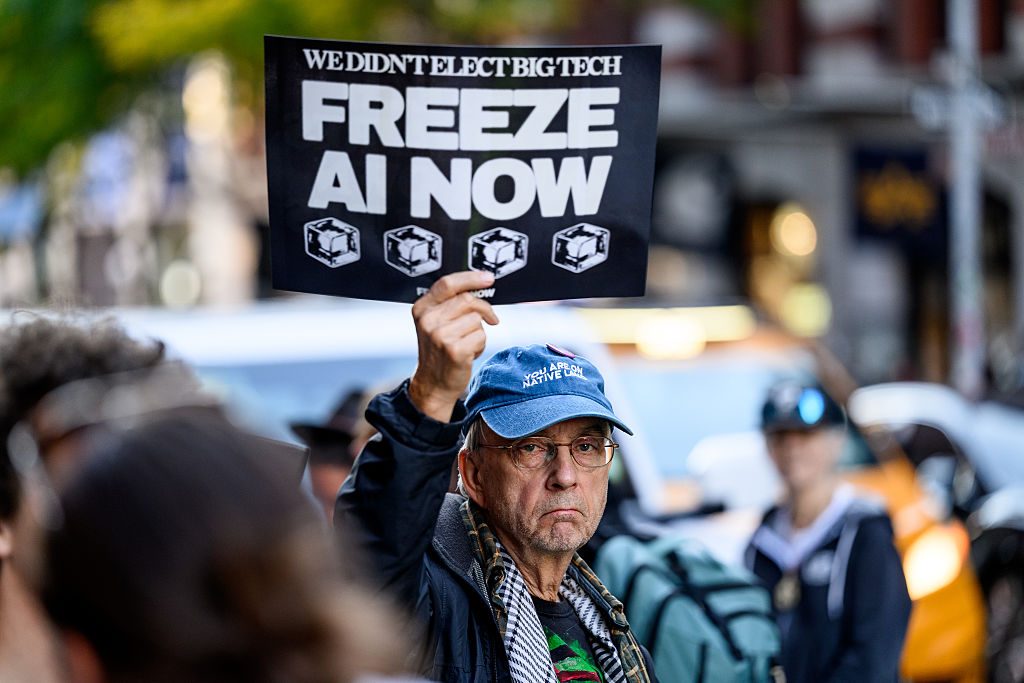
Protesters in New York City hold signs during the Nationwide Walkouts to Freeze AI on Oct. 20. (Photo by Roy Rochlin/Getty Images for Irreplaceable Action Fund)
Despite the attention artificial intelligence companies drew during the midterms and their massive financing, the most prominent pro-AI super PAC wound up being outspent by a collection of groups committed to regulating the industry.
The pro-AI super PAC Leading the Future, backed by venture capital firm Andreessen Horowitz and OpenAI co-founder Greg Brockman, was one of the biggest outside spenders of the midterms – and one of the most polarizing.
Following several high-profile security breaches and employee resignations over the summer, most Americans believe government needs to place safeguards on AI, and Leading the Future’s money was labeled as politically toxic. Brockman announced he would not donate a previously promised $25 million to the PAC, and in an interview with Politico, OpenAI CEO Sam Altman said the industry’s political spending was “clearly not working.”
As Leading the Future’s political capital declined over the course of the election cycle, advocates and donors rushed to form a new coalition of influence – one built around support for AI regulation. These groups ultimately spent more than $45 million in the midterms, surpassing the $41 million spent by Leading the Future.
Pro-regulation spending grew rapidly ahead of the general election
Through a review of political action committee registrations and independent expenditure filings, OpenSecrets found at least 14 pro-AI-regulation nonprofits and super PACs raising and spending during the 2026 election cycle.
Many of these PACs and nonprofits are interconnected. Because 501(c)(4) organizations do not have to disclose donors but can distribute their money to super PACs, having an affiliate nonprofit allows the political committees to obscure their funding sources.
Several of these organizations were founded between March and September. The newest groups, Who Decides and Tomorrow Together, launched with $30 million and $10 million, respectively.
(function(){function e(){window.addEventListener(`message`,function(e){if(e.data[`datawrapper-height`]!==void 0){var t=document.querySelectorAll(`iframe`);for(var n in e.data[`datawrapper-height`])for(var r=0,i;i=t[r];r++)if(i.contentWindow===e.source){var a=e.data[`datawrapper-height`][n]+`px`;i.style.height=a}}})}e()})();
Who Decides was founded by Alex Bores, who became a prominent advocate for AI regulation after Leading the Future spent millions to oppose his campaign for the Democratic nomination in New York’s 12th District. Public First, the largest AI regulation-focused spender, poured millions into efforts to boost Bores.
Who Decides did not record any expenditures during the midterms. Bores has said its focus is shaping Democrats’ AI agenda for the 2028 presidential election.
Scott Wisor, policy director at the Secure AI Project, said Bores’ primary campaign showed politicians, voters and donors that the AI industry’s political spending would be a significant force in the midterms.
“When Leading the Future came in and said, ‘We’re gonna end Alex Bores’s political career,’ I think that that was a wake-up call for people,” Wisor said. “It created this moment where people realized that some AI companies were willing to go to the mat and punish candidates who called for any oversight of their technology.”
Wisor said the donor base supporting pro-regulation super PACs and candidates largely works in AI, tech or finance. And while OpenSecrets’ review of donations to those groups generally found that to be true, some of the organizations are funded by untraceable dark money.
Guardrails Alliance’s top donor, OpenAI research engineer Juan Felipe Uribe, contributed $200,000. Its next two biggest donors, Dylan Mavrides and Jacob Eliosoff, are a quantitative trader and investment manager, respectively. They each gave $100,000.
Public First PAC’s top donations all came from members of Anthropic’s staff, including a contribution of $1 million from CEO Dario Amodei. Anthropic has also contributed $40 million to Public First’s 501(c)(4) organization.
Americans for AI Accountability, another super PAC, has been almost entirely funded by Anthropic researchers.
Democratic candidates often overcame major spending on behalf of GOP candidates
AI regulation has bipartisan support from the public, and some of the groups that spent in its favor during the midterms were focused exclusively on conservative candidates.
Public First Action, the largest regulation-focused group, is a 501(c)(4) with three affiliated super PACs – the Jobs and Democracy PAC, Defending Our Values PAC and Public First. The Jobs and Democracy PAC supported Democratic candidates, while the Defending Our Values PAC focused on electing Republicans.
Anthony Rivera-Rodriguez, a spokesperson for Public First, said the group is focused on advocating for “common sense safeguards on AI and a strong federal framework,” especially given the “outpouring of public support for AI safety following the wave of AI incidents our country witnessed this past summer.”
In July, Public First announced a “Conservative AI Consensus Project” that would back Republican candidates who have “led the fight to hold AI companies accountable.” As part of the campaign, Public First launched ads in mid-August supporting Sen. Ashley Moody (R-Fla.) for “fighting back” against the “danger” of AI. Moody’s opponent, Democrat Angie Nixon, called her “AI Ashley” during the campaign, criticizing the incumbent for taking money from the “AI lobby.” Moody won by 3 percentage points.
Another conservative-aligned 501(c)(4) group, the Alliance for a Better Future, disclosed more than $2 million in electioneering communications. ABF advocates for AI development “the American way,” stating on its website that the people building AI “wield greater power than presidents or kings, while deploying their billions to stop all regulation.”
In mid-September, ABF announced a seven-figure advertising campaign thanking Sen. Susan Collins (R-Maine), Sen. Roger Marshall (R-Kan.) and Rep. Ashley Hinson (R-Iowa) for advocating for “commonsense cybersecurity” in AI. Days later, ABF announced a seven-figure ad buy for Mike Rogers, the Republican Senate candidate in Michigan, “emphasizing the critical need for meaningful AI safeguards and praising Mike Rogers as among those supporting such measures.” All four of those candidates lost their races.
Brendan Steinhauser, a Republican political consultant and CEO of the nonprofit Alliance for Secure AI, told OpenSecrets ahead of Election Day that he believes ABF’s ad buys were effective for elevating Republican candidates on AI, an issue the party has fallen behind on.
“In some ways, the Democrats are ahead of Republicans on AI overall, but Republicans are catching up slowly,” Steinhauser said.
Steinhauser said, particularly after safety researcher Jacob Coxon’s public resignation from Anthropic, the conversation around AI’s impact “weighed heavily in the midterms.”
Pro-regulation forces spent big in the final weeks and notched several wins
Public First, including its affiliated super PACs, was one of the largest outside spenders of the election cycle, spending more than $26 million total – but the vast majority of that money was devoted to Bores’ primary in New York.
During the final weeks before the general election, new top spenders emerged – Guardrails Alliance and Tomorrow Together. Each group spent millions of dollars on ad buys throughout the month of October.
(function(){function e(){window.addEventListener(`message`,function(e){if(e.data[`datawrapper-height`]!==void 0){var t=document.querySelectorAll(`iframe`);for(var n in e.data[`datawrapper-height`])for(var r=0,i;i=t[r];r++)if(i.contentWindow===e.source){var a=e.data[`datawrapper-height`][n]+`px`;i.style.height=a}}})}e()})();
Guardrails spent over $3.3 million on general election races, mainly against candidates who had been backed by Leading the Future, such as Jimmy Gomez (D) in California’s 34th District, Aaron Flint (R) in Montana’s 1st District and Jay Feely (R) in Arizona’s 1st District.
“What makes those important and interesting to watch, from our perspective, is that Leading the Future has been involved in those races,” Shaunna Thomas, the co-founder of Guardrails, told OpenSecrets ahead of Election Day. “We are only going into races where they have attempted to have influence. But also, these are very competitive races, they are swing districts, and our polling suggests that the fact of Leading the Future’s involvement is meaningful to the voters in that race and could impact who they show up to vote for.”
Every candidate opposed by Guardrails lost their general election, except Daniel Koh (D) in Massachusetts’ 6th District, whom Guardrails spent against after Leading the Future supported his campaign.
Tomorrow Together, founded by Democratic strategists Rob Flaherty and Karthik Ganapathy, announced its first spending of the midterms on Oct. 13. The group spent approximately $3.5 million on ads opposing Republican incumbents in four House races – Rob Bresnahan (Pa.), Juan Ciscomani (Ariz.), Derrick Van Orden (Wis.) and Tom Barrett (Mich.). Ahead of the general election, they spent an additional $2.5 million on ads opposing Sen. Jon Husted (R-Ohio) and Marshall.
Every candidate opposed by Tomorrow Together lost their election.
Despite AI industry leaders publicly stating they would retreat from political spending, Thomas said Guardrails and other pro-regulation advocates will continue to track and combat the industry’s money.
“I think we have to track extremely carefully where they are going to try to have influence, because they are not going to take their money off the field,” Thomas said. “They are not going to stop trying to manipulate what comes out of Congress in terms of regulations, at the federal level and the state level. It is extremely important to them that they are not regulated in any ways that they don’t want to be regulated.”
