


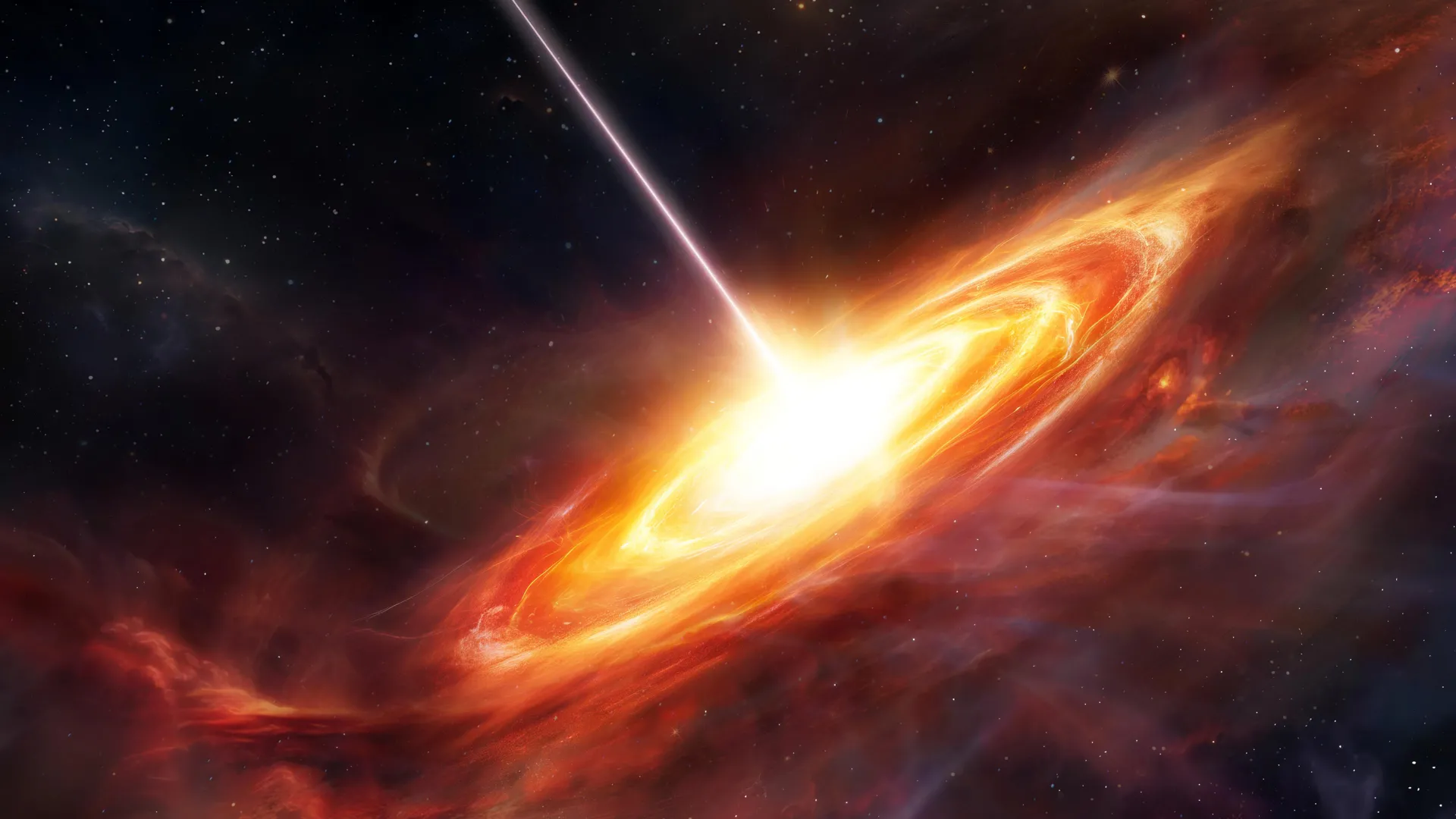
The European Space Agency’s Euclid space telescope has discovered 31 exceptionally ancient quasars, including two that have set new records as the earliest ever observed. These brilliant galactic centers, powered by enormous black holes, were already radiating as much light as a trillion Suns when the Universe was only 670 million years old, about 5% of its present age.
Quasars are among the brightest objects in the cosmos. They appear during a relatively short period in a galaxy’s history when huge quantities of gas and other material spiral toward its central supermassive black hole. This process releases extraordinary amounts of energy, causing the galaxy’s core to shine hundreds or even thousands of times more brightly than the rest of the galaxy combined.
Astronomers have spent decades searching for quasars from the Universe’s earliest years because they offer valuable clues about the formation of the first galaxies and supermassive black holes. Finding them, however, is extremely challenging. Few galaxies had grown large enough to host such objects at that early stage, and the light reaching us today is incredibly faint. These distant sources can also be difficult to distinguish from stars much closer to Earth.
Launched in 2023, Euclid is transforming that search. Its ability to survey enormous regions of the sky and detect faint objects has already produced an unprecedented collection of 31 quasars from the early Universe, including some dating back to when the cosmos was just 5% of its current age.
“These early quasars date back to the Universe’s infancy,” says Daming Yang of Leiden University in the Netherlands, lead author of the Euclid discovery paper. “By finding and studying them, we can better understand how these enormous systems formed and grew so quickly – one of the greatest mysteries in astrophysics.”
Euclid Reveals a Hidden Population of Ancient Quasars
Until now, astronomers had identified only a small fraction of the quasars that existed during the Universe’s earliest period. Most known examples were exceptionally luminous objects that stood out because they were easier to detect. This limited sample made it difficult to understand the broader population and how these powerful systems developed.
Euclid is changing that picture by identifying not only the brightest quasars but also much fainter examples that previous searches struggled to find. Its discoveries are providing scientists with a far more representative view of the ancient quasar population, opening the door to more detailed studies of these early cosmic objects.
“Euclid is a true game-changer,” adds Daming. “Before, we could only find a handful of the very brightest ancient quasars, but Euclid lets us search far more efficiently across huge areas of sky to capture much fainter light. It’s a unique tool for quasar hunting.”
Among the 31 newly identified quasars, 12 have a redshift of 7 or greater. Redshift describes how light is stretched as the Universe expands and helps astronomers determine how far away an object is and how far back in cosmic history its light originated. A redshift of at least 7 places these quasars within the Universe’s first 770 million years.
Two Record-Breaking Quasars From Cosmic Dawn
Two objects stand out as particularly extraordinary. The most ancient, EUCL J172902.75+641018.1, has a redshift of 7.77, while EUCL J125308.55+705432.3 has a redshift of 7.69. Both are located just over 13 billion light-years from Earth and were already shining within the first 670 million years of cosmic history.
These discoveries establish new records for the earliest known quasars. The previous record belonged to an object discovered in 2021, which has a redshift of 7.64.
“This finding more than doubles the number of quasars we know of that are so ancient,” says Antonio La Marca, an ESA Research Fellow in the Euclid team.
The pace of discovery is especially remarkable. Astronomers needed more than a decade to identify roughly the first 10 quasars with redshifts of 7 or higher. Euclid has already surpassed that number in just one year, demonstrating how dramatically the telescope is accelerating research into the early Universe.
“The Euclid team has taken a true ‘census’ of quasars at the dawn of the Universe for the first time,” adds Antonio. “It’s a big step towards understanding these fascinating objects on a more fundamental level.”
Ancient Black Holes Reveal Clues About the First Galaxies
One of the newly discovered objects is already offering additional insight into conditions during the Universe’s infancy. Silvia Belladitta and colleagues recently conducted a more detailed investigation of the second most ancient quasar identified by Daming and his team.
Their observations revealed that the quasar sits inside a galaxy filled with gas and dust where new stars are forming at a tremendous rate. This provides an important glimpse of the environment surrounding an early supermassive black hole and could help researchers understand how the first massive galaxies evolved alongside the black holes at their centers.
These quasars also belong to a transformative chapter in cosmic history known as the epoch of reionization. During this period, the Universe emerged from a cold, dark state (the ‘dark ages’) as increasingly energetic radiation heated the surrounding gas and ionized it (split apart by energetic light). This fundamental transition helped establish the conditions that shaped the Universe we observe today.
“Ancient quasars are rare discoveries. They’re interesting in themselves, but also time machines that enable us to explore the early Universe and understand how the first generation of galaxies came to be,” says ESA Euclid Project Scientist Valeria Pettorino.
How Euclid Is Transforming the Search for Cosmic Giants
Euclid’s success comes from a powerful combination of capabilities. The telescope can examine enormous portions of the sky while collecting detailed images and detecting faint infrared light from extremely distant objects. Together, these features make it exceptionally effective at finding rare sources that earlier surveys could easily miss.
“Euclid’s capabilities are unrivaled. The telescope combines a large area, depth, sharp imaging, and unique space-based infrared vision in a way that lets us pick out rare, extremely distant objects far more efficiently than before.
“And it’s not just the telescope: the data processing is only possible thanks to thousands of Euclid Consortium scientists and engineers working together to deliver scientific discoveries, sifting through enormous datasets to identify rare, distant quasars that we can study further using telescopes on the ground.”
All 31 quasars were identified using observations from the Euclid Wide Survey, an ambitious project that will eventually examine more than one-third of the entire sky.
Although Euclid’s primary mission is to investigate the dark Universe, its observations are revealing much more. By studying billions of galaxies, the telescope is helping astronomers investigate the Universe’s composition, history, evolution, and vast cosmic structure. At the same time, its sweeping survey is uncovering rare ancient quasars that offer a remarkable opportunity to explore how the first galaxies and giant black holes emerged.
As Euclid continues mapping the cosmos, astronomers expect its growing collection of distant quasars to provide new clues about one of astrophysics’ most enduring questions: how supermassive black holes became so enormous in such a remarkably short time after the Big Bang.
