


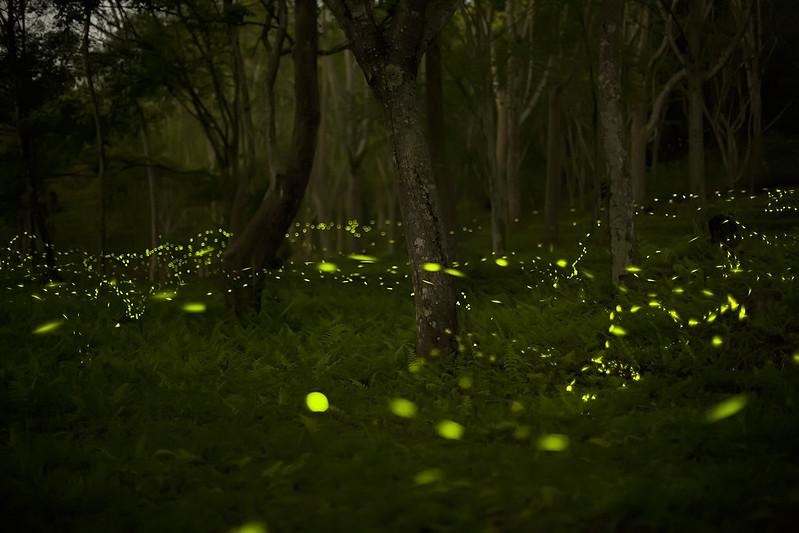
- The similar firefly (Pyractomena similis), which had not been documented since 1983, was spotted three times in the eastern U.S. this year: twice in Virginia and once in Delaware.
- Entomologist Christopher Heckscher identified the species by its quick string of amber flashes in a meadow in Delaware’s Brandywine Creek State Park, marking the first record of the firefly in the state.
- A new paper in the Journal of Lost Species lists 28 firefly species in the U.S. and Canada as lost to science, meaning they haven’t been spotted in at least a decade.
- Researchers say many lost fireflies are likely not extinct but overlooked, and that targeted searches and community scientists can help find them.
On a June night in a meadow in the U.S. state of Delaware, Christopher Heckscher stood with his camera and waited for the fireflies to come out. Most of the flashes he saw were familiar, but a quick run of amber pulses caught his attention.
“The amber color of the flash and the long rhythmic pattern did not match any other firefly I was familiar with in this region,” Heckscher, an entomologist and ecologist at Delaware State University, said in a press release. “I was confident I had found the species the moment I saw the flash pattern.”
“The species” was the similar firefly (Pyractomena similis), which hadn’t been documented since 1983. Then, in spring 2026, it turned up three times, according to a new paper in the Journal of Lost Species.
An observer first spotted males flashing over a meadow in the neighboring state of Virginia on May 15 and posted the sighting to iNaturalist, a citizen science platform. A second population turned up nearby two weeks later. Heckscher’s sighting at Brandywine Creek State Park was the first record of the species in Delaware.
He found it in a meadow full of shrubs, brush, and low plants. The species is known to live in open fields near water. “The habitat is not terribly common,” Heckscher said. “We think of fields and open meadows as being pretty common, but most times we’re managing them for other things, maybe livestock, or we’re mowing them once in a while.”
The paper, which Heckscher co-authored, lists 28 firefly species in the U.S. and Canada as lost, meaning scientists have no confirmed records on them for the past decade. That’s 16% of the region’s known native fireflies.

The similar firefly was once found in Washington, D.C., Maryland, Virginia, South Carolina, Alabama, and Mississippi, but scientists never studied it closely. “There’s hardly any information out there about it,” Heckscher said. “That’s true for a lot of our fireflies, even our common species.”
“Many people are unaware that the U.S. has so many different firefly species, let alone that many of these have been lost to science for a decade or more,” said Candace Fallon, lead author of the paper and senior conservation biologist and firefly lead at the NGO Xerces Society, which coordinates the Firefly Atlas.
“The good news is that a lot of these species likely aren’t gone forever — they are simply overlooked,” Fallon said.
According to the study, 69 species are listed as data deficient on the IUCN Red List, meaning there isn’t enough information to judge their extinction risk, and another 48 have never been evaluated.

Fireflies are not flies, but beetles in the family Lampyridae, found on every continent except Antarctica. The firefly family includes the popular blinking types, glowworms, and daytime dark fireflies, which communicate without blinking.
Fireflies produce light through an internal chemical reaction between oxygen, a luciferin molecule, and an enzyme called luciferase. Scientists believe fireflies and their larvae glow to warn predators that they are toxic. Fireflies contain toxic compounds called lucibufagins, which they use to defend against predation by birds and amphibians.
Humans also threaten fireflies through habitat loss, pesticides, light pollution, water pollution, invasive species, and climate change.
In 2021, researchers published the first extinction-risk assessments for fireflies in the U.S. and Canada in the journal PLOS ONE. They evaluated 132 species and found at least 18 species were threatened with extinction.
Fireflies are most vulnerable in the larval stage. Adults usually live less than a month, but larvae can live up to two years. In the southeastern U.S., invasive red imported fire ants kill firefly larvae.

To thrive, fireflies need abundant food sources like snails and slugs, plenty of leaf litter, and underground burrows, clean water, diverse native vegetation, and dark nights. That last part is crucial: About three-quarters of firefly species are nocturnal and rely on their flashes to find mates. Some can only mate in complete darkness.
Protecting and restoring their habitat also helps other insects, which are seeing global declines. On average, the decline in global insect abundance is thought to be around 1-2% per year, or 10-20% per decade.
However, researchers say many lost firefly species may still be out there. Nine from a list the team compiled in 2024 for Re:wild, a U.S.-based NGO, have been found again. Some were found through targeted surveys by researchers, and others by people simply enjoying nature and documenting it. Experts reviewing observations posted to iNaturalist found several, according to the paper.
“If we can devote a few resources to surveys for these species,” said Anna Walker, species survival specialist for invertebrates at the New Mexico BioPark Society and a co-author of the paper, “we will likely be able to rediscover the vast majority of them.”
Here are some things you can do to protect fireflies and other insects:
- Leave areas of leaf litter on your land or lawn.
- Mow less, or better yet, replace your lawns with native plants.
- Use fences to keep cattle out of fragile wetlands.
- Reduce ground-disturbing activities or do them on a rotational basis.
- Reduce or eliminate the use of chemical fertilizers and pesticides (especially broad-spectrum pesticides like neonicotinoids).
- Allow slugs and snails to live. Firefly larvae love to eat them!
- Eliminate invasive species.
- Reduce unnecessary outdoor lighting and close your blinds at night.
- Participate in community science projects like Firefly Watch.
- Learn more about threats to fireflies and what you can do to help.
Banner image of Fireflies synchronizing their flashes for mating in Japan by Fred Huang via Flickr (CC BY-NC 2.0).
Citations:
Fallon, C. E., Walker, A. C., Joyce, R., Baine, Q., Buschman, L. L., Cicero, J., … Pfeiffer, B. (2026). Extinguished or overlooked? An examination of lost firefly species of the US and Canada. Journal of Lost Species, 1. doi:10.66264/r4siwh4a
Fallon, C. E., Walker, A. C., Lewis, S., Cicero, J., Faust, L., Heckscher, C. M., … Jepsen, S. (2021). Evaluating firefly extinction risk: Initial red list assessments for North America. PLOS ONE, 16(11), e0259379. doi:10.1371/journal.pone.0259379
Wagner, D. L., Grames, E. M., Forister, M. L., Berenbaum, M. R., & Stopak, D. (2021). Insect decline in the Anthropocene: Death by a thousand cuts. Proceedings of the National Academy of Sciences, 118(2). doi:10.1073/pnas.2023989118
FEEDBACK: Use this form to send a message directly to the author of this post. If you want to post a public comment, you can do that at the bottom of the page.
