


- Amid extended summers and frequent heat spells, heat-stressed pregnant mothers in Bangladesh give birth to babies vulnerable to health risks.
- A recent policy brief from research group Zero Carbon Analytics suggests that rising preterm births in Bangladesh are linked to extreme heat.
- Gynecology and public health experts say health action plans should focus on strengthening neonatal mothers’ immune systems and restoring natural cooling systems within planned urbanization.
Hafsa Begum, 25, spent most of her recent pregnancy in a two-room apartment on the third floor of a five-storey building in a densely populated neighborhood of Dhaka, Bangladesh.
Her bedroom remained dark even during the day, she says, as neighboring residential buildings blocked sunlight and restricted the flow of fresh air through the windows. Frequent power outages during the humid summer exhausted her and she was often exposed to scorching heat while traveling to see her gynecologist.
At government-run Mother and Child Health Hospital in Mohammadpur, a neighborhood in western Dhaka, Hafsa gave birth to a baby boy on Nov. 7 — three weeks before a full, 40-week term.
The hospital’s chief gynecologist, Nazmoon Naher, told Mongabay on Nov. 8, “We have been seeing increasing preterm births by mostly malnourished and overstressed mothers.” She could not, at the time of reporting, provide the hospital’s records of preterm deliveries.
She said that mothers who gave birth earlier were required to stay in the hospital for more than three days after admission, as their babies were vulnerable to complications, including pneumonia, sepsis and gastroenteritis.
Naher said that she had not specifically researched the link between extreme heat and preterm birth.
Research links heat spells and preterm births
On Nov. 2, international nonprofit research group Zero Carbon Analytics released a policy brief based on a study of heatwave spells across Bangladesh, India and the Philippines in 2024.
It was there was a link between extreme heat and an increase in premature births in the three Asian countries, with Bangladesh experiencing the highest rate.
During the heat spells in April 2024, ZCA estimated 5,515 excess preterm births, around 19 per 1,000 births, in Bangladesh — the highest rate of the three countries. Dhaka and Chattogram, the two most populous urban areas, carried 47% of the national burden, according to ZCA.
ZCA’s brief says Bangladesh experienced the most unusual heat, with temperatures averaging around 2.88°C higher than the April baseline temperature for the country between 1991-2020.
Joanne Bentley-McKune, a senior research analyst for ZCA and one of the authors of the policy brief, told Mongabay by email, “The link between heat and preterm birth is well established.”
She said that babies who do survive preterm birth could face health and developmental problems that follow them for years.
“Our analysis shows that extreme heat is already adding to this burden in Asia, and with a strong El Niño now underway, next year’s hot season could be severe,” Bentley-McKune added.

Citing a recent global review of 83 heat-health action plans from 24 countries, she said that only around half named pregnant women as at risk, and fewer than four in 10 named newborns.
She said that none of the countries reviewed fully addressed the heat-related risks to mothers and newborns, while most relied on advising behavioral change rather than structural measures, like access to cooling and strengthening monitoring mechanisms.
The adverse effect of the heat spells in April 2024 prompted the Bangladesh government to issue pregnancy-specific heat guidance the following month. However, heat protection is not yet a routine aspect of maternal care in the country.
Beyond the direct effects of rising temperatures, Bangladesh faces additional challenges, including unreliable electricity supplies, limited access to cooling facilities and inadequate temperature management in neonatal care units.
Hafsa’s husband, Abu Bakar, who works in the private sector, said that his home had ceiling fans but frequent power outages interrupted room cooling.
“My pregnant wife felt like her body was burning inside at the time of power outages,” Bakar told Mongabay. “She also suffered discomfort paying pre-delivery hospital visits while going by public transport.”
In April 2026, Bangladesh faced a persistent power generation shortfall of around 3,000 megawatts due to the prolonged shortage of primary energy driven by conflict in the Gulf.
In addition, technical problems and a fall in imports have complicated the situation, with power outages occurring more frequently in rural areas than in urban areas.
That same month, a severe heatwave gripped around 26 districts of the country.

Cooling mechanism required
The Bangladesh government’s Every Newborn Action Plan aims to reduce neonatal mortality to no more than 12 newborn deaths per 1,000 live births, and stillbirths to no more than 12 per 1,000 total births by 2030.
According to the ZCA policy brief, the plan broadly addresses newborn and maternal survival, but heat risk is not yet systematically integrated into routine maternal care.
“The main ask is that governments in Asia build heat protection into routine antenatal care, so every pregnant woman is checked and advised before the hot season, not after a heatwave hits,” ZCA’s Bentley-McKune said.
She recommended that well-equipped health facilities with trained midwives and community health workers at several levels, and a reliable supply of water and power for cooling be included.
Assuming that many women in remote areas of Bangladesh can’t easily reach a health clinic, she also recommended the arrangement of mobile or community cooling points. “Governments can also help fund cooler homes through reflective roofs, shade and insulation; help households pay for affordable cooling, and send heat warnings through trusted community health workers,” she said.


Bangladeshi public health expert Shamim Hayder Talukder, also chief executive officer of Eminence Associates for Social Development, said that the rate of postpartum hemorrhage is very high in Bangladesh and has a possible link to heat stress.
Speaking to Mongabay, he stressed the importance of proper nutrition for pregnant women to strengthen their immunity.
“Only equipping hospitals with cooling facilities is not enough,” he said. “We need to restore the environment with more greenery. The government needs to stop unplanned infrastructural development.”
Due to unplanned urbanization, Dhaka city witnessed a 56% decrease in its vegetation from 1989 to 2020, according to a study.
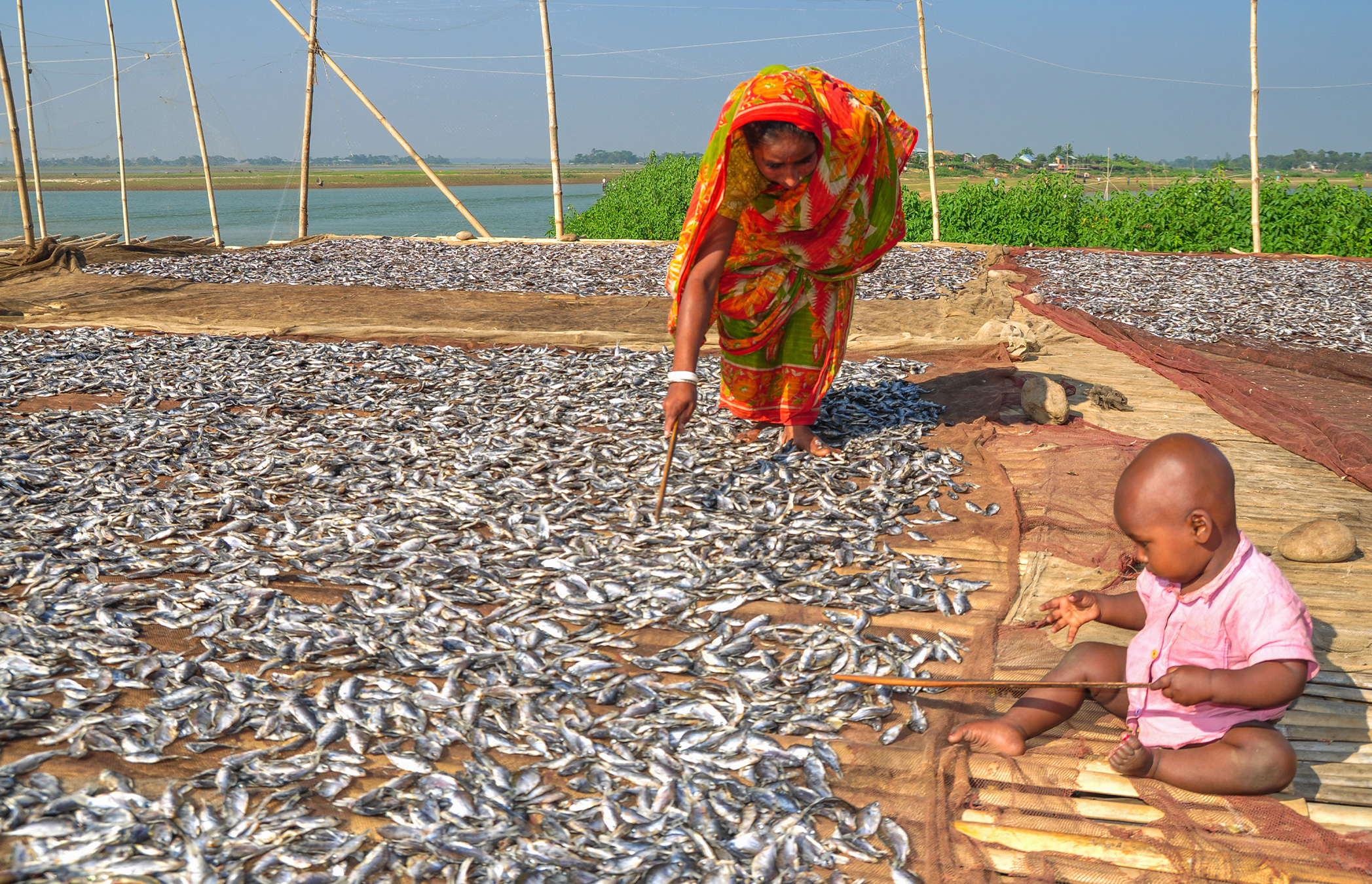
Banner image: A mother dries fish in the sun in Bangladesh as her baby watches. Image by WorldFish Bangladesh / Balaram Mahalder via Flickr (CC BY-NC-ND 2.0).
Bangladesh’s climate migrants are arriving in cities unprepared to protect them
Citation:
Nawar, N., Sorker, R., Chowdhury, F. J., & Rahman, M. M. (2022). Present status and historical changes of urban green space in Dhaka city, Bangladesh: A remote sensing-driven approach. Environmental Challenges, 6. doi:10.1016/j.envc.2021.100425
Feedback: Use this form to send a message to the author of this post. If you want to post a public comment, you can do that at the bottom of the page.

