


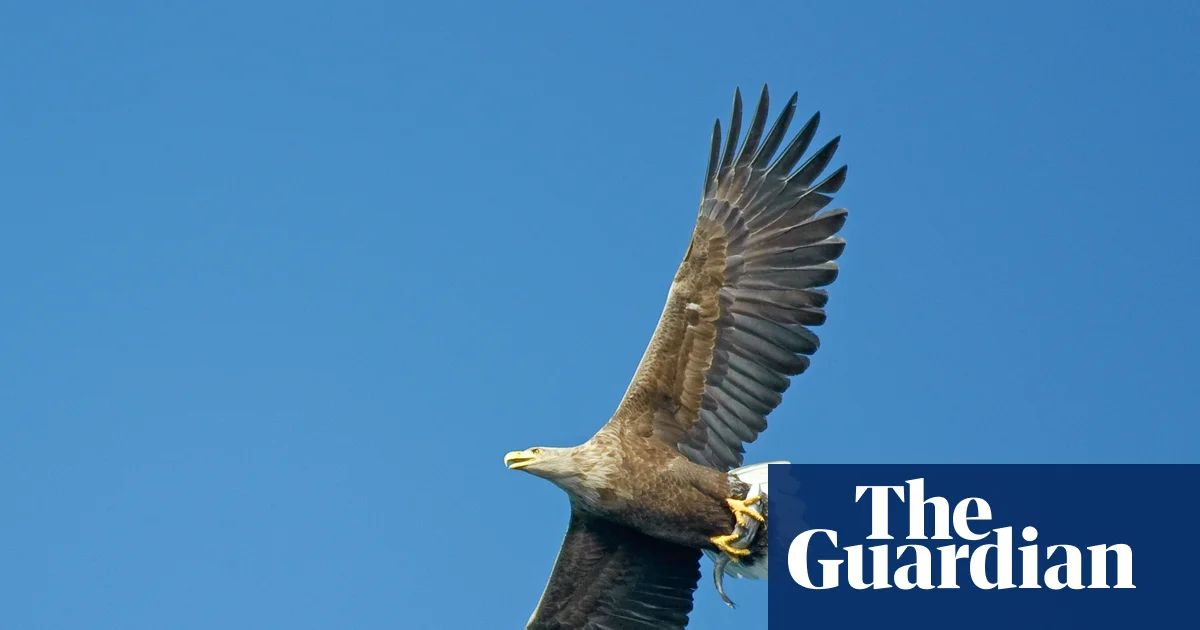
Your article (Reintroduction of white-tailed eagles puts seabird colonies at risk of wipeout, say experts, 8 November) raises important questions, but overlooks a fundamental point: eagles and seabirds coexisted around Britain’s coastline for thousands of years before eagles were driven to extinction through human persecution. Predation and disturbance are therefore not novel ecological pressures, but historically established interactions that have been absent from much of the British landscape for over a century.
There is a danger here of accepting an ecologically impoverished landscape as our conservation baseline. Seabird colonies have existed in the absence of a native apex predator, but that does not necessarily make predator-free conditions either natural or desirable. Restoring eagles is not simply about recovering a charismatic species; it is about restoring lost ecological relationships and processes.
Importantly, the Norwegian research cited does not demonstrate that eagles cause the “wipeout” of seabird colonies. Rather, it documents how eagle disturbance, largely involving immature eagles from an established population, can accelerate declines in colonies already experiencing food shortages. This distinction matters. If impacts are greatest where seabirds are struggling to find sufficient food, protecting prey availability must be central to conservation efforts.
Of course, seabirds face considerable additional pressures, including climate change, declining prey availability and disease. These vulnerabilities must inform reintroduction planning. However, impacts on individual colonies do not necessarily demonstrate population-level consequences, particularly for mobile species.
Through the Cumbrian White-tailed Eagle Project, we are exploring these questions, combining ecological research with community engagement to assess the opportunities and risks of restoration. The appropriate response is rigorous ecological assessment and adaptive management, not an assumption that restoring a native predator represents an unacceptable conservation risk.
Prof Ian Convery
University of Cumbria
Your article distracts from the real causes of seabird decline. Britain’s seabird numbers are collapsing primarily due to overfishing, seabed degradation and climate change, which have reduced fish stocks, leaving seabirds struggling to find enough food to raise their chicks. Extreme weather has also put pressure on remaining colonies.
Of course, the return of any species, including white-tailed eagles, needs careful consideration – with strict licensing following rigorous ecological feasibility and community engagement. But it is wrong to portray the reintroduction of a native predator as a major conservation threat while giving so little attention to human-driven decline of the food chain on which seabirds depend.
By restoring natural habitat and ecological processes, rebuilding food chains and reintroducing lost native species through rewilding, we can give nature the chance to recover and thrive. Framing native species’ return as a threat delays vital recovery and traps ecosystems in a degraded state. Rather than blaming native predators, our focus must remain on restoring the healthy ecosystems on which all wildlife depends.
Rebecca Wrigley
Founder and chief executive, Rewilding Britain
