


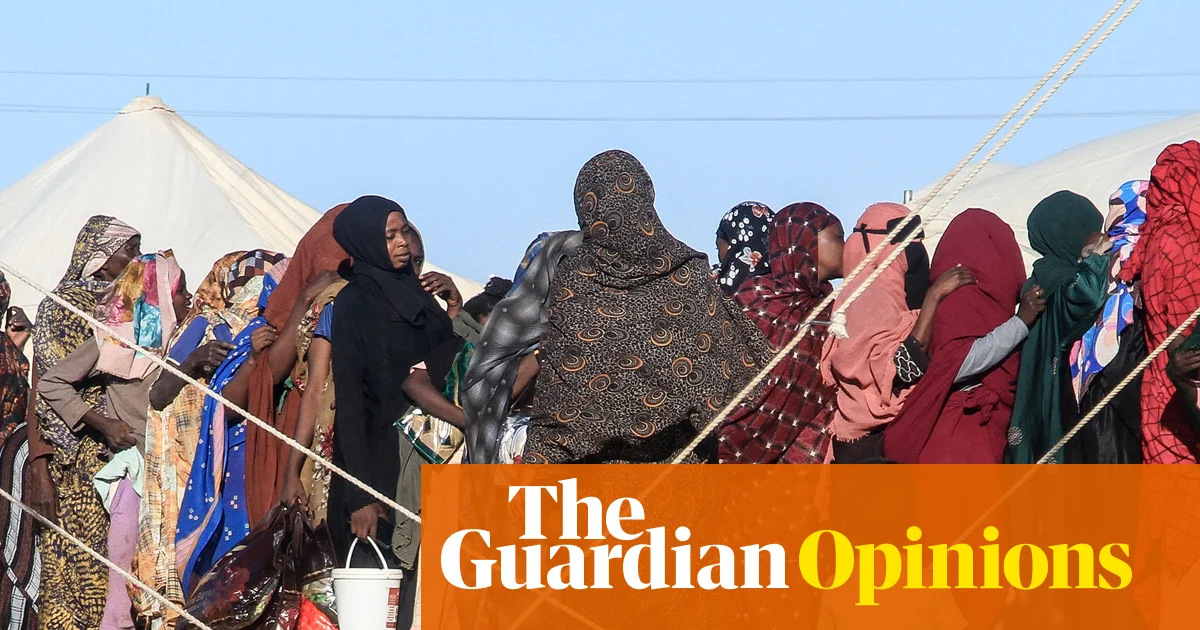
Since the devastating war in Sudan began in 2023, some of the best investigative work uncovering those responsible has been carried out by the UN panel of experts. Its reports have revealed clear evidence that the United Arab Emirates (UAE) has been funnelling weapons and providing mercenaries to the Rapid Support Forces (RSF), a Sudanese paramilitary group that has been accused of genocide.
It is these reports, produced by UN-funded investigators, that the UN secretary general, António Guterres, cites whenever he speaks about Sudan.
Every time a report has been published or leaked, one person has tended to take the lead in pushing back: Lana Nusseibeh. For more than a decade she has been one of the UAE’s top diplomats, spent almost 11 years as its representative to the UN and more recently as a Foreign Office minister. She has repeatedly denied the UAE’s involvement in fuelling the conflict and has publicly disputed the findings of the UN panel of experts.
But there is a high chance that in the coming weeks, Nusseibeh will replace Guterres and become the next UN secretary general. The representative of an authoritarian regime with a terrible human rights record that has been accused – by the UN, no less – of fuelling one of the world’s worst conflicts would become the voice of the dispossessed.
A few weeks ago, Nusseibeh was not even in the running. But for months the race to succeed Guterres has been in stasis as the declared candidates have struggled to win support from the major powers. The late entry allowed Nusseibeh to escape months of hustings and interviews around the world that would have placed her under more sustained scrutiny. It also ensured there was little time for her opponents to mobilise against her candidacy.
Choosing a new secretary general is a secretive business. There are hustings and the “vision statements”, but the decision is made behind closed doors and rests, ultimately, with the five permanent members of the security council: the US, Russia, China, France and the UK, also known as the P5. Only once all five have agreed can that name be passed on to the general assembly of all 193 nations, who will then vote to approve the P5’s choice.
In the most recent security council straw poll, Rebeca Grynspan, a former vice-president of Costa Rica and the secretary general of UN trade and development, had the most votes, but at least two P5 members appear to be opposed.
While all the major powers have been careful to avoid publicly indicating who they are backing, several UN watchers and diplomats I’ve spoken to believe Nusseibeh’s candidacy is backed by both the US and Russia, sparking fears that the election is being stitched up by those most opposed to the very idea of the UN.
The election comes at a bleak moment. Multilateralism is under attack, authoritarianism is on the rise, and the world is becoming more dangerous and volatile every day. One of the few consistent strains of Trumpism is the undermining of the UN, from the US’s withdrawal from numerous UN bodies to the creation of the rival Board of Peace. As I’ve written before, the US president would far prefer a world split into spheres of influence, where military and economic might counts for everything – and democracy and human rights for nothing.
A world of transactionalism suits the UAE too. For years it has used its oil wealth to build relationships across the world, whether that’s buying defence systems, building ports or investing in other nation’s cultural institutions. It is worth noting that it has major dealings with all five permanent members of the security council.
In the past month, France revived plans to jointly develop a new Rafale fighter jet with the UAE after the French president, Emmanuel Macron, met the UAE president, Sheikh Mohamed bin Zayed Al Nahyan, in Abu Dhabi; meanwhile, a trade deal between UAE and Russia, which both sides hope will increase annual trade to $50bn a year by 2032, has come into force. One of Donald Trump’s first foreign visits in his second term was to the UAE, where he announced new deals between the two countries worth $200bn, while China is the UAE’s largest trading partner.
Then there is the UK. Its relations with the UAE have been described recently as “frosty”, but the coolness has been coming only from Abu Dhabi. UK officials appear keen to do what they can to keep the UAE sweet. Unlike the UN panel of experts, no UK foreign secretary has been willing to name the UAE as one of those fuelling the conflict in Sudan, let alone point the finger at Sheikh Mansour bin Zayed Al Nahyan, the UAE’s vice-president, who has been accused by activists of playing a leading role in the country’s support for the RSF.
Mansour, of course, is also the owner of Manchester City. In September, the Premier League’s independent commission found the club guilty of serious breaches of its financial rules. It is the biggest scandal in English football, bringing into question the validity of more than a decade of Premier League football. Put simply, a foreign power corrupted our national game. But much of the commentary in the weeks after the verdict has focused on how the UAE will react if the club faces a severe punishment. The UAE, it seems, is simply too powerful – or the UK simply too in need of its investment – to rock the boat.
after newsletter promotion
All of this has made civil society groups and NGOs fearful that the UK will not stand in the UAE’s way, smoothing the path to Nusseibeh becoming secretary general.
When Ed Miliband became foreign secretary in July, he made clear that he would “fight for … our values of democracy, freedom and the rule of law on the world stage”. His announcement of economic sanctions against Israeli settlers, plus his description of Israel’s occupation of the West Bank as “unlawful”, showed these were not empty words.
But fighting for “democracy, freedom and the rule of law” is a continuous battle. If Miliband is serious about restoring international law and placing human rights at the heart of foreign policy, then he cannot go along with Trump and Vladimir Putin and give the UK’s backing to Nusseibeh. It may have an impact on relations with the UAE, but that’s no excuse. It may mean that no other candidate can be agreed upon, leaving the UN leaderless from January. That, too, is no excuse.
The UN simply cannot be run by a mouthpiece for an authoritarian regime. The UK has a veto – it needs to use it.
