


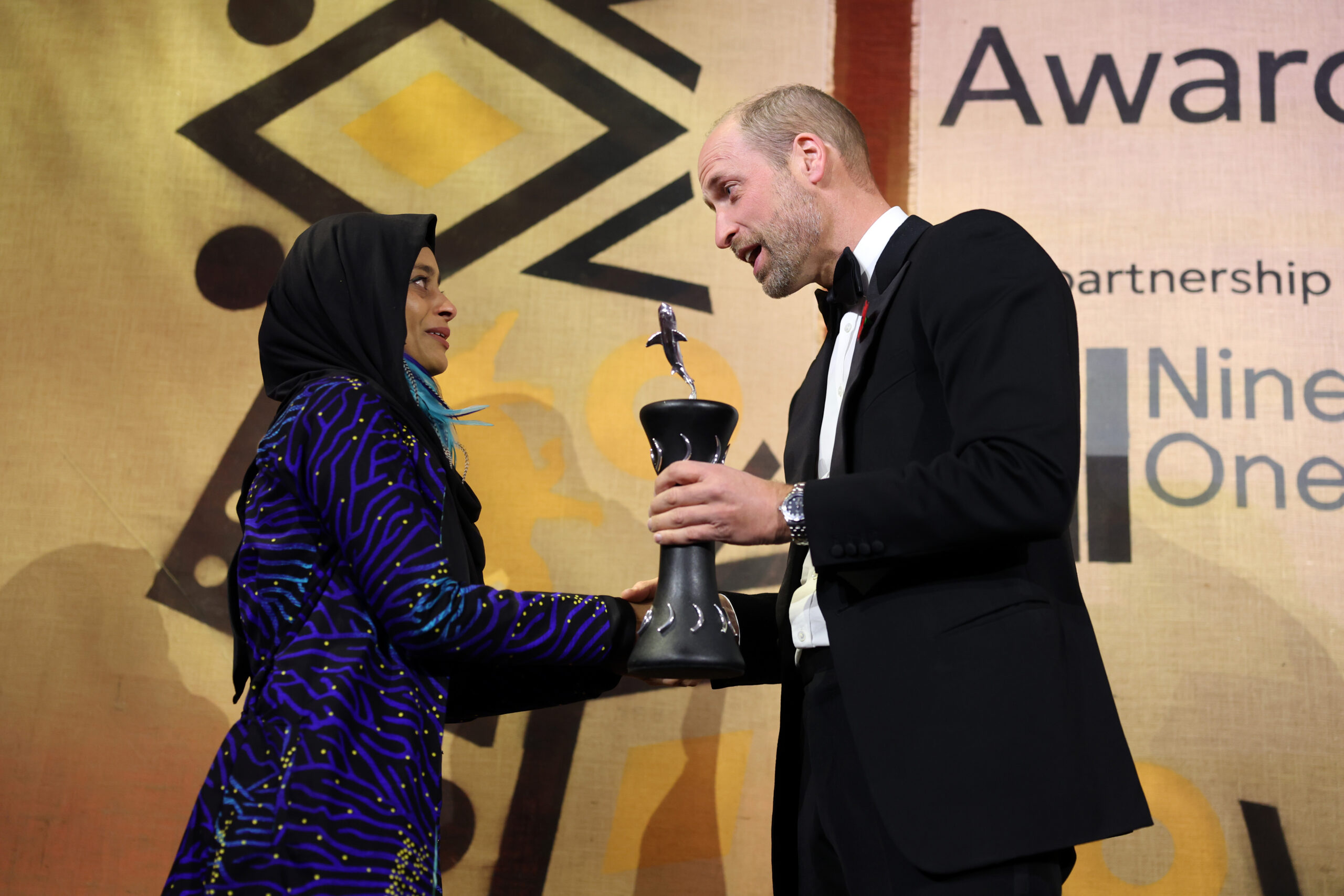
- Raabia Hawa received the 2026 Tusk Award for Conservation in Africa on Nov. 11 for her work as the founder of Ulinzi Africa Foundation, which was initially set up to conduct patrols to counter elephant poaching and wildlife crime.
- Her work has expanded beyond anti-poaching to combat illegal industrial bottom-trawling and empower local communities resisting extractive mining concessions.
- Hawa’s vocal stance against environmental destruction has come at a personal risk, including death threats and being designated a target by the militant group al-Shabaab.
- Hawa spoke with Mongabay about the realities of countering industrial fishing and mobilizing rural women against mining giants, highlighting the disconnect between global biodiversity targets and the daily battles frontline nature defenders fight on the ground.
Conservation is rarely conflict-free. On Kenya’s northern coastline, in Lamu and Tana River counties — a biodiversity hotspot where the nation’s longest river meets the Indian Ocean — the work of protecting marine and terrestrial habitats often takes a willingness to challenge industrial fishing and extractive industries.
For Raabia Hawa, defending nature against these activities has meant operating in areas largely neglected by official conservation bodies. A former broadcast journalist and Montessori teacher turned environmental defender, Hawa founded the Ulinzi Africa Foundation (“Ulinzi” means the defenders in Swahili) in 2014 to provide frontline ranger patrols against elephant poaching and wildlife crime. Her work has since expanded beyond anti-poaching to combat illegal industrial bottom-trawling and empower local communities resisting extractive mining concessions.
Operating near the Somali border comes with high political insecurity. Hawa’s vocal stance against environmental destruction has come at a personal risk, including death threats and being designated a target by the militant group al-Shabaab. Despite these perils, Ulinzi has continued to operate on a shoestring, powered by volunteer family support.
In London to receive the 2026 Tusk Award for Conservation in Africa — which provides Ulinzi with three years of critical funding — Hawa spoke with Mongabay about the realities of countering industrial fishing and mobilizing rural women against mining giants, highlighting the disconnect between global biodiversity targets and the daily battles frontline nature defenders fight on the ground.
Raabia dedicates the award to her father, Abdul Kadir Hawa, who she credits for her success. “He really believed in allowing me to find my path and walk my path, and he just empowered me every day,” she says.
The interview was edited for length and clarity.
Mongabay: Congratulations on your award. Can you take us into the everyday reality of your work?
Raabia Hawa: We work in a quite a difficult situation because it’s a high security area, a little bit different from some other conservation spaces. I have an anti-poaching team, which is the frontline defense or rapid response unit. Our marine program is the newest — we discovered that there’s actually quite a lot of illegal, unreported and unregulated fishing, because we are close to the Somali border, in the LAPSSET Corridor.
In 2021, there were all these reports of dead dolphins, dead turtles — every day. So, I went to check with my rangers. We documented two dead dolphins [and] 15 dead turtles. And then we saw the trawler. We actually mounted the trawler for an inspection. What we found on board was just a total massacre. They had 48 endangered species on board — shark, rays and guitarfish, which are meant to be protected species. We then were instructed to arrest the boat captain, and the trawler was instructed to anchor. What they did instead was they fled the waters after we left.
I realized that fisheries is actually a very dirty, corrupt industry. I got calls from the owner of the vessel; I got calls offering money, saying we will fund your conservation work if you just leave this alone. And I wasn’t entertaining that. It resulted in the first spate of threats and intimidation against me. The first being, I was notified that I was a named target of an al-Shabaab attack, which usually around these parts is used to just disappear you.
Mongabay: How did you evade that threat?
Raabia Hawa: I realized it was just a tactic to intimidate me into not pursuing the case. But I did not relent. I continued to write letters to the DPP [Director of Public Prosecutions]. The Kenya Coast Guard put together a thorough investigative report for prosecution. The DPP has still not prosecuted that case.
I started teaching some of the community how to gather evidence and make a strong letter. Because before, they would just do a march to the chief’s office, or write a letter to the fisheries department. The fisheries department never gave [them] any attention. So, I said maybe we need to try a new tactic here: Because it’s affecting turtles, and turtles are protected by the Wildlife Act, let’s instead write to the Ministry of Wildlife. What that resulted in was the Minister of Wildlife responding in writing and committing to keeping Kipini, which is the name of the landing site area there, a trawling-free zone.
Mongabay: Did that make a difference?
Raabia Hawa: It was really such a win. Between 2023 and 2025, we recorded a notable decline in the death of turtles as a result of trawling. In 2025, they tried to bring in a trawler under research purposes; and this year there has been a trawler: We’ve already recorded 20 turtle deaths. Because of a lack of enforcement, [and] a lot of ambiguity with our fisheries regulations, and the fact that the Ministry of Fisheries and Blue Economy [The Ministry of Mining, Blue Economy and Maritime Affairs] is prioritizing fisheries over the health of the ocean — despite making pledges at our ocean conference last year to really do everything possible to stop illegal fisheries.
Mongabay: What gives you the motivation to devote yourself to this fight against the odds, against threats?
Raabia Hawa: I’ve always loved wildlife. But there’s loving wildlife, and then really dedicating your life to making sure they’re safe. For me, it was difficult to get into conservation — I didn’t really know how. I ended up becoming a teacher instead. During the time that I was teaching, I was [also] working on radio. Media was really who I was.
By [that] time I had worked with rangers for some years, I had lost some friends to poachers, and it was very difficult for me. So, I wanted to see how I could leverage my media work to change that. I wanted to do a big awareness campaign. I did a cross-country trek called “Walk with Rangers from Arusha in Tanzania to Nairobi in Kenya through the bush.” Interest peaked on social media. I ended up having 71 people from all over the world join me on Walk with Rangers. I had an online fundraiser going, and raised enough money to purchase a Land Cruiser — that vehicle is what we [still] use today.
I never planned to have an organization or do projects of my own, but then I realized that this particular ecosystem really needed somebody. And at the time, nobody was willing to come here. There was a lot of insecurity because of al-Shabaab, no tourism. I decided, maybe I’ll just try and do it myself.
Mongabay: You mentioned losing friends to poachers, threats to yourself and the overall security situation — can you tell me what’s creating this climate?
Raabia Hawa: At the moment things are difficult. We are facing new threats. I think one of the most dangerous things that Kenya has done is combine the ministry functions of mining and blue economy, and combine the ministerial functions of tourism and wildlife. Because wildlife now is seen as a commodity, all the focus goes to tourism, and no [remotely sufficient] budget is allocated towards conservation. Mining and [the] blue economy are just being used for exploitation all over the country, and this is affecting us here on the ground.
Mongabay: Can you give me an example?
Raabia Hawa: We’ve recently had a lot of interest from the titanium mining industry. In 2024, there were applications for mining prospecting from Base Titanium, [which has] an Australian [parent] company. They wanted to take over entire blocks of land, including the environmentally significant area. I was able to put together a coalition. We successfully wrote memorandums in objection to this.
I also tried to sensitized the community [at Kipini village]. I found [out] that the mining company was taking the community for excursions to the mining site — showing them how they built schools, a clinic, how this was going to transform their lives. It was like a massive greenwashing campaign. Members from this very marginalized community bought into it. I spoke about my concerns [at a women’s meeting]. And that just lit a spark. They all said: “We don’t want the mining, but how do we stop this?” I said, “Well, we can write a letter of objection because the minister has said he’s calling for public comments.”
We [also] made a lot of information open source. We were able to map the mining blocks and hold a training session for the farming community and the women to enable them to access Google Maps — when they’re at their homestead, or at their farm, or at their grandfather’s graveyard, [to] put your live location and see if this is within the mining site and if you’re going to lose your land. That really helped to shift the perspective. They pushed back against the company, and Base Titanium pulled out their interest in mining in this area.
Mongabay: Who funds your work, and how did you build that capacity?
Raabia Hawa: All of the capacity that we brought as Ulinzi, no one’s funding it. Our advocacy program is completely unfunded, with the exception of one which we recently got funding for, to fight against bottom trawling and industrial scale fishing. The stuff on mining has all been pro bono, and actually, with the support of my brother: He did a course on GIS mapping and open-source data, and so he was able to bring that skill set [in], again, pro bono at the time. My sister is a lawyer, so she’s been doing all the legal stuff for Ulinzi pro bono —checking MOUs, going through affidavits, that kind of thing.
This is one of the reasons why I’m so excited about Tusk [and the award], because for the first time, Ulinzi has got a donor who is giving us sustained funding for three years. I can’t tell you what a lifeline this is for us. The thing is, our rangers are the beating heart of Ulinzi: This is our core program, and as long as my rangers get paid, honestly, I’ll do everything else for free.
(Banner Image: Raabia Hawa receives The Tusk Award for Conservation in Africa from William, Prince of Wales, at a ceremony in London on Nov. 11. Image courtesy of Chris Jackson/Getty Images for the Tusk Conservation Awards 2026.)
