


In 2021, the then shadow justice secretary, David Lammy, asserted his Englishness on the Saturday LBC programme he hosted, only for a caller named Jean to insist that his African-Caribbean heritage disqualified him. He could be British, she maintained, but “never be English”. Jean defended Englishness as though it were a possession she would never surrender to the country’s Black populace. Lammy’s entreaties to recognise it as a civic identity were ignored, as Jean attempted to demarcate its racial boundary live, on air.
After cross-party condemnation of Jean’s nativist screed, Lammy would go on to appeal for census options that would allow him, his children and other Black people building lives in England to identify as English, but the Office for National Statistics (ONS) stood firm. A spokesperson responded: “The evidence did not support a change to include Black English in England.” This was despite the ONS having recommended Black Welsh and Asian Welsh categories, with equivalent options available in Scotland. In Wales, the change followed criticism that census categories recognised Welsh identity among white respondents but not ethnic minorities; Scotland’s approach was informed by research and consultation showing that Scottishness was integral to the identities of many people from ethnic minority backgrounds.
The Liberal Democrat MP for Eastbourne, Josh Babarinde, has now brought the argument Lammy was making five years ago to parliament, introducing a 10-minute rule bill to extend English identity to people of all ethnic backgrounds. He is backed by a range of MPs including Lammy and the Conservative James Cleverly, and support for his proposal has been signalled by the prime minister.
“Polite society” and recent polling largely agree that Blackness and Englishness are compatible. In 2025, a study by YouGov found that only 13% of adults in England thought someone had to be white to be English, while 43% of UK-born ethnic-minority adults described themselves as either “British, not English” or “more British than English”.
The more interesting resistance, then, is coming from within Black communities. To be called English by another Black person is never a neutral descriptor. The designation is often used by relatives or Black friends, humorously or caustically suggesting that we have drifted from the cultures we inherited.
The same dynamic follows us to the countries our parents or grandparents left, where it becomes shorthand for the cousin changed by life in England. “To be colonised in the Caribbean,” wrote Sam Selvon, author of the 1956 book The Lonely Londoners, “celebrating Christmas with images of snow or pastoral interludes with daffodils – was to live with a kind of permanent unreality, for reality always seemed to be elsewhere, in London or in the metropole as a whole.”
That invasive identification bound colonial subjects to the mother country. As Anne Spry Rush notes in Bonds of Empire, West Indians were taught to think of themselves “not as conquered people, but as conquerors”. The repudiation of this supposed bond on arrival in post-second world war Britain partially explains the suspicion towards Englishness carried by their descendants.
That particular betrayal belongs to a Caribbean history. Black African communities arrived in England through different routes and with distinct relationships to Britain, but they encountered the same racial and institutional forces that marked Black people as conditional members of national life.
If Englishness felt like a gated identity – culturally alien and difficult for us to recognise ourselves within – Britishness offered a broader, more abstract way of reconciling ourselves to the country. Forged as a political and diasporic identity, Black Britishness provided solidarity and a means of asserting belonging.
But its very success deserves closer scrutiny. Jean, the LBC caller, had no issue with an arrangement that recognised Lammy as British while refusing him Englishness, as neither position troubled her increasingly anachronistic worldview. Seen in this light, Black Britishness may also have functioned as an identitarian kettling pen: capacious enough to contain all of us while leaving Englishness the preserve of the country’s white population.
Babarinde’s bill arrives amid continuing attempts on the hard right to equate Englishness with whiteness, even as Reform MP Suella Braverman’s recent denial of a Black audience member’s Englishness on BBC Question Time inadvertently staged a public referendum on the proposition that left her on the losing side.
Where Lammy invoked his attachment to recognisably English sensibilities, Babarinde speaks proudly of his Englishness, arguing that skin colour should have no bearing on who can claim it. Their feelings shouldn’t be dismissed, but their pride is not necessarily shared by the Black population of England, whose relationship with Englishness has yet to produce a settled consensus.
after newsletter promotion
The ancient presence of darker-skinned people – from Cheddar Man to soldiers of African descent guarding Hadrian’s Wall – has moved neither reluctant Black Britons nor the ethno-nationalists who have long defined the debate.
Celebrated Black Britons are held up as evidence of inclusion, although the honours bestowed on them can have the opposite effect, distancing them from the communities they are made to represent owing to their historical association with an empire built on colonial exploitation and slavery. Representation in sports poses its own problem: infographics designed to highlight how much weaker the England national team would be without Black migration suggest that Englishness is earned through exceptional achievement.
All these arguments render Black Englishness a perpetually conditional identity, at odds with the reality of how it is experienced. The census should have offered a Black English option long ago, but Black Englishness has already arrived without announcement, and needs no manifesto. It can be recognised in the things mistaken for mundanity: the places we identify with so deeply that they become part of us; the streets and areas we mythologise; the neighbourhoods where memories accumulate and the Black English vernacular that has travelled far beyond the communities that birthed it; and older relatives born ‘back a yard’ who nevertheless regard burial here as obvious, joining generations of West African and Caribbean dead already committed to English soil.
Sociologist Paul Gilroy – who told the Guardian in 2021 that he has always regarded himself as English – understands such transformations as “the fissures, stress cracks and structural fatigue in the edifices of Englishness [that] become more interesting and acquire their own beauty”.
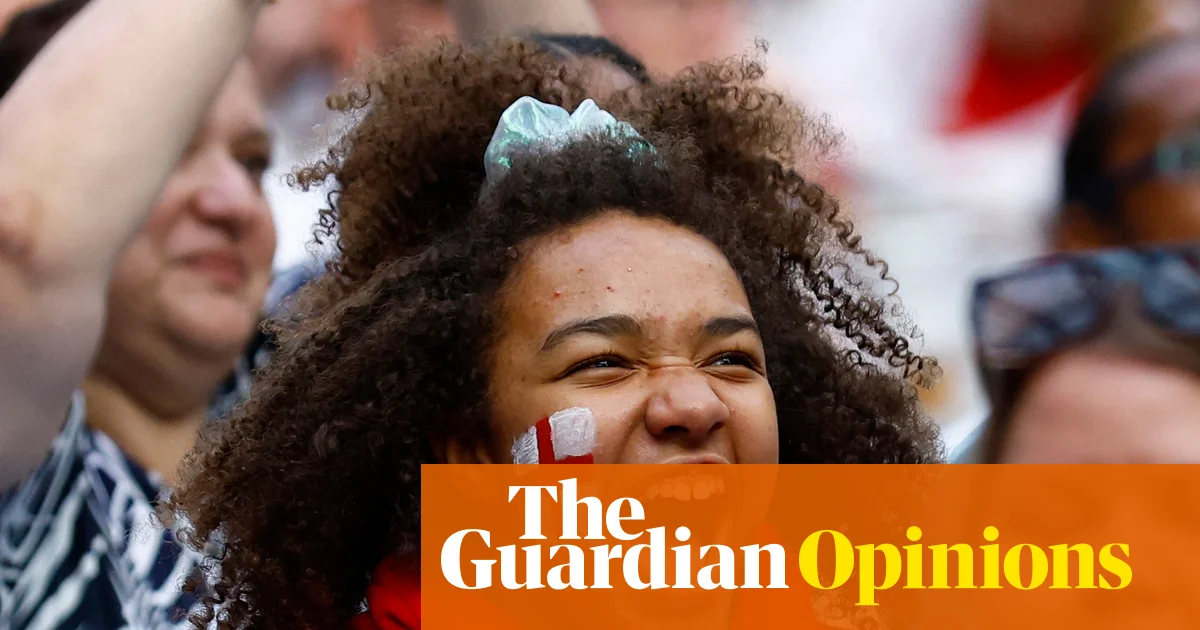
After England’s World Cup victory over Mexico in July, Sky News found two Black children huddled beneath a flag of Saint George in the morning sun, having stayed up beyond bedtime to support their country. The image felt jarring because nothing about it appeared that way to them. They seemed free of the self-consciousness with which older Black generations have approached Englishness: no qualification, no argument and no need to negotiate the terms of their belonging.
