


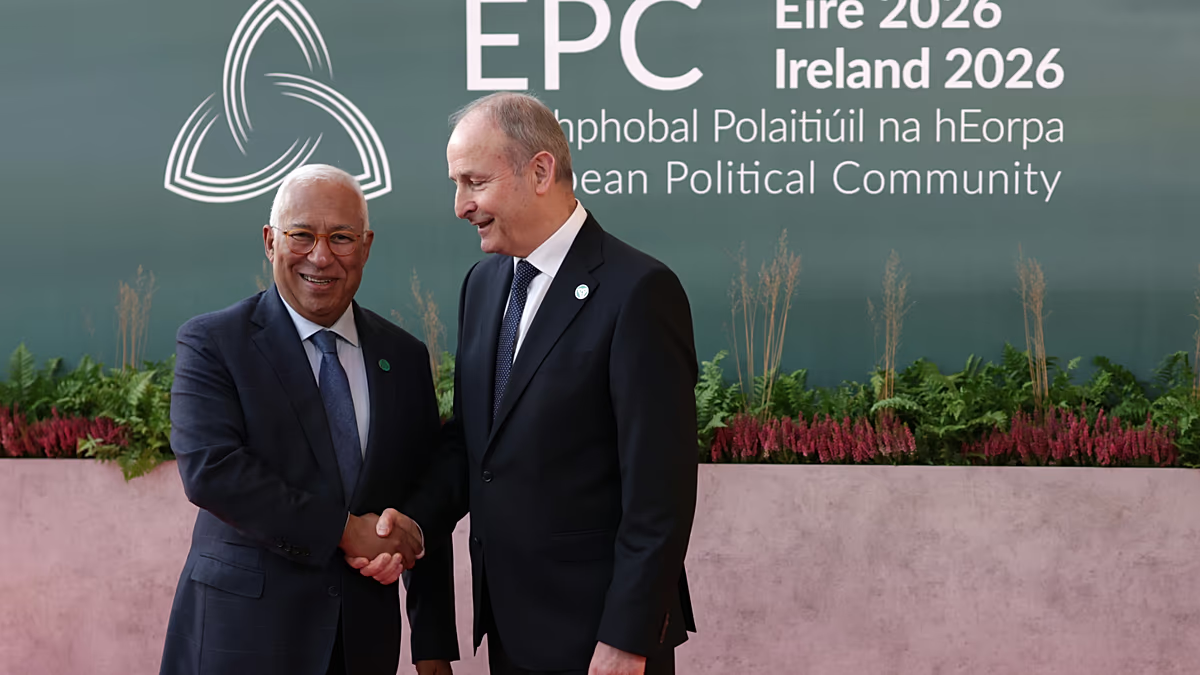
Ukraine talks take over. Today was meant to be the first European Council summit dedicated to artificial intelligence. President António Costa had invited Arthur Mensch, CEO of Europe’s AI darling Mistral, and Nobel laureate Geoffrey Hinton to discuss the opportunities and risks of the disruptive technology.
ADVERTISEMENT

ADVERTISEMENT
As an EU official put it, “sometimes [the European Council] gets overcrowded by current events.” And that is precisely the case, with the peace talks on Ukraine firmly at centre stage.
Late last night, Ukrainian President Volodymyr Zelenskyy held talks with US envoys Jared Kushner and Steve Witkoff at a military airbase outside Dublin, Shona Murray reports from the ground.
The short meeting was hastily arranged in the aftermath of two days of talks in Abu Dhabi. Witkoff and Kushner arrived at the air corps barracks in cold, bleak conditions, straight from a meeting with Russian President Vladimir Putin in Moscow.
A place at the table. Zelenskyy confirmed that Europe will take part directly in the next round of negotiations, rather than being kept on the sidelines. Witkoff had already floated that Putin had agreed to open the negotiating table to the Europeans, though the Kremlin quickly played down the prospect.
“Next time, next meeting, Europe … will be in the negotiating team,” he told journalists waiting outside. Kushner also made clear that Europe’s involvement was now a given, saying a deal to end the war in Ukraine couldn’t emerge without European countries at the table.
“We cannot conclude this deal without the Europeans being at the table. We’ve been telling President Putin that we believe that’s very important, and President Zelenskyy has been a very strong supporter, and he’s been saying that from the very, very beginning.
“And I think that we’re able to achieve that with President Putin, and he is willing to give it a try,” Kushner said.
As Zelenskyy made his way towards his aircraft, Shona managed to ask him what the US envoys had told him about Putin’s demands following their meeting in Moscow. He declined to go into detail, saying only that everything would “depend on when and how the war will end in Ukraine”.
Europe’s security architecture. Earlier yesterday, Zelenskyy warned Europe to pay close attention to the ongoing cooperation between Washington and Moscow, and to what it could mean for the continent’s security architecture.
“It’s more about some kind of new security framework between Europe and Russia,” Zelenskyy told the European Political Community summit in Dublin. “We are waiting for more details, and Europe needs to pay close attention,” he added.
Russia has indeed tried to turn the negotiations into a broader restructuring of Europe’s security architecture. EU leaders have rebuffed the move as an attempt to divert attention from Moscow’s battlefield setbacks and re-establish its sphere of influence.
At the EPC meeting yesterday, 43 countries signed a declaration on the key principles for the future of European security, stressing that any matter on European security must be decided by Europeans.
The signatories also “underline the necessity to provide robust and credible security guarantees to Ukraine and reiterate, for those concerned, their intention to do so, in order to prevent the recurrence of aggression in Europe in the future.”
EU peace envoy. To make sure the EU has a voice when the future of Ukraine and European security are decided, the bloc’s leaders can no longer dodge the question of who will represent them at the table, especially now that a seat may actually be on offer.
Italian PM Giorgia Meloni was the first to raise the issue again, warning that the different formats risked undermining Europe’s credibility and calling for someone with a clear mandate to join the talks. Rome has since secured a place for Meloni’s sherpa, Fabrizio Saggio, alongside his E3 counterparts in Abu Dhabi.
Speaking to reporters ahead of the summit, Meloni said Italy’s presence in the negotiations does not change her call to streamline the approach. “We need to identify who should represent European interests and with which mandate,” she said. “When we talk about the security of European nations, we are talking about making commitments about countries not present at the table.”
By contrast, Polish Prime Minister Donald Tusk, whose country is the other major player excluded from the E3 format, tried to lower the temperature. “I do not feel that Poland is suffering from a lack of participation. Quite the opposite. As I have told you many times, I sometimes feel there are too many meetings,” he said.
The name game. Who is it going to be, then? For Luxembourg’s Prime Minister Luc Frieden, Costa is the natural choice. “We, as heads of government, have a representative. And that is President Costa,” he told the press on Thursday.
Costa has earned the trust of many leaders by cautiously building a reputation as an honest, even-handed broker. His most notable misstep came in June, when his head of cabinet, Pedro Lourtie, tried to open a diplomatic channel with Moscow.
EU foreign policy chief Kaja Kallas has also pitched herself, alongside Costa, to represent the bloc in the negotiations, pointing out that the decision on who should deal with Russia was taken when she was offered the post in 2024. However, some EU leaders see Kallas as an anti-Russian hardliner, which may not help her case for a mandate.
If no final decision on the peace envoy is taken today, it will be postponed to the special summit at the end of the month, which is already loaded with the deadly combination of the EU budget and financing for Ukraine.
Kyiv is shieldless (again). Ukraine’s air defences face mounting strain as renewed restrictions on Starshield satellite services compound a chronic shortage of anti-ballistic interceptors.
Zelenskyy confirmed on Thursday that restrictions had been reintroduced on Starshield, the military version of SpaceX’s Starlink satellite service, hampering Ukraine’s ability to intercept Russian jet-powered Shahed drones. Similar restrictions had been lifted less than three weeks earlier.
Following his meeting with NATO Secretary General Mark Rutte in Dublin, Zelenskyy said Russia had launched 115 missiles of various types in the first week of November alone, alongside thousands of guided aerial bombs and jet-powered drones.
He warned that Moscow is exploiting Ukraine’s shortage of anti-ballistic interceptors to target its energy infrastructure, urging allies to ensure Kyiv is not left with empty air defence launchers as peace negotiations continue. “Artificial restrictions do not serve peace – they serve the aggressor,” Zelenskyy said.
End of the year rush. European Commission President Ursula von der Leyen said her executive will present an option paper on how to cover Ukraine’s financial needs in 2027, along with the 22nd sanctions package, at the special European Council on 26-27 November.
The timing for the sanctions package is particularly tight. The secretive bilateral meetings with EU governments, dubbed “confessionals” in ecclesiastical fashion, have yet to start because Costa has been busy consulting member states on the EU budget.
The aim is to adopt the package by the end of the year, so that Putin and the Russian elite have a nice Christmas present to unpack. But some EU countries are already grumbling that, if Europe is serious about the peace talks, another round of sanctions might send the wrong message.
Barbs with Beijing. China is set to top the agenda of Brussels’ two-day Foreign Affairs Council early next week. Angela Skujins has learned from EU insiders that Kallas intends to take aim at Beijing for supplying dual-use technology to the Kremlin and allegedly training Russian soldiers.
Sanctions remain the EU’s main instrument to deter Chinese companies and entities from propping up Moscow on the battlefield. But Kallas’ approach is drawing criticism from member states, who say she overrelies on sanctions in her diplomacy, which also risks triggering a cascading tit-for-tat dispute.
FAC (Ukraine). Foreign and defence ministers from the 27 EU member states will also hear directly from Ukraine’s Foreign Minister Andrii Sybiha and Defence Minister Evgeniy Khmara on the situation on the frontline, as well as energy resilience and air defence.
US Undersecretary of War for Policy Elbridge Colby will also join Tuesday’s defence ministerial to discuss the transatlantic alliance. Expect no surprises on that item, with EU officials anticipating an update on the Pentagon’s ongoing force posture review.
Notable absences. Dutch Prime Minister Rob Jetten and Belgian Prime Minister Bart De Wever are due to miss today’s summit because of domestic turbulence. Both have given a mandate to Luxembourg’s Frieden, who will represent the whole of Benelux.
Spain’s Pedro Sánchez, who faces a snap election on 29 November, will also skip the summit. That means both governments that have put forward candidates to head the European Central Bank will be absent today.
But the Spanish candidate, Pablo Hernández de Cos, seems to have received France’s support as part of a broader agreement with Germany, the FT reported.
Preparing is caring. The EU is stepping up preparations to help Ukraine survive another winter of freezing temperatures and devastating attacks on civilian energy infrastructure.
The bloc is mobilising 500 generators from its rescEU reserves, helping set up emergency support centres and supplying essential equipment, according to a joint statement from Costa and von der Leyen. Norway is expected to provide 200 buses and four floating bridges.
What needs to be done. The IMF’s Europe Director Mateusz Szczurek told Europe Today EU governments need to follow a very simple economic recipe that could also help reduce political instability.
“What needs to be done is to stabilise public debt, and make sure that growth accelerates. These growth-enhancing reforms will also reduce the political tensions within countries: when wages grow, when prosperity grows, then the political pressure also falls,” he said.
Follow the money. The EU sealed a migration deal with Nigeria this week. But what did Abuja get in return for agreeing to take back its own nationals? Accounts vary, including a mysterious €100 million pledge from EU officials. My colleague Vincenzo Genovese is on the case.
Commission set to approve Hungary’s €10bn in post-pandemic recovery fund next week
Hungary is on course to receive almost €10 billion in EU recovery funds frozen under Viktor Orbán, after Prime Minister Péter Magyar’s government pushed through sweeping rule-of-law and anti-corruption reforms.
The European Commission is set to approve almost all of Hungary’s €10 billion allocation from the Recovery and Resilience Facility (RRF) later this month, Commission officials have confirmed to Euronews.
Prime Minister Péter Magyar, who swept to power in a landslide election victory in April, campaigned on a promise to unlock EU funds frozen during Viktor Orbán’s 16 years in office.
In May, Magyar and Commission President Ursula von der Leyen agreed to release €16.4 billion that had been withheld over rule-of-law and corruption concerns under Orbán’s government.
Of that total, €10 billion is due from the EU’s post-pandemic RRF, which expires later this year. All payments have to be authorised by the end of November, to be paid before the end of the year.
Sandor Zsiros and Luca Bertuzzi have the story.
More from our newsrooms
Spain grinds to a halt in first general strike in 14 years
Riot police clashed with masked protesters in Madrid and Barcelona, leaving more than 70 people arrested, as unions and employers gave opposing verdicts on the walkout. Cristian Caraballo and Juan Carlos De Santos Pascual have the story.
Merz urges EU to stand firm on carbon market reforms despite growing opposition
The German Chancellor has warned against weakening the EU’s carbon market, insisting that businesses need predictable carbon prices despite mounting pressure from member states and his own economy minister. Marta Pacheco has the report.
Trump’s upgrade of US-led AI alliance runs into European resistance
The US wants to turn Pax Silica, its AI supply chain alliance, into a wider economic security pact, to be endorsed in San Francisco on Sunday. EU countries have raised concerns, citing vague definitions, a terminology clash over superintelligence and risks to their regulatory autonomy. Read more.
We’re also keeping an eye on
- EU leaders meet in Dublin for an informal European Council, chaired by António Costa, President of the European Council, and attended by Ursula von der Leyen, President of the European Commission, Kaja Kallas, High Representative for Foreign Affairs and Security Policy, and Roberta Metsola, President of the European Parliament.
- Commissioner for Equality, Preparedness and Crisis Management Hadja Lahbib continues her visit to Greenland.
- Commissioner for Democracy, Justice, the Rule of Law and Consumer Protection Michael McGrath speaks at a European Parliament conference on the Digital Fairness Act in Brussels.
- Migration Commissioner Magnus Brunner is in Cairo meeting government representatives and stakeholders.
That’s it for today. Sasha Vakulina, Shona Murray, Angela Skujins and Vincenzo Genovese contributed to this newsletter.
