


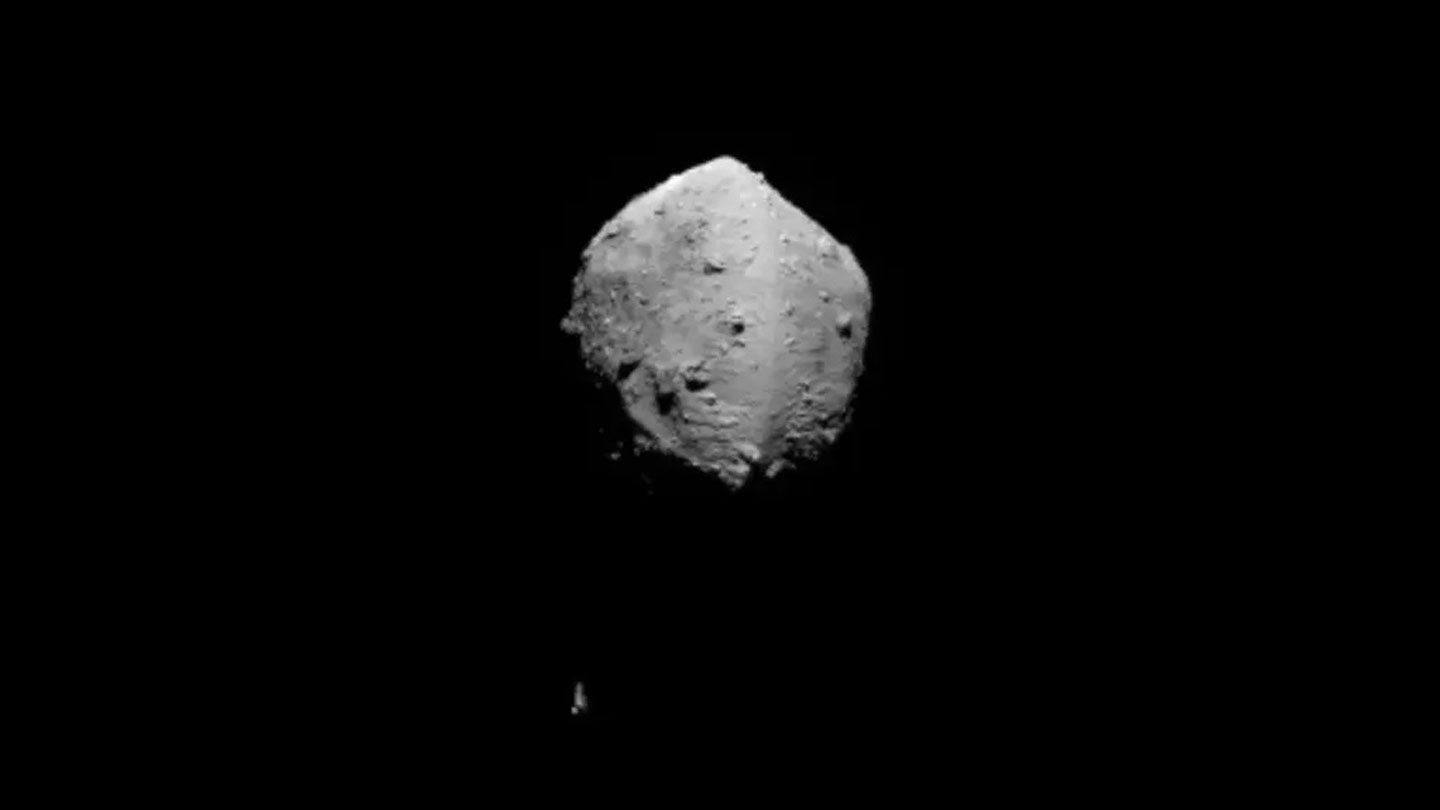
The European Space Agency’s Hera spacecraft is about to start a twofold mission to a twofold asteroid.
On November 4, after more than two years trekking through space, the spacecraft finally came within 30 kilometers of space rocks named Didymos and Dimorphos. The encounter marks the first time scientists will explore a pair of asteroids navigating the solar system together. To date, spacecraft have stopped to investigate just seven other asteroids, every one of them a lonely speck in outer space.
Hera will spend the coming weeks approaching Didymos and Dimorphos and will release two small companion spacecraft in January for an even closer look.
Didymos, a mass of rocks about twice as wide as the Empire State Building is tall, and its small moonlet Dimorphos have had a rough time lately. In 2022, NASA slammed its Double Asteroid Redirection Test (DART) spacecraft into Dimorphos, sending a plume of debris into space and shortening its orbit around Didymos by more than half an hour.
The cosmic realignment wasn’t a mere lark. Such an impact is one of the few ways scientists can practice planetary defense, the field dedicated to searching for dangerous asteroids and developing ways to deal with them lest humans go the way of the dinosaurs. DART and Hera are a carefully coordinated pair, with Hera’s top priority being to investigate the aftermath of DART’s crash and inform future planetary defense efforts.
That process will also yield a treasure trove of observations asteroid scientists are determined to exploit.
“Planetary defense and science are sort of two sides of the same coin,” says planetary scientist Jessica Sunshine of the University of Maryland, who was on the DART team but is not involved in the Hera mission. On the science side, she says, “we’re trying to figure out not so much how did we break the thing, but how was it put together in the first place.”
DART purposefully targeted a binary system instead of a solo asteroid to make measuring the change in orbit it accomplished easier: Any difference would be much more obvious against the 12-hour baseline orbit of Dimorphos around Didymos than against the months- or yearslong orbit of an asteroid circling the sun. (Despite the difficulty, scientists were able to calculate that DART shortened the more-than-two-year orbit of the Didymos system around the sun by a fraction of a second.)
Hera’s observations will provide a crucial glimpse at binary asteroids generally, which astronomers believe account for some 15 percent of all asteroids. Scientists expect that most binary asteroids in the inner solar system, including the Didymos system, probably formed their moonlets from debris that sloughed off the larger object then clumped together in orbit.
NASA/Johns Hopkins APL
Didymos spins so quickly that its gravity may not be strong enough to hold all its rock together. As the asteroid spins, it may send boulders into space, where they could end up landing on Dimorphos, continuing that material transfer today. Scientists will comb through Hera’s imagery for signs of rocks moving across each object’s surface, as well as between the two objects.
Scientists expect that Dimorphos is a rubble pile composed of boulders and rocky debris. It’s similar in structure to other recent spacecraft targets Ryugu and Bennu, although those are both significantly larger. The boulder-strewn landscape DART saw as it sped toward Dimorphos aligns with this theory, but how deep the rubbly structure extends is a mystery. “We’ve never seen the interior of an asteroid before,” says planetary scientist Angela Stickle of the Johns Hopkins University’s Applied Physics Laboratory.
Juventas, Hera’s companion cubesat about the size of a breadbox, will change that. It carries a first-of-its-kind radar instrument to investigate Dimorphos’ internal structure.
Juventas will also attempt to land on Dimorphos, allowing scientists to directly interact with the surface. That’s a particularly tantalizing endeavor given one of the biggest surprises of NASA’s OSIRIS-REx mission. When that spacecraft grabbed a sample of Bennu, it accidentally sank some half a meter into the rubble as the asteroid unexpectedly gave way beneath it, even though the surface had looked perfectly sturdy.
“Even though we had amazing images, the reaction was not what we expected,” says planetary scientist Patrick Michel of the French National Centre for Scientific Research (CNRS) of that experience. “There is still sort of a mismatch between what we see and what we feel.” He hopes that the Juventas landing will help scientists better connect appearance and reality on this front.
Although scientists will need to pick out the ways DART made Didymos and Dimorphos different from other binary asteroids, observations with Hera will offer new avenues for investigating more general questions in asteroid science.
For example, scientists know that before DART’s impact, Dimorphos always showed the same face to Didymos, just like our moon does to Earth. The collision probably changed that, sending Dimorphos tumbling — but there’s no way to know what state it’s in now because scientists have never seen this resetting process unfold. “Eventually, the system might stabilize, but we don’t know how long it takes,” says planetary scientist Eva Lilly of the Planetary Science Institute, who is not involved in either mission.
Similarly, scientists know that the rain of charged particles onto an asteroid’s surface darkens a thin layer of rock at the surface, but without the detailed understanding they’d like. At Dimorphos, they’ll be able to observe fresh rock uncovered by a known event, potentially offering clearer insight into the universal process.
Cosmic crash scene or not, asteroid scientists are never going to miss out on up-close views of two different space rocks.
