


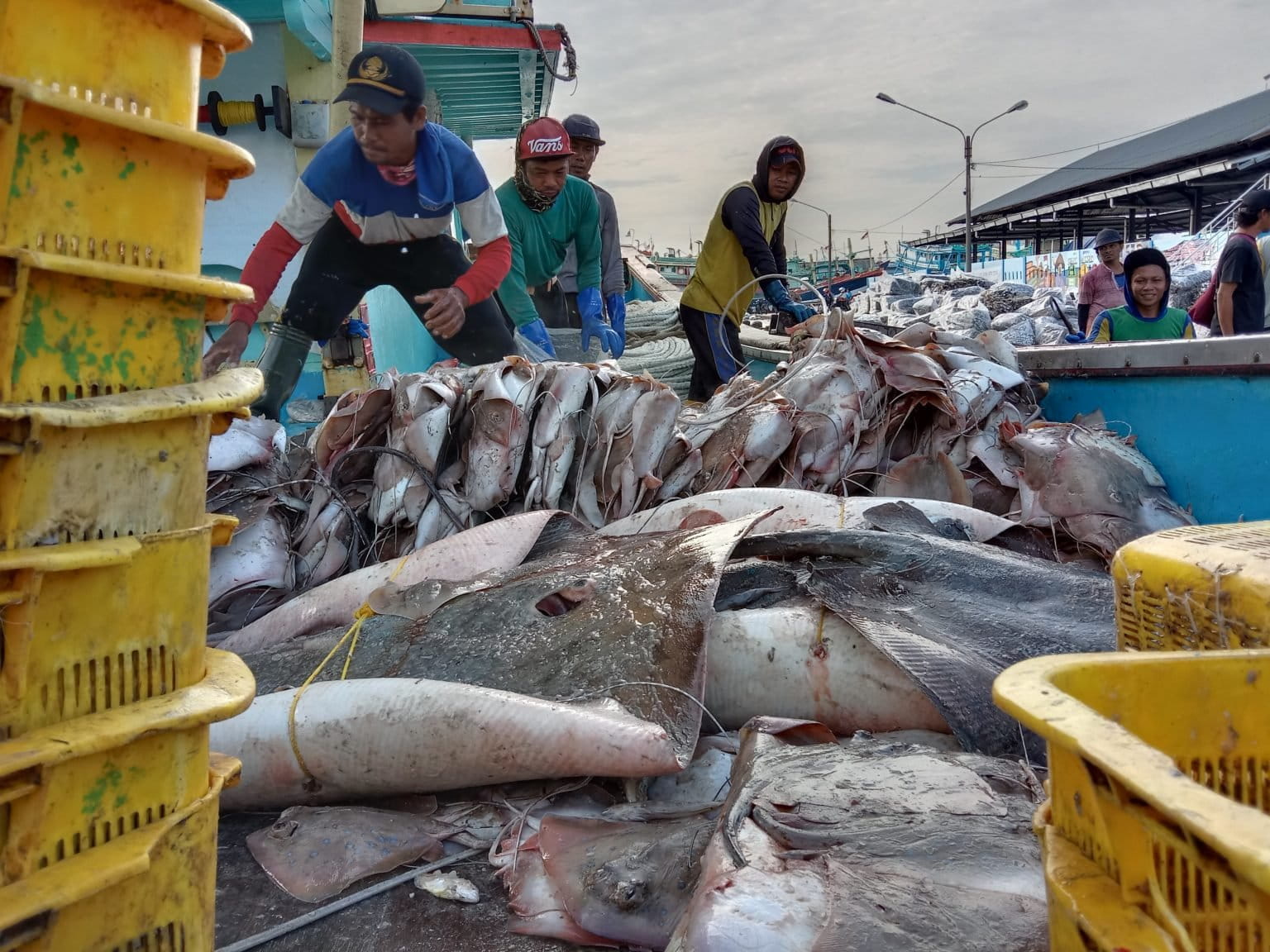
- Indonesia has ratified the ILO Work in Fishing Convention (ILO 188), committing to stronger protections for fishing crews, including safer working conditions, fairer pay and better access to health care.
- Labor groups say the convention could close long-standing legal gaps that have left many domestic fishing workers vulnerable to poor conditions and weak oversight.
- Experts say stronger labor standards could also help curb illegal fishing and boost the credibility of Indonesian seafood exports in markets with strict sustainability requirements.
- The biggest challenge now is implementation, with the government facing a year to update regulations and improve enforcement, training, and support for the fishing industry.
JAKARTA — Endi sat in front of the door leading to the second deck of a fishing boat at the Nizam Zachman fishing port in Jakarta. As he waited for the vessel to depart, the 42-year-old member shared his experience working at sea.
“I only have a primary school education. I tried other jobs, like construction, but I couldn’t handle it. The pay was low,” he told Mongabay.
On fishing boats, he said, crew members are paid according to their roles. Ordinary deckhands earn around 25,000 rupiah per day, or about $1.40, while the chief engineer gets up to four times that much. For a two-month voyage, that puts total earnings anywhere from 1.5 million to 6 million rupiah ($84-$334). Endi said that while this is still insufficient to support a family, he remains grateful to have work.
This could improve in the near future. In April this year, the Indonesian government ratified the International Labour Organization’s Work in Fishing Convention of 2007 (also known as ILO 188), marking a major step toward strengthening labor protections in the fishing sector. The government now has one year to prepare for its implementation, including revising existing regulations governing the recruitment, training, certification, and management of fishing crews. Overall, the convention seeks to establish minimum standards for occupational safety and health, fair wages, decent working conditions, social security, legal protection, and adequate rest for workers in the fishing industry.
Syofyan Razali is one of the organizers behind Team 9, a coalition of Indonesian civil society organizations and labor unions advocating for fisheries labor reform. He welcomed Indonesia’s ratification of ILO 188 as a way to address legal gaps in fisheries labor governance, including unclear authority for labor inspections, fragmented regulations, and the absence of a clear legal definition of fishing crews in existing national legislation.
Beyond expanding worker safeguards, other experts say the ratification will also support marine conservation by reducing incentives for labor abuse and illegal, unreported, and unregulated (IUU) fishing, which are often linked in global seafood supply chains. They also say that stronger labor standards can help improve the traceability and credibility of Indonesian seafood exports, helping the country meet the growing sustainability and due diligence requirements of international markets.
Arnon Hiborang, chair of the North Sulawesi provincial chapter of the Indonesian Fishing Crew Union (SAKTI), said he hopes the ratification will improve the working conditions of domestic fishing crews. The union has long received complaints from workers employed on Indonesian fishing vessels, and says policy attention has focused more on protecting Indonesian crew members working on foreign vessels, even as domestic crews face similar challenges. Although Indonesia already has regulations governing fishing crew employment, the union argues the existing framework lacks sufficiently detailed provisions to ensure effective protection.
“There should be no gray areas anymore,” Arnon said.
Fis Purwangka, who researchers occupational safety in the fisheries sector at the Bogor Institute of Agriculture (IPB), urged the government to use the ILO 188 ratification to strengthen worker protections for fishing crews through clearer and more binding regulations, particularly for fishing vessels with a capacity larger than 30 gross tonnage (GT).
He said protection should extend throughout the entire voyage and include adequate medical care, onboard living facilities, certified emergency medical personnel, mandatory health insurance, and stronger safety standards, especially during hazardous conditions. The implementing regulations should also define minimum requirements for workers’ age, working and rest hours, and administrative procedures, while recognizing that effective enforcement will remain a major challenge, he added.
“Several large companies in Indonesia already require health examinations for fishing crews, but this has not been implemented across the industry,” Fis said.
The main challenges, he said, will be in helping local communities and small-scale fisheries comply with the new regulations, preventing fraud and document manipulation, and improving the limited existing onshore medical facilities. He added he’s also concerned that some fishing vessels may use foreign flags to evade compliance.
“Building medical facilities, strengthening oversight of crewing agencies, and providing education, training, and certification for fishing crews are among the solutions the government can pursue,” Fis said.

Brant Connors, a director of the International Maritime Health Association (IMHA), a Belgium-headquartered NGO that campaigns for improved seafarer welfare, said the fishing industry employs more than 15 times as many workers as the merchant shipping sector and remains one of the world’s largest and most hazardous industries. This, he said, demonstrates the need for stronger international standards covering preemployment health checks, adequate rest, nutrition, clean water, and access to medical care throughout long voyages.
“Ultimately, if conditions and treatment on board do not meet acceptable standards, the people working on those vessels are at risk,” he said.
Mohamad Abdi Suhufan, special assistant to the Indonesian fisheries minister, said the ratification of ILO 188 strengthens Indonesia’s international standing by raising employment standards for Indonesian fishing crews working on foreign-flagged vessels while reinforcing the country’s reputation in global seafood markets through its commitment to labor standards. He added that ratification could increase the value of Indonesian seafood exports, as experienced by Thailand after it ratified the convention in 2019.
“The challenge is dealing with countries that have not ratified ILO C188. In those cases, broader international rules must still be applied,” he said.
Many of the foreign jurisdictions where Indonesian migrant fishers work as crew members, including Taiwan, South Korea, Aotearoa New Zealand, and several European countries, have adopted ILO and International Maritime Organization (IMO) standards establishing minimum requirements for the health, safety, and welfare of fishing crews.
For Endi, the crew member in Jakarta, the ratification offers hope that life on board Indonesian fishing vessels will finally improve. “I will comply with all the required conditions as long as they improve my life on fishing vessels,” he said.

This story was first published here and here on May 30 and June 13, 2026.
Basten Gokkon, senior staff writer for Indonesia at Mongabay, adapted this reporting.
See related:
Indonesia pursues agreements to protect its fishers on foreign vessels
FEEDBACK: Use this form to send a message to the author of this post. If you want to post a public comment, you can do that at the bottom of the page.


