


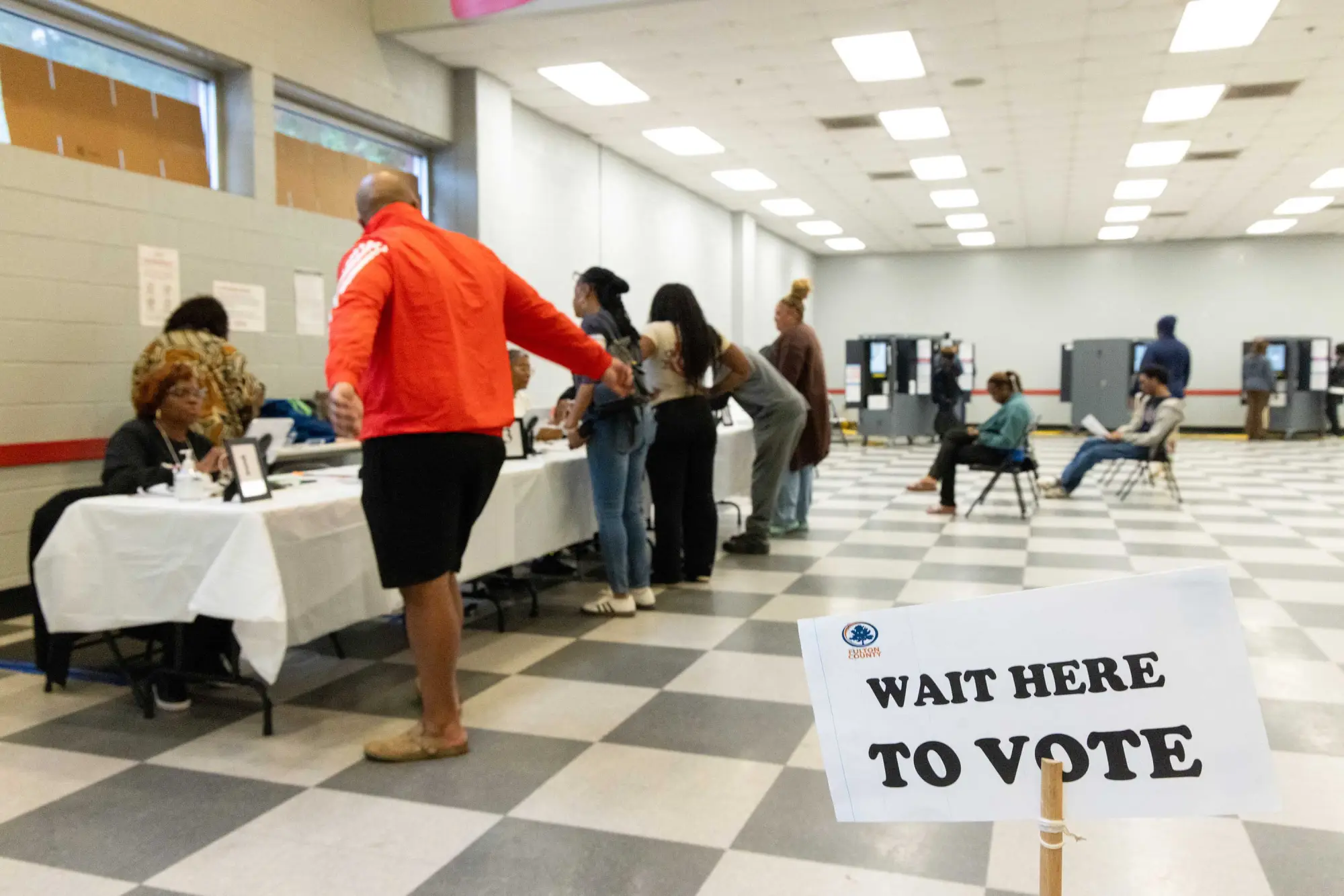
Ahead of the midterms, conservative election activists discussed plans to wield a powerful new weapon in the war against fraud: a data tool built by one of their own that could identify suspicious voters and help with contesting their ballots.
The system was put to the test this week in Forsyth County, Georgia, where a member of the county’s election board provided other officials with what he suggested was evidence of wrongdoing: four allegedly dead voters.
But it turns out all four are alive and well, ProPublica determined. The board rejected the attempt to challenge their ballots.
The effort, though, shows that even after last week’s blue wave, those who believe the 2020 election was stolen have continued to relentlessly search for ways to contest Republican losses. In Georgia, Democrats swept statewide offices.
The board member who initiated the Forsyth County challenge, Max Clavijo, is a member of the Election Integrity Network, a group led by conservative lawyer Cleta Mitchell that works to restrict voting and tighten election laws and rules. Mitchell worked closely with Donald Trump in his attempt to overturn his defeat in the 2020 election and, since he retook the presidency, has been central to his push to assert greater federal control over voting.
In the run-up to the midterms, on right-wing media and on private organizing calls, EIN participants outlined plans to search voter rolls with a software tool known as ELLY’s Election Monitor and contest ballots the tool deemed suspicious.
ELLY was developed by EIN member Rick Richards. It aggregates public data from state voter files, federal change-of-address records, tax documents, obituaries, property websites like Zillow and other sources. In Georgia, State Election Board members and top staffers have urged counties to use the tool to search their voter rolls for signs of fraud.
Richards talked about ELLY’s national potential on a podcast in late September, on which right-wing media personalities and activists touted its capacity to help GOP candidates contest their defeats. “We can prove the fraud that’s gone on in every state,” one commentator said. “This data will be able to set up challenges to those who lose.”
The following month, on a private call with EIN members and other conservative activists, Richards promised to provide data from more than 3,000 counties to “citizen monitors” and GOP candidates to try to prove fraud, according to a recording reviewed by ProPublica.
In an interview, Richards told ProPublica that he gave Clavijo data on Forsyth County at Clavijo’s request. He said in a subsequent email that their actions were meant to inform the board and remain confidential. Clavijo didn’t respond to questions from ProPublica.
Richards refused to answer questions about whether Clavijo’s effort was part of a wider EIN campaign to contest votes cast in the midterms.
“That’s irrelevant,” he said. “The data is the data. People can use it for what they want to.”
Mitchell, EIN’s leader, didn’t respond to questions about the group’s plans related to ELLY, either in Georgia or nationally.
In the months since some on Georgia’s State Election Board started promoting ELLY’s use, its accuracy has been much debated. The tool doesn’t have access to personal identifiers such as voters’ Social Security or driver’s license numbers or full dates of birth, which increases the potential for mismatches involving people with the same names.
Voting rights groups have called ELLY error-prone. The Cherokee County election director complained to the state board after the tool falsely flagged a county board member’s spouse as dead.
State Election Board members and Richards have defended ELLY. Accusations that the data is unreliable were “horse hockey,” Richards told ProPublica, explaining this was “a Southern colloquialism for B.S.”
Late last week, according to several people familiar with the matter, Clavijo circulated documents to board members and Forsyth County’s election director. Based on data from ELLY, Clavijo questioned whether the names of more than 22,000 people on the county’s voter roll were correct and disputed the eligibility of 69 voters. In addition to four he claimed were deceased, he alleged others had moved out of the county or state, had voter ID irregularities or had registered under fictitious names, giving an initial as their first name.
During the meeting, Clavijo claimed that he was not trying to disrupt the election’s certification or formally challenge the voters, a process outlined in statutes that can lead to ballots being tossed or voters removed from the rolls. (Richards also said they had not formally challenged ballots.) Clavijo said he was merely seeking “to clean the voter rolls” and inform the board so officials could investigate further.
But other board members accused him of doing an end run around the formal challenge process. Barbara Luth, the board chair, said she felt “sorry for” Clavijo because activists were bypassing the challenge procedure “by coming to you and having you submit it.”
Under fire from fellow board members, Clavijo admitted he could not vouch for the data’s accuracy.
“I did not make any explicit accusation that the information was 100% correct,” he said.
The cover letter Clavijo submitted with the challenges said that they had not been verified with any “human review,” according to sources familiar with the matter.
Richards and Clavijo submitted obituaries for the voters they claimed were dead, but there were discrepancies between the information in them and the voters’ records. All of the obituaries said or suggested the deceased lived outside of Forsyth County, which would have made it impossible to vote there. One said the person lived in Arizona.
ProPublica confirmed that all four are actually alive.
Alexis Ramirez, a night-shift nurse, told ProPublica that she cast her ballot during early voting. She was surprised to hear her vote had been contested — and why.
“It’s kind of crazy that they attempted to do that without trying to prove it first,” she said.
Saramma George, another voter Richards and Clavijo claimed was dead, said she was “really angry” to have the validity of her ballot questioned.
In the third case, ProPublica spoke with a voter’s son, who said she was alive but didn’t want to talk to ProPublica. Her “ballot is valid,” he said.
The fourth voter, Chris Strickland, said, “I don’t know where they’re getting their information from, but it’s false. I’m alive. I’m here.”
The majority of the challenges — 38 of them, according to people familiar with the matter — involved voters who’d registered using an initial.
One voter, Alexander Knight, told ProPublica that he goes by his middle name and that the information in voter records mirrors how Department of Driver Services officials suggested he be identified on his driver’s license.
“I am real,” he told ProPublica.
Four other challenged voters said they, too, abbreviated their first names. A. Joseph Guntherberg confirmed he routinely used the same formulation of his name, adding that blocking his ballot would not help the challengers: “My candidate didn’t win.”
Richards said it was up to county election workers to check ELLY’s data — he merely gathers it to facilitate efforts to maintain accurate voter lists.
But at the meeting, Joel Natt, a Republican board member, said the responsibility lay with challengers to justify their accusations. “This has no relevance to anybody here until” they provide solid evidence, he said, “through the proper channel.”
