


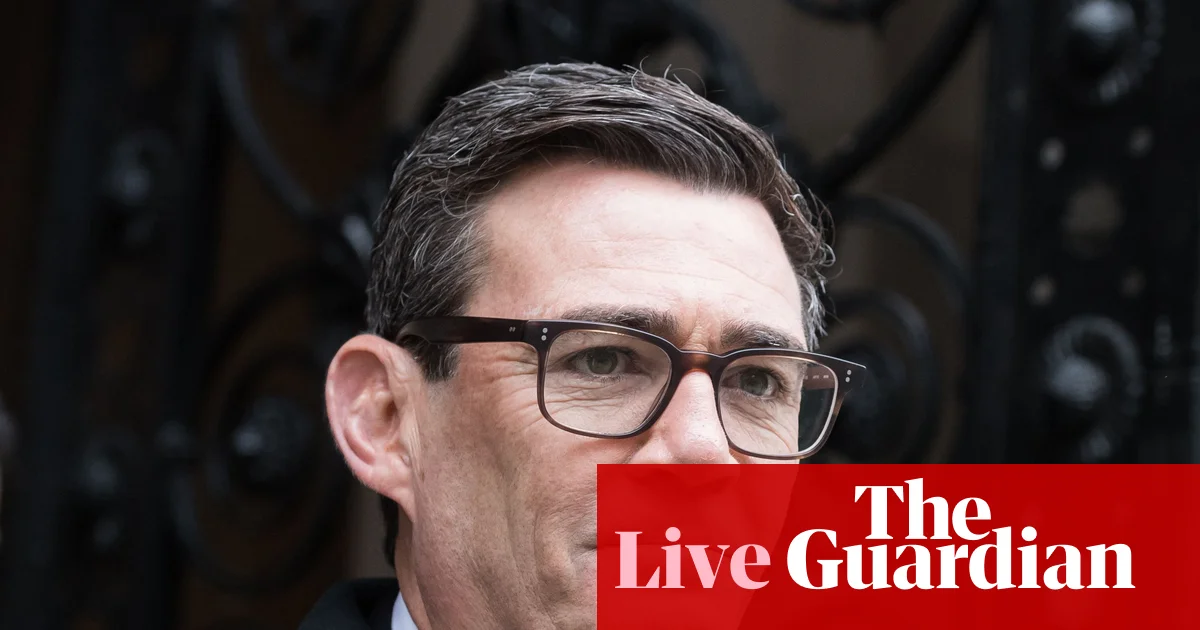
Burnham hails approval for two huge windfarm projects as ‘power under British control’
Good morning. Andy Burnham has got PMQs today, and after that he will leave for what looks like a rather hectic Turkey/Ireland trip which tomorrow will see him address the Cop31 climate summit in the morning, before attending his first major summit with EU leaders (and some other European leaders – it’s a European Political Community event) in Dublin later in the day.
Of the two events, the EPC is probably the more important for Burnham because it will give him the chance to clear the air ahead of the UK-EU summit next week, and because Burnham has made renegotiating the relationship with the EU a key aim of his premiership.
But Cop31 is important too because Burnham wants to show that he remains committed to the net zero climate agenda but that he is also “pragmatic” about pursuing this in a way that helps with cost of living pressures. This morning he has an announcement that will help in this respect; Downing Street has announced the next stage in two huge offshore wind projects.
One relates to the Vanguard East and Vanguard West projects. No 10 says:
Energy company RWE, together with global investment firm KKR, have announced a total investment of £12bn, believed to be the biggest of its kind in UK history to date. It will give the green light to its Vanguard West and Vanguard East offshore wind farms, set to be operational by 2030 and delivering clean, secure, homegrown power to homes and businesses that will protect families from global fossil fuel price shocks …
On top of bolstering the UK’s green energy future, the investment will support more than 2,400 jobs during construction and operation, and once operational, the wind farms will have the capacity to supply the equivalent of around three million UK homes …
The decision marks a major milestone for the project, with the developers now making their final investment commitment to deliver the projects. Onshore works are already well advanced, with construction offshore set to begin in early 2027.
The other relates to Berwick Bank B. No 10 says:
On top of this, Scottish-headquartered SSE has announced that the latest phase of its major offshore wind farm, Berwick Bank B, will back 2,677 skilled jobs in manufacturing, engineering and project delivery across the north of England and Scotland, with the company contracting Siemens Energy for the manufacturing of wind turbines and substation platforms. This includes the creation of 130 new project delivery roles in Glasgow and Montrose.
At its full capacity, Berwick Bank, off the east coast of Scotland, could become the world’s largest offshore wind farm, capable of meeting more than 6% of current UK electricity demand.
Welcoming these announcements, Burnham said:
This major investment in UK renewables is a vote of confidence for building in Britain. And it is great news for billpayers because every turbine we put up is power under British control, not at the mercy of events on the other side of the world.
Ajit Niranjan has a separate live blog covering Cop31.
Here is the agenda for the day.
10am: Angela Rayner, the housing secretary, gives evidence to the Commons housing committee.
10.50am: Lucy Powell, the education secretary, gives a speech to the Association of Colleges annual conference in Birmingham.
11am: Louise Casey gives a speech at the National Children and Adult Services conference in Liverpool.
Noon: Andy Burnham faces Kemi Badenoch at PMQs.
Noon: Morgan McSweeney, Keir Starmer’s former chief of staff, gives evidence to the Lords constitution committee about constitutional safeguards.
1pm: Heidi Alexander, the transport secretary, gives a speech to the annual airlines’ conference in London.
2.15pm: John Healey, the chancellor, gives evidence to the Commons Treasury committee about the budget.
Afternoon: Burnham leaves London to fly to the Cop31 climate conference in Turkey.
I’m afraid we are no longer able to have comments open below the line every day on this blog. If you want to contact me, please email politics.live@theguardian.com. You can use this email to flag up corrections, comments for publication, questions or complaints.
Key events
Here are some more comments on the report for the Casey commission released today looking at how social care is run in England. (See 9.56am.)
This is from Natasha Curry, deputy director of research at the Nuffield Trust and one of the report’s authors.
Compared to the other countries we looked at, the governance of England’s social care system is confused and complex. Overlapping and unclear roles leave dangerous uncertainty around who is responsible for important decisions, contributing to the inertia around reform England has struggled with for decades. The serious consequences of this were laid bare during the Covid pandemic.
This is from Stuart Hoddinott, associate director at the Institute for Government, who is another co-author of the report.
The system for governing adult social care in England has evolved haphazardly and with little clear planning. That has been exacerbated by successive governments ducking politically unpalatable decisions for decades. That has scattered responsibility for the sector across and outside government in a way that few would design from scratch.
And this is from Prof Nicola Ranger, general secretary and chief executive of the Royal College of Nursing.
This report makes for sober reading of how adult social care and those who rely on it have been systematically failed. The fragmentation we see today is what happens when there is a total absence of political leadership to ensure the sector is well-funded and provides equitable access to care.
Ministers discussed EU policy at a political cabinet yesterday. Downing Street issued a readout afterwards that stressed the advantages that might come from the deals due to be agreed at next week’s UK-EU summit. But, according to a story by Arj Singh and Caroline Wheeler in the i, there was not quite as much unity at the meeting as the official account implied. They report:
[Burnham] struggled to dampen splits among cabinet ministers, which were first revealed by The i Paper, who used the meeting to express differing views on the future relationship with Brussels.
One source with knowledge of the cabinet discussion said there was a “clear divide between those who want to go further and those who don’t want to push the issue too far”.
The source said no consensus position was reached at the meeting, in a blow to Burnham’s plan to try to persuade reluctant cabinet ministers opposed to moving too quickly towards a closer relationship with Europe to unite behind him.
On Sunday Kiran Stacey reported that a crunch ministerial meeting, chaired by Louise Haigh, was due to take place today and that it was expected to lead to the government’s electric vehicle (EV) targets being watered down. Now Politico reports the meeting has been postponed until tomorrow “due to diary clashes”.
Britain willing to discuss paying into EU to join electricity market, says minister
Britain is willing to discuss paying towards infrastructure schemes in poorer parts of the EU in return for access to the European electricity market, according to the minister in charge of renegotiating the bilateral relationship, Sally Weale and Kiran Stacey report.
Welsh government sets up commission to provide evidence and advice on Wales’s constitutional future
The Welsh government has announced it is setting up a National Commission for Wales “to provide advice, evidence and analysis on Wales’s constitutional future”. It is expected to cost around £500,000 a year. Announcing the move, Dafydd Trystan Davies, minister for government effectiveness and the constitution in the Plaid Cymru-led Welsh government, said:
The way the United Kingdom is structured and governed is under increasing strain, and debates about devolution, accountability and where decisions should be made are increasingly pressing.
Responsible government means ensuring Wales is ready to shape its own future, with the evidence, advice and democratic space needed to make informed choices. This is not an abstract debate. It is about whether Wales has the right tools, powers and democratic arrangements to deliver better outcomes for our people.
That preparation cannot be the work of government alone. It requires a broad, open and constructive conversation across this Senedd and across Wales.
Government should consider putting cap on profits for firms in care sector, report to Casey commission says
In a speech later today, Louise Casey, the Whitehall troubleshooter who is leading a commission reviewing adult social care for the government, will say successive governments in England have been “asleep at the wheel” on social care, leaving the system to grow as a chaotic patchwork of local services with no clear vision. Patrick Butler has the story here.
Casey was also on the Today programme this morning and she
The most telling thing is the fact that nobody really sees the importance and the value – the human value, let alone anything else – of personal social care.
And I think that over time the National Health Service has become much more pulled into being a National Hospital Service that very much concentrates around medical treatment, surgery and those sorts of things. And of course, that’s incredibly important …
But by the same token, we do not put the same value on somebody who is, say, recovering from a stroke, and needs physiotherapy and occupational therapy, and then they still need somebody to help them get in and out of bed.
To coincide with Casey’s speech, the Nuffield Trust and the Institute for Government have published a report, commissioned by the Casey commission, looking at the governance of the social care system in England. Bluntly, it says the system is a bit of a mess. It explains:
The result [the adult social care system developed in England] is a complex system where responsibilities are spread between central government departments, and across a range of arm’s-length bodies; between national and local government; and between government and a vast array of non-public sector providers. Decision-making processes can be opaque and a single point of responsibility for overall oversight and stewardship is lacking.
The report also suggests the Casey commission should consider the
In England, the current distribution of provision, in which private providers dominate and only a very small proportion is operated by the state, has emerged in a largely uncontrolled and unintended way (see the [Richard] Humphries and [Nicholas] Timmins working paper). The commission and the government may wish to take an explicit position on the balance of public, not-for-profit, and for profit provision, and whether social care is a sector where profit from public funding is tolerable – as the government under the previous prime minister announced for the children’s care sector with the intention to set profit caps for private providers. The role of private equity in the market is of particular significance and its benefits of attracting investment versus its risks of instability driven by high debt ratios needs to be carefully examined.
Ed Miliband says national security of all countries at risk from climate crisis
The national security of all countries is at risk from the climate crisis, as “science fiction” scenarios of widespread destruction are already coming true and economic shocks from fossil fuels are now the norm rather than the exception, Ed Miliband, the foreign secretary, will warn at the Cop31 summit today. Fiona Harvey has the story.
The CBI has issued a statement welcoming the PM’s offshore wind announcement. (See 8.55am.) This is from its chief executive, Rain Newton-Smith.
The prime minister’s announcement of major investment in offshore wind is a powerful restatement of the UK’s clean energy ambitions and the economic opportunities they can unlock. Investment on this scale can attract further private capital, create skilled jobs and support growth in communities across the country.
Burnham hails approval for two huge windfarm projects as ‘power under British control’
Good morning. Andy Burnham has got PMQs today, and after that he will leave for what looks like a rather hectic Turkey/Ireland trip which tomorrow will see him address the Cop31 climate summit in the morning, before attending his first major summit with EU leaders (and some other European leaders – it’s a European Political Community event) in Dublin later in the day.
Of the two events, the EPC is probably the more important for Burnham because it will give him the chance to clear the air ahead of the UK-EU summit next week, and because Burnham has made renegotiating the relationship with the EU a key aim of his premiership.
But Cop31 is important too because Burnham wants to show that he remains committed to the net zero climate agenda but that he is also “pragmatic” about pursuing this in a way that helps with cost of living pressures. This morning he has an announcement that will help in this respect; Downing Street has announced the next stage in two huge offshore wind projects.
One relates to the Vanguard East and Vanguard West projects. No 10 says:
Energy company RWE, together with global investment firm KKR, have announced a total investment of £12bn, believed to be the biggest of its kind in UK history to date. It will give the green light to its Vanguard West and Vanguard East offshore wind farms, set to be operational by 2030 and delivering clean, secure, homegrown power to homes and businesses that will protect families from global fossil fuel price shocks …
On top of bolstering the UK’s green energy future, the investment will support more than 2,400 jobs during construction and operation, and once operational, the wind farms will have the capacity to supply the equivalent of around three million UK homes …
The decision marks a major milestone for the project, with the developers now making their final investment commitment to deliver the projects. Onshore works are already well advanced, with construction offshore set to begin in early 2027.
The other relates to Berwick Bank B. No 10 says:
On top of this, Scottish-headquartered SSE has announced that the latest phase of its major offshore wind farm, Berwick Bank B, will back 2,677 skilled jobs in manufacturing, engineering and project delivery across the north of England and Scotland, with the company contracting Siemens Energy for the manufacturing of wind turbines and substation platforms. This includes the creation of 130 new project delivery roles in Glasgow and Montrose.
At its full capacity, Berwick Bank, off the east coast of Scotland, could become the world’s largest offshore wind farm, capable of meeting more than 6% of current UK electricity demand.
Welcoming these announcements, Burnham said:
This major investment in UK renewables is a vote of confidence for building in Britain. And it is great news for billpayers because every turbine we put up is power under British control, not at the mercy of events on the other side of the world.
Ajit Niranjan has a separate live blog covering Cop31.
Here is the agenda for the day.
10am: Angela Rayner, the housing secretary, gives evidence to the Commons housing committee.
10.50am: Lucy Powell, the education secretary, gives a speech to the Association of Colleges annual conference in Birmingham.
11am: Louise Casey gives a speech at the National Children and Adult Services conference in Liverpool.
Noon: Andy Burnham faces Kemi Badenoch at PMQs.
Noon: Morgan McSweeney, Keir Starmer’s former chief of staff, gives evidence to the Lords constitution committee about constitutional safeguards.
1pm: Heidi Alexander, the transport secretary, gives a speech to the annual airlines’ conference in London.
2.15pm: John Healey, the chancellor, gives evidence to the Commons Treasury committee about the budget.
Afternoon: Burnham leaves London to fly to the Cop31 climate conference in Turkey.
I’m afraid we are no longer able to have comments open below the line every day on this blog. If you want to contact me, please email politics.live@theguardian.com. You can use this email to flag up corrections, comments for publication, questions or complaints.
