


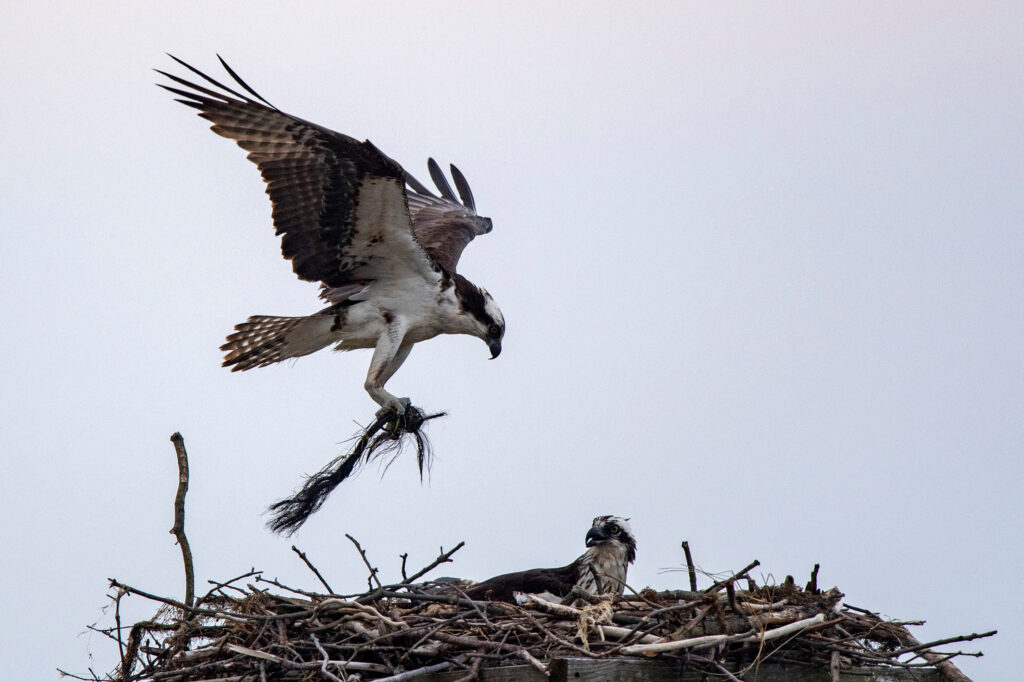
For 20 years, Roberta Kellam, a retired lawyer and longtime birder, has watched ospreys return to their nests and raise chicks from her home on Nassawadox Creek, on Virginia’s Eastern Shore.
She’s been monitoring around two dozen nests near her house. Kellam has also surveyed osprey populations with Bryan Watts, a longtime researcher at William & Mary’s Center for Conservation Biology and logs her observations on Osprey Watch, a citizen-science project the center runs.
Nassawadox Creek drains into the Chesapeake Bay, the nation’s largest estuary and home to the world’s largest breeding population of ospreys. The birds typically return from their wintering grounds in late February and early March to rebuild nests and raise chicks.
But about eight years ago, the situation turned from joy to dread.
“Once they hatched, they were disappearing,” Kellam recalled. By mid-to-late May, according to Kellam, the creek could shift from active osprey nests to “just silence” in recent years, with adults no longer feeding the young, signaling a worrying decline. The disturbing observations prompted her to report the situation to Watts, who she’d known for nearly two decades.
Early on, they considered possibilities such as predation. But nothing seemed to explain the losses. Watts, who’s studied Chesapeake Bay ospreys for about 40 years, said they decided to ramp up nest monitoring after residents and watermen raised concerns about poor osprey reproduction.
The first comprehensive survey of Kellam’s local osprey colony began in 2024, which she described as “very grim.” That was the first time she could “look inside the nest and see the dead chicks and the abandoned eggs.” Sometimes chicks were still alive, she said, but many did not survive.
The center’s 2026 osprey breeding performance survey found the bay’s osprey population in steep decline, especially in saltier regions of the estuary. The study linked the decline to severe food stress tied to the low availability of Atlantic menhaden for nesting ospreys.
Menhaden for decades have been considered a “keystone prey species for the osprey population” due to their abundance, high energy density and schooling behavior, the survey said. Nesting ospreys “require high fish abundance during April, May and June to successfully raise broods” and are not able to adjust when menhaden do not arrive in large numbers until late June or July.
The study described the 2026 breeding season as “the worst productivity year ever recorded for ospreys in the Chesapeake Bay,” raising fears that breeding rates are too low to sustain the population.
Watts said that on the lower Patuxent River, where ospreys depend more heavily on menhaden, pairs are raising too few young to replace the adults that die. Upriver, where birds have access to a different mix of fish, pairs are doing better.
The food shortage is visible in the nests, he said, and chicks were starving at older ages than historically observed. Watts estimated an 80 percent decline in menhaden deliveries and a 50 percent decline in food quality compared with the 1980s.
More than 30 percent of osprey females in some study areas were not laying eggs, Watts noted, compared with about 2 percent in the 1980s. Current productivity was about 0.26 chicks per pair, below the minimum break-even estimate of 0.8.
Watts said ospreys show strong fidelity to their nesting sites, but in saltier bay regions, where menhaden is the birds’ primary food source, many pairs now cannot bring home enough food to raise their young. “They need [menhaden] in mid-May to about mid-June. That’s a critical period, and they’re not available.”
Researchers have a much firmer grasp on what is happening in the nests than on why fewer menhaden are reaching ospreys. According to Watts, climate change is a contributing factor, shifting the fish’s distribution and arrival times. And while state and regional fisheries councils emphasize that localized menhaden depletion has not been empirically linked to commercial harvest, conservationists and researchers like Watts have field observations to raise questions about that.
Watts said researchers lack fisheries monitoring data, and industry-held commercial data is not available to the public, leading to data gaps about menhaden availability and older age classes of ospreys.
The American Small Pelagics Network, a group representing fishermen and processors tied to the menhaden industry, have pushed back on the Center for Conservation Biology’s research.
“A struggling predator does not by itself prove a menhaden harvest problem,” the group said in a recent statement. “The 2025 Atlantic menhaden assessment found the stock is not overfished and overfishing is not occurring.”
A spokesperson for a leading menhaden fishing firm, Ocean Harvesters, stated the “suggestion that the fishery’s catch is hidden from scientists and regulators is wrong,” pointing instead to federal catch records and a daily logbook database—though both have access restrictions.
America’s “Reduction” Fishery
From the chilled estuaries of Nova Scotia to the brackish bays of northern Florida, massive schools of metallic menhaden form the ecological and economic foundation of the Atlantic shoreline. Following blooms of phytoplankton, menhaden migrate north in the spring and return south in the fall, offering a concentrated calorific meal for dozens of predators.
The largest commercial fishery, by volume, along the East Coast—second nationally only to Alaskan pollock—menhaden are a primary target of striped bass, predatory birds, marine mammals and fishermen alike.
In 2024, an estimated 410 million pounds of Atlantic menhaden was caught coastwide.
But menhaden isn’t the kind of fish you can easily buy at the supermarket.
Instead, roughly 20 percent of the U.S. catch is used as commercial bait for lobster and blue crab fisheries. The other 80 percent is reduced into fertilizer, livestock feed or dietary supplements, according to New Jersey Fish and Wildlife.
Rich in nitrogen, phosphorus and potassium, menhaden is a key ingredient in agricultural products, used to fertilize crops across the country. Originally developed by Indigenous communities, “reduction factories” today cook, press and dry the silvery species into micronutrient-filled scraps to spread across fields.
Since the mid-1980s, the explosion of aquaculture has also made the omega-3 and fatty acid-filled menhaden a prime commodity in the production of fishmeal, a protein-rich, dark-yellow powder used to feed farmed fish.
Using spotter planes and small aluminium chase boats, fishing fleets are able to rapidly deploy large purse seines that encircle dense schools of menhaden with a vertical wall of netting, including in the lower Chesapeake Bay’s vital menhaden nursery.
Though researchers have not proven these industrial fleets are the cause of osprey food depletion, some conservationists point to them as a possible factor.
The largest players in the menhaden reduction industry are Ocean Harvesters, an American fishing firm, and Omega Protein, a processor owned by Canadian aquaculture giant Cooke Seafood. As part of a long-standing partnership, Omega Protein processes roughly 70 percent of the coast’s menhaden catch, according to the Chesapeake Bay Foundation.
From their three menhaden plants in Virginia, Mississippi and Louisiana, Omega Protein produces fishmeal that’s shipped from Mexico to Greece. While 70 percent of Omega Protein’s 2025 sales remained in the U.S., much went to feeding the ever-growing $313 billion global aquaculture industry.
A spokesperson for Ocean Harvesters told Inside Climate News that “poor osprey breeding in parts of the Chesapeake Bay does not establish that commercial menhaden fishing caused the food stress or that further restricting the fishery would solve it.”
The spokesperson added that U.S. Geological Survey “scientists identified a range of factors that can affect osprey reproduction, including food availability, competition, disease, weather and environmental contaminants,” and highlighted similar osprey population trends in states without menhaden fisheries.
While Atlantic menhaden are “not overfished,” according to the Atlantic States Marine Fisheries Commission’s 2025 stock assessment, local anglers have reported an “alarming absence of menhaden” off New Jersey and New York.
Last month, a collection of recreational fishers and charter captains filed a petition to Commerce Secretary Howard Lutnick, calling for the prohibition of industrial menhaden “reduction fishing”—when catch is processed into fishmeal or fish oil rather than for direct human consumption—in the New York-New Jersey Bight. They warned in a press release that “the region’s fall fishing season and coastal economy are at risk,” and demanded permanent protections from May to December annually.
“Healthy fisheries are the backbone of our coastal economy, and those fisheries depend on [menhaden],” said Phil Sciortino of Tackle Box Fishing Co. in a press statement. “When industrial vessels remove massive quantities of these fish, the consequences ripple through our communities.”
Though Virginia is the only East Coast state that permits menhaden reduction fishing within its three-mile state waters, anglers in New York and New Jersey are far from the only mid-Atlantic residents calling for a change to fishing in federal waters, where menhaden fishing is currently allowed from three to 200 miles offshore.
Two Maryland Democrats, U.S. Sen. Chris Van Hollen and U.S. Rep. Sarah Elfreth, called last month for the regional fisheries commission to prioritize an ecosystem-based management approach to protect menhaden populations.
“Worrisome signs in the Chesapeake Bay — from dwindling osprey populations to reduced bait fishery landings — indicate that Atlantic Menhaden populations may be declining,” said the letter, signed by eight fellow House and Senate Democrats. “Atlantic menhaden are a public resource that benefit Atlantic coast communities in many ways, and so managing this species for long-term sustainability is key.”
This story is funded by readers like you.
Our nonprofit newsroom provides award-winning climate coverage free of charge and advertising. We rely on donations from readers like you to keep going. Please donate now to support our work.
A similar letter signed by 29 Maryland state lawmakers—22 Democrats and seven Republicans—in September noted: “Osprey chicks are starving at unprecedented levels in parts of the Bay where the birds depend heavily on menhaden.”
A spokesperson for Omega Protein told Inside Climate News that “fishermen and their families want healthy osprey populations, just as they want a healthy menhaden population. They also want decisions that affect their livelihoods to be based on evidence that identifies a problem, establishes its causes and demonstrates that a proposed restriction will help.”
Both Omega Protein and Ocean Harvesters said any reduction to quota allowances might result in facility closures and job losses, noting the Southern Christian Leadership Conference had urged Maryland Gov. Wes Moore to consider the benefits menhaden fishing provides African American working families.
A Worrysome Decline
Greg Kearns is a senior park naturalist at Patuxent River Park in Maryland.
For more than 40 years, he monitored ospreys along the Patuxent River and frequently partnered with Watts, including in 2024 on a bay-wide study comparing the river’s lower, saltier reaches with its upper, fresher waters. In one lower-river study area, he said, the number of osprey chicks that fledged fell from about 201 in 2019 to 11 this year.
“That’s a 95 percent decline in seven years,” he said.
Lower-river ospreys depend heavily on menhaden, Kearns said, whereas birds upriver feed more on gizzard shad and catfish. The upper-river population has also struggled, he noted, but “the freshwater birds are doing much better.” The difference made him question if changing weather patterns alone can explain the decline.
Cold, wet springs can delay fish movements, leaving returning ospreys short of food. But over the years, Kearns has increasingly come to see commercial menhaden fishing as a central driver, arguing that industrial harvests reduce the supply of larger, energy-rich fish the birds need.
“I am now convinced it is the menhaden,” he said.
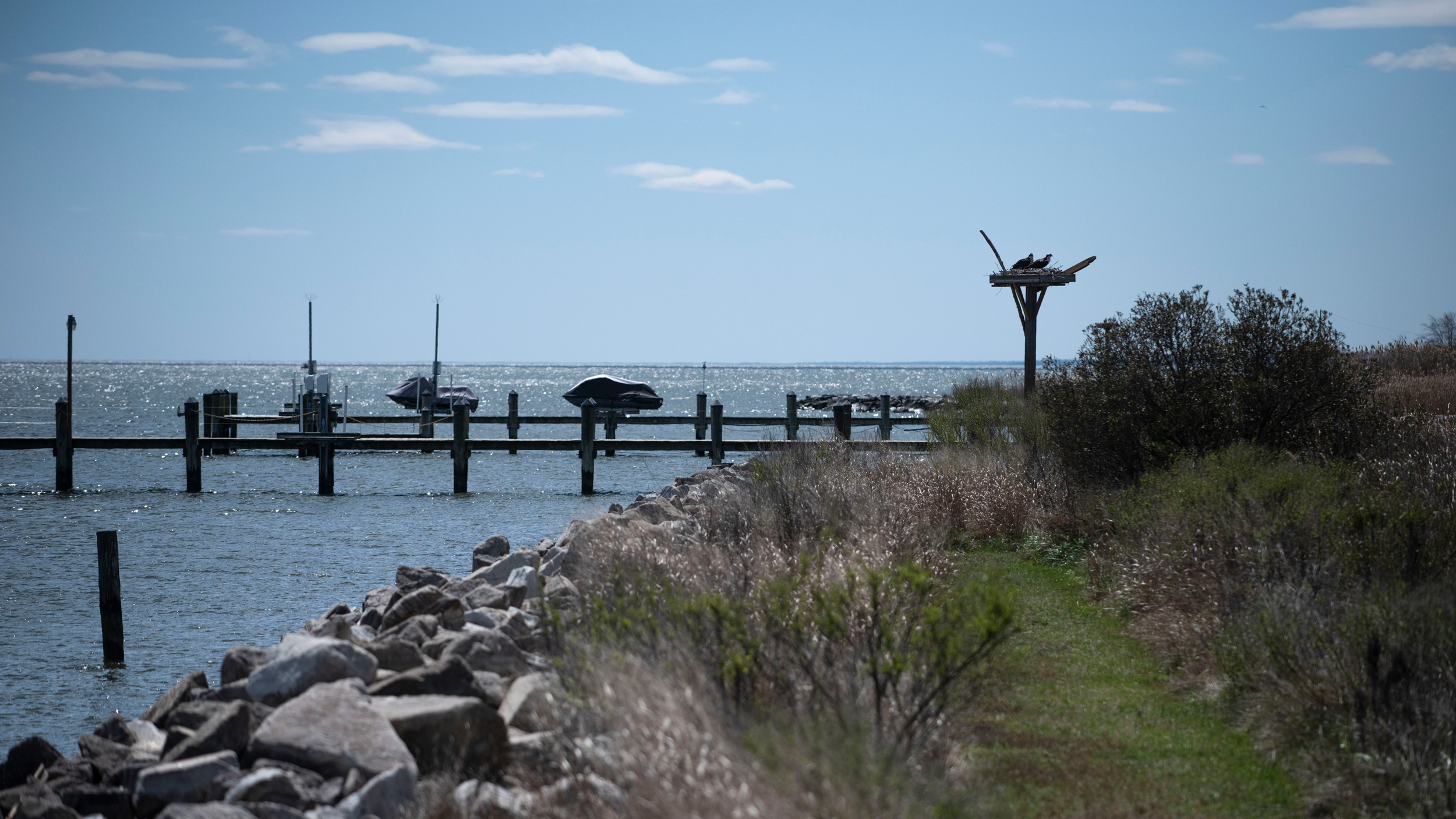
Kearns questioned how fleets equipped with powerful boats, sonar and industrial equipment are managed amid uncertainty over fish population estimates, arguing that commercial interests wield too much influence over fishing decisions.
He acknowledged, however, that the causes of the decline have not been conclusively established and that more data is needed.
After decades of building and monitoring nest platforms, Kearns described the observed osprey decline as “stunning” and “shocking.” Speaking for himself rather than his employer, he warned that commercial fishing pressure could be pushing the bay’s ecosystem toward collapse.
For Will Poston, forage campaign manager at the Chesapeake Bay Foundation, some of the information needed to understand menhaden in the estuary remains out of public reach.
He said there was a single operator in the reduction fishery and confidentiality rules shield key catch records from public scrutiny, although some scientists and managers have had access to them. Menhaden are “a public resource that benefits the entirety of the commonwealth,” he noted.
The Chesapeake Bay Foundation and its partners have repeatedly sought funding for menhaden research in Virginia through legislation and budget amendments. But industry opposition delayed or defeated those efforts, Poston said, until a budget amendment from Gov. Abigail Spanberger in June secured $2 million for the Virginia Institute of Marine Science to carry out comprehensive bay-wide menhaden research in partnership with the Virginia Marine Resources Commission. Though the institute is now developing population studies, he said, getting any answers could take years.
Poston sees warning signs with osprey pairs producing fewer young, smaller menhaden catches among bait fishermen and an industrial reduction fishery falling short of its coastwide quota because there are already too few menhaden in the bay. Conservationists believe this is mainly due to heavy harvesting, but the industry challenges a causal link. Those signals, he argued, warrant reducing harvests even without a precise estimate of how much fish predators need.
“The recourse is the same,” he said. “Remove less menhaden” so more remain in the estuary.
Poston explained that the Chesapeake Bay Reduction Fishery Cap was intended as a precaution against the industry’s expansion within the estuary. First implemented in 2006, the cap was lowered several times in its early years, but has remained at 51,000 metric tons since 2018, despite coastwide limits fluctuating. The commission is now considering another reduction.
While coastwide catch limits draw on stock assessments and ecosystem-based science, he noted, comparable research for the bay remains limited.
He said technical committee projections called for a 39 percent reduction to stay within ecosystem-based management targets.
A Looming Decision
Just as advocates and researchers ponder if the regulators will heed the signs of an ecosystem in crisis because of the menhaden scarcity, Roberta Kellam plans to drive to Rhode Island to attend the Atlantic States Marine Fisheries Commission’s 2026 annual meeting, set for Nov. 9-12.
The commission will vote on whether to cut the Chesapeake Bay cap on the reduction fishery by up to half, and whether to spread that harvest across the season.
Kellam said she’s particularly concerned about this year’s decisions in view of the dwindling osprey population. She’s already sent comments calling for maximum limits to be placed on the menhaden catch coastwide.
According to the Chesapeake Bay Foundation, which supports the largest possible reduction, the commission received 42,000 comments on its proposal.
Dozens of groups partnering with the foundation and “tens of thousands of stakeholders from the public” provided comments supporting stronger measures, Poston said.
Omega Protein told Inside Climate News that it supported “management based on sound science,” but that it did not support further Chesapeake Bay restrictions until more research to inform such decisions had been produced.
The Atlantic states commission will also decide the coastwide menhaden catch limit for 2027 through 2029. The 2026 limit was set at 186,840 metric tons.
In modeled scenarios, the commission’s scientists tested a cut of 50 percent and found it led to a good chance of hitting the fishing target meant to leave enough menhaden for predators.
About This Story
Perhaps you noticed: This story, like all the news we publish, is free to read. That’s because Inside Climate News is a 501c3 nonprofit organization. We do not charge a subscription fee, lock our news behind a paywall, or clutter our website with ads. We make our news on climate and the environment freely available to you and anyone who wants it.
That’s not all. We also share our news for free with scores of other media organizations around the country. Many of them can’t afford to do environmental journalism of their own. We’ve built bureaus from coast to coast to report local stories, collaborate with local newsrooms and co-publish articles so that this vital work is shared as widely as possible.
Two of us launched ICN in 2007. Six years later we earned a Pulitzer Prize for National Reporting, and now we run the oldest and largest dedicated climate newsroom in the nation. We tell the story in all its complexity. We hold polluters accountable. We expose environmental injustice. We debunk misinformation. We scrutinize solutions and inspire action.
Donations from readers like you fund every aspect of what we do. If you don’t already, will you support our ongoing work, our reporting on the biggest crisis facing our planet, and help us reach even more readers in more places?
Please take a moment to make a tax-deductible donation. Every one of them makes a difference.
Thank you,

Reporter, Washington, D.C.
Aman Azhar is a Washington, D.C.-based journalist who covers environmental justice for Inside Climate News with focus on Baltimore-Maryland area. He has previously worked as a broadcast journalist and multimedia producer for the BBC World Service, VOA News and other international news organizations, reporting from London, Islamabad, the United Arab Emirates and New York. He holds a graduate degree in Anthropology of Media from University of London’s School of Oriental and African Studies (SOAS) and an MA in Political Science from the University of the Punjab, and is the recipient of the Chevening scholarship from the UK government and an academic scholarship for graduate studies from the Australian government.

Fisheries Reporter
Johnny Sturgeon is a London-based reporter covering fisheries and aquaculture. Joining us from the Outlaw Ocean Project, he has experience producing in-depth maritime investigations for nonprofit newsrooms. A former boatbuilder, he holds a B.A. in History & Politics from the University of Oxford, and an M.S. from Columbia Journalism School.
