


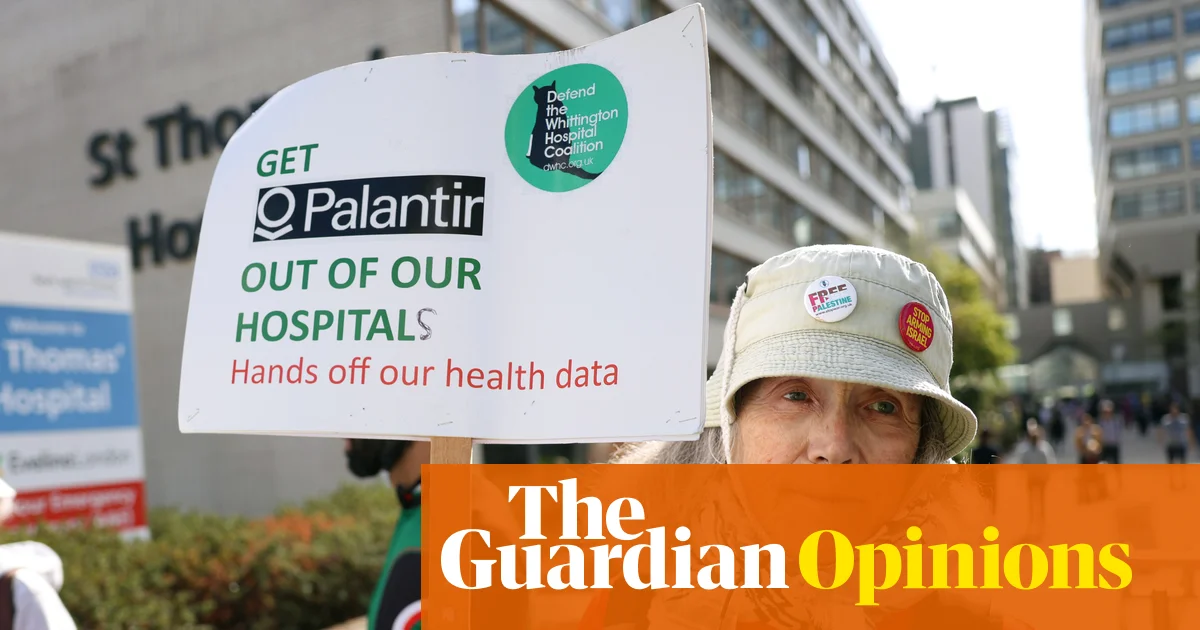
Next March, Palantir’s £330m contract to run NHS England’s federated data platform (FDP) ends. Ministers must decide by Christmas whether to extend it. They should move on from Palantir, and transition to new suppliers that put the NHS in full control of its technology and patient data.
I sit on the health and social care committee. In June, we recommended no extension – people don’t trust Palantir, its benefits are contested and other tools could deliver the same or similar advantages. The debate so far has been whether to drop Palantir. The harder question is what replaces it. The tempting solution is to hire a single British firm. But that would not give the NHS the control it lacks: the freedom to switch supplier without losing what it has built.
Currently, NHS teams build applications on Palantir’s software platform. The NHS owns the applications and rents the platform. The aim is to join up hospital data to manage waiting lists, plan operations and get patients home. We need clarity about what will happen if the Palantir contract ends. How easy would it be to move the applications to another supplier? Will there be disruption that affects patient care?
Ministers assure me the NHS is not locked into Palantir’s service. Local NHS data teams, British tech firms and thinktanks tell me they are not convinced. A ministerial response to the committee in August left questions open. It said the NHS owned, or had a right to use, the applications built on the platform, but that some arrangements would end with the contract. It did not say which. Owning your applications is useless if they won’t work elsewhere.
It also said the government would explore how to move the applications on to a different platform only if the contract ended, and it declined to audit which Palantir tools hospital trusts depend on. Surely ministers need to know this now?
The NHS’s dependence on Palantir worries the national data guardian, too. She told ministers this month that “concerns about interoperability, vendor lock-in and data sovereignty must be addressed”, including by considering open standards. Open standards are shared, published rules for how health information is recorded and labelled, so that software from different suppliers can work together, much as any UK plug fits any UK socket.
In an FDP based on national open standards, regions could choose their own suppliers to build the software they need, from in-house NHS developers to small British firms. Data would stay with each region and be shared only under strict permissions. Suppliers could be swapped without starting again.
Britain has the skills to do this. Nigel Shadbolt, co-founder of the Open Data Institute, told our committee there is “nothing to suggest that the UK lacks the talent or capability to produce an equivalent to what Palantir offers”. For example, Greater Manchester’s integrated care board already runs its own analytics platform, while NHS OneLondon joins up patient records across the capital.
It is not too late to reverse the dependence on Palantir. The Guardian reported recently that 16 trusts and health boards say they do not use the platform. Some tried it and reverted to old systems. The British Medical Journal says a third of signed-up trusts have never logged in and many barely use it. The case for change is about more than avoiding lock-in. A data platform works only if patients trust it, yet mistrust of Palantir means opt-outs are growing.
The FDP’s benefits are also uncertain. Palantir claims a 14% fall in discharge delays, but the Health Foundation has found no noticeable change. Just one trust, Chelsea and Westminster in my constituency, accounts for 84% of the claimed national cut in outpatient waiting lists. Even NHS England now says cause and effect are unproven. I’ve asked its chief executive, Jim Mackey, why it lets Palantir claim otherwise.
A full evaluation is not due until 2029. Mackey told our committee that an independent review now would be “helpful and necessary” but could not be done before the decision.
after newsletter promotion
Then there is sovereignty. Britain needs to be able to build and control its own health tech, including AI, and not leave the NHS dependent on a US company.
Could an open system be ready by March? Probably not. So ministers should agree only a short transition, on new terms, while it is built. That transition should do four things. Freeze new applications on Palantir’s platform. Run it for at most two years, with leaving made easier over time. Publish what the FDP does and costs, which tools trusts depend on and how an exit would work so others can bid. And make Palantir prove there is no lock-in by moving one application off the platform within a year.
Beyond the FDP, the planned single patient record, which will bring each person’s health records together, must be open, too, or it will tie the NHS to a single supplier on a far larger scale.
Data sovereignty means more than keeping health data on British soil. If Britain wants sovereign AI in health, it needs a system it controls. A British Palantir would not give it that. Open standards would.
