


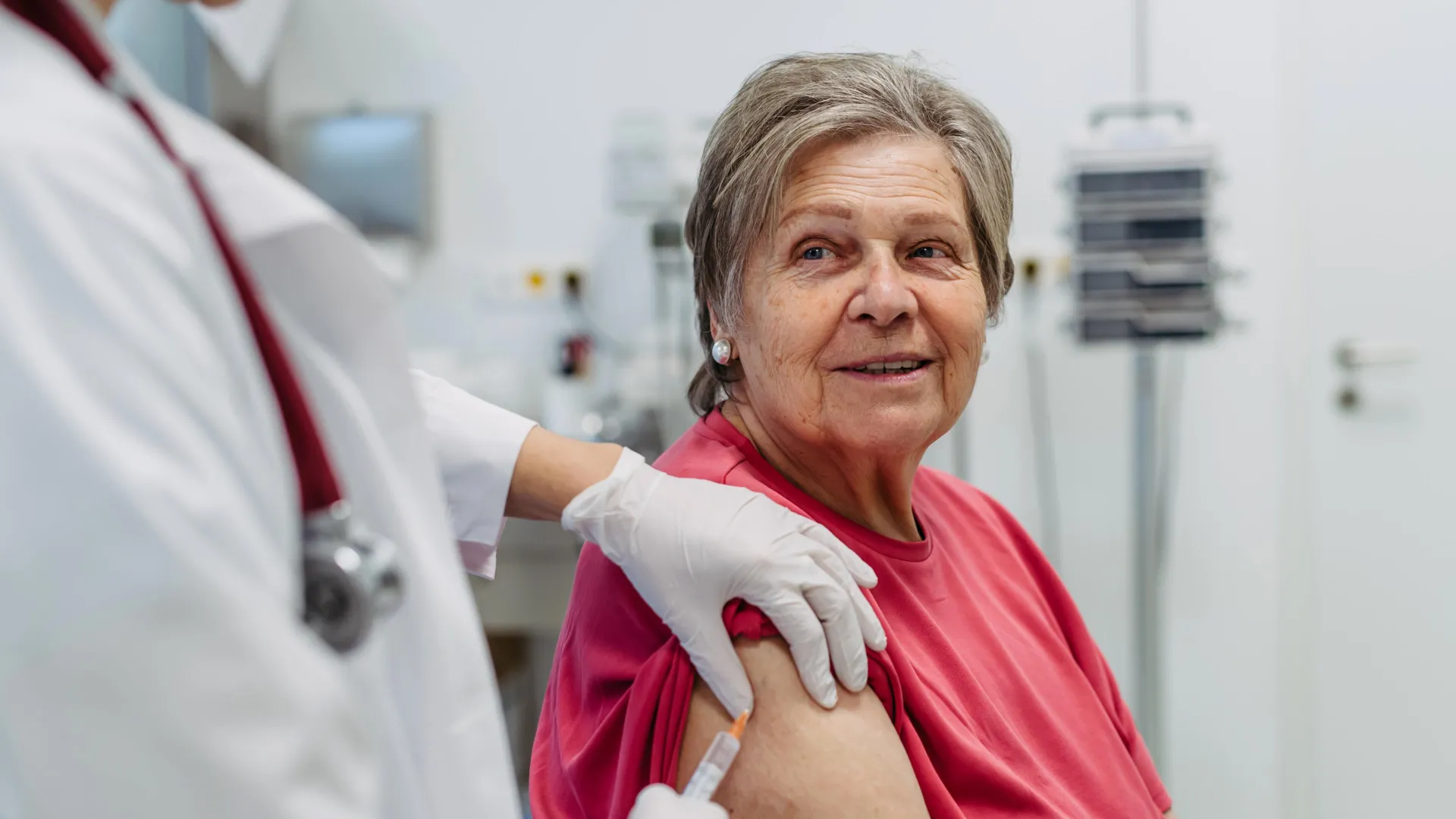
A higher dose of the annual flu vaccine may offer older adults an unexpected benefit: a significantly lower risk of developing Alzheimer’s disease.
In a large study led by researchers at UTHealth Houston, adults ages 65 and older who received a high-dose influenza vaccine were less likely to develop Alzheimer’s than those given the standard-dose version. The findings, published in the medical journal Neurology, suggest that the strength of a flu vaccine could matter for more than just protection against influenza.
The discovery grew out of an unexpected conversation between a UTHealth Houston physician and local public health officials. What began as a visit to discuss earlier vaccine research eventually led scientists to investigate whether different flu vaccine doses might be associated with different levels of Alzheimer’s risk.
A Surprising Connection Between Flu Vaccines and Alzheimer’s
Alzheimer’s disease is the leading cause of dementia and an increasingly serious public health concern. In 2025, more than 7 million Americans ages 65 and older were living with the disease, representing approximately 1 in 9 people in that age group. That figure is projected to more than double by 2050.
Researchers have been exploring whether common vaccines might influence the likelihood of developing Alzheimer’s. In a 2022 study, a team led by Paul Schulz, MD, found that flu vaccination was associated with a reduced risk of Alzheimer’s among adults 65 and older.
Schulz is a professor of neurology at McGovern Medical School at UTHealth Houston and director of the Neurocognitive Disorders Center at UTHealth Houston Neurosciences.
Three years after that earlier investigation, Schulz and his colleagues published new research examining a more specific question: Could receiving a stronger flu vaccine be associated with an even greater reduction in Alzheimer’s risk?
The idea came from public health officials who had learned about the team’s previous findings and invited Schulz to discuss them.
“The public health department had seen our vaccine research and asked if I could come down to talk to them about it,” said Schulz, who is the senior author of the study and the Rick McCord Professor in Neurology and Umphrey Family Professor in Neurodegenerative Diseases at McGovern Medical School. “We went through the findings, and they asked if there was a difference with different dosages; I was confused.”
Why Older Adults Receive Stronger Flu Shots
As people grow older, their immune systems gradually become less effective at recognizing and fighting infections. This age-related decline can make influenza particularly dangerous for seniors.
To help address that vulnerability, the Centers for Disease Control and Prevention (CDC) recommends high-dose influenza vaccines as a preferred option for adults ages 65 and older. These vaccines contain four times as much influenza antigen as standard-dose shots. Antigens are the components of a vaccine that stimulate the immune system to recognize and defend against a virus.
The higher dose is designed to produce a stronger immune response in older adults, whose immune systems may respond less effectively to conventional vaccines.
Schulz had not previously realized that this stronger formulation was available.
“I was stunned that, as a physician, I didn’t know a higher dose was offered,” Schulz said.
Annual flu vaccination is recommended broadly, but preventing influenza is especially important for people with Alzheimer’s disease. Flu infections and their complications can pose serious health risks for individuals already coping with cognitive impairment.
Before 2022, the CDC did not express a preference for one type of injectable influenza vaccine over another for people ages 65 and older. Instead, the guidance emphasized receiving a flu shot every year, regardless of the specific formulation.
Previous research from UTHealth Houston had already linked inactivated influenza vaccines, which use viruses that cannot cause influenza infection, to a 40% lower risk of developing Alzheimer’s disease. However, researchers had not yet determined whether a higher vaccine dose might be associated with additional benefits.
Another practical issue made the question particularly relevant. As the population of older Americans continues to grow, demand for high-dose flu vaccines sometimes exceeds the available supply. Consequently, some seniors receive standard-dose vaccines instead.
This variation gave researchers an opportunity to compare Alzheimer’s outcomes among older adults who had received different formulations.
“So we started looking, and sure enough, we were able to put together thousands and thousands of people over the age of 65 who got the high- or low-dose vaccine. They’re more at risk for Alzheimer’s than anybody else, of course, because it’s age-related and we could look at high-dose versus low-dose and see if there was a difference,” Schulz said.
Nearly 200,000 Adults Reveal a Significant Difference
To investigate the potential connection, the research team analyzed data from nearly 200,000 men and women ages 65 and older.
The results showed that people who received high-dose influenza vaccines had a significantly lower risk of developing Alzheimer’s disease than those who received the standard-dose formulation.
The researchers reported that standard-dose influenza vaccination was associated with a 40% reduction in Alzheimer’s risk, while high-dose vaccination was linked to a reduction of nearly 55%.
The association was particularly pronounced among women, who appeared to experience a greater reduction in Alzheimer’s risk with the stronger vaccine.
These findings add to growing evidence of a possible relationship between influenza vaccination and brain health. They also raise important questions about whether the immune response triggered by vaccination might influence biological processes involved in Alzheimer’s disease.
However, the findings demonstrate an association rather than establishing cause and effect. Additional research is needed to determine whether high-dose flu vaccination directly reduces the likelihood of developing Alzheimer’s and to understand the mechanisms that might explain the connection.
What the Findings Could Mean for Alzheimer’s Prevention
With Alzheimer’s affecting millions of Americans and the number of cases expected to rise sharply in the coming decades, researchers are searching for practical ways to reduce risk.
The possibility that an existing vaccine could have benefits extending beyond influenza prevention is particularly intriguing. Unlike an entirely new treatment, flu vaccination is already widely used, and higher-dose formulations are specifically designed for older adults.
The new findings suggest that vaccine dosage could be an important consideration in future studies exploring the relationship between the immune system and Alzheimer’s disease.
For now, the research provides another reason to investigate the potential benefits of influenza vaccination while emphasizing the need for further studies before drawing conclusions about Alzheimer’s prevention.
Research Team and Study Contributors
Avram Samuel Bukhbinder, MD, a graduate of McGovern Medical School who is currently a clinical fellow in neurology at Massachusetts General Hospital and Harvard University, served as a corresponding author of the study.
Schulz is also a faculty member of The University of Texas MD Anderson Cancer Center UTHealth Houston Graduate School of Biomedical Sciences.
Other contributors from McGovern Medical School included Elizabeth He, visiting scholar in the Department of Neurology; Kristofer Harris, MPH, research coordinator in the Department of Neurology; Mya Rodriguez, graduate research assistant in the Department of Neurology; Kamal Phelps, MD, an alumnus of the Department of Neurology; Jenna Thomas; Gabriela Cruz, MD, resident in the Department of Neurology; and Lauren Jhin.
Researchers from the McWilliams School of Biomedical Informatics at UTHealth Houston also participated. They included Xiaoqian Jiang, PhD, associate vice president for medical AI, chair of the Department of Health Data Science and Artificial Intelligence, and Christopher Sarofim Family Professor in Biomedical Informatics and Bioengineering; Yejin Kim, PhD, assistant professor in the Department of Health Data Science and Artificial Intelligence; Luyao Chen, researcher; and Yaobin Ling, PhD, postdoctoral research fellow.
