


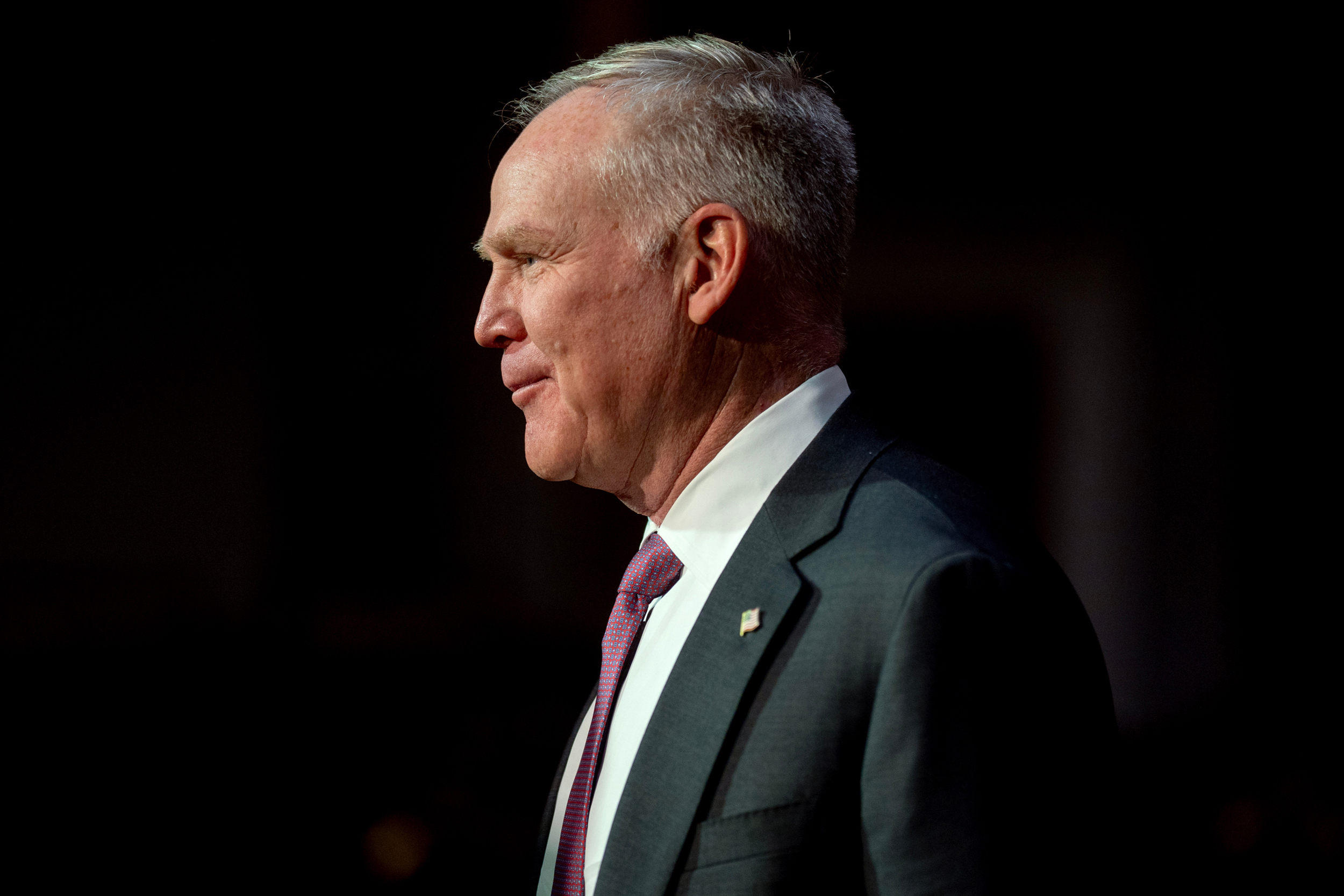
Alan Armstrong of Oklahoma entered the U.S. Senate to fill a vacancy in March with a clear priority: pass permitting reform that he argued was necessary based on his experience leading a major natural gas pipeline company.
Now, as he prepares to leave office, that goal is within reach—with big potential benefits for the company and him personally.
The bipartisan permitting bill slated for a vote next week would overhaul regulations for building all kinds of projects. But it also includes provisions Armstrong promoted that could push through a disputed pipeline that the Williams Companies, his former employer, has tried to build through New York for more than a decade.
When state regulators denied a water quality permit for the Constitution pipeline in 2016, it was a rare rebuke for an industry unaccustomed to having government officials block its projects. Provisions in the new bill would limit New York’s authority to deny it again.
Williams is now asking federal regulators to revive their approval of the pipeline from more than a decade ago.
Armstrong continued to hold at least tens of millions of dollars in Williams stock as of Oct. 22, according to his most recent financial disclosures. He also hired three former Williams colleagues to his staff, one of whom maintained his role as senior vice president and general counsel at the company while temporarily serving as Armstrong’s chief of staff in the Senate.
The Bipartisan American Affordability and Jobs Act would greatly restrict states’ and tribes’ ability to deny or place conditions on water quality certifications. The bill would also make other changes to accelerate approval of Constitution and other pipelines, including restricting judicial review and scaling back certain environmental reviews.
Environmental lawyers say changes to what’s known as a Section 401 certification of the federal Clean Water Act appear tailored to help a small number of gas pipeline projects. One of the companies that would benefit most is Williams, where Armstrong served as chief executive and chairman for 15 years until his appointment in March by Oklahoma’s governor to fill a vacated U.S. Senate seat.
Williams has already received extraordinary support from the Trump administration.
President Donald Trump claimed he made a deal with New York Gov. Kathy Hochul to get the Constitution pipeline built, which she denies. Environmental Protection Agency Administrator Lee Zeldin has pledged support for the pipeline, and his agency is finalizing a rule change that would restrict states’ and tribes’ ability to condition permits in order to safeguard water quality, similar to the permitting bill.
In October, the U.S. Department of Energy said it would devote up to $42 million under the Defense Production Act to pay permitting costs for the project.
Armstrong’s office did not respond to questions for this article, though he has frequently criticized what he calls a broken regulatory system that drives up costs.
“When every pipeline, transmission line, power plant and industrial project is treated as something to stop rather than something to build responsibly, the costs do not disappear,” Armstrong said in a Senate speech in July. “They accumulate slowly, until families are paying more, reliability is deteriorating, and investment is moving elsewhere.”
Williams spokesperson Blake Jackson said the company supports the permitting bill “and all its provisions to provide a tech-neutral and level-playing field for all energy infrastructure.”
Some residents of upstate New York see things differently.
A Threat to State Waters
Anne Marie Garti, a lawyer who owns a home near the Constitution pipeline route, fought the project the first time around. From the start, “there was a huge amount of opposition,” Garti said, “and skepticism.”
The Constitution project would run 125 miles from the Pennsylvania shale gas fields across upstate New York, eventually connecting to other interstate pipelines. The Federal Energy Regulatory Commission, also known as FERC, oversees interstate gas pipelines. But states retain authority under the Clean Water Act, which requires energy companies like Williams to apply for water quality certifications.
Garti called these permits the “weak link” in the regulatory process. Taking inspiration from an earlier permit denial in Connecticut, she and other residents focused their fight on the pipeline’s potential effects on 251 streams along its route. State regulators said 87 of those streams provided trout habitat.
Building the pipeline would require digging trenches across streams, diverting their flow and clearing trees and brush along their banks. The work would send sediment into clear waters, raise temperatures and temporarily damage habitat for trout and other species, according to the New York Department of Environmental Conservation’s 2016 denial.
State regulators rarely reject water quality permits, which are needed not only for pipelines but many federally regulated projects. In a recent survey of 24 states by the Association of Clean Water Administrators, no state reported a denial rate higher than 3.5 percent—most said they’d never denied a permit.
New York denied the certification for Constitution in 2016, saying the company had failed to address the project’s water quality impacts and had not provided sufficient proof that Williams would comply with state standards. The denial kicked off years of legal wrangling. In 2020, Williams said it would not pursue the pipeline and a federal appeals court ruling later vacated the federal permit.
Another permit denial followed in 2019 for a second Williams project: the Northeast Supply Enhancement (NESE) pipeline that would have run from New Jersey across the New York harbor. A few other pipeline proposals in the Northeast and mid-Atlantic faced similar fates, while in some cases regulators imposed conditions to protect waterways.
The bipartisan permitting bill would severely limit states’ ability to impose these restrictions in the future. Currently, states or tribes can consider the full scope of how pipeline construction and operation would affect waterways—for example, how clearing trees could increase erosion on banks, or how contaminated runoff could enter the water.
The permitting bill would limit states to considering only direct discharges when reviewing projects. It would also shift the burden of proof. Instead of requiring pipeline companies and other developers to show their projects would protect water quality, state regulators would have to prove they would cause harm.
Regulators would also face a higher standard of evidence to make their case, and they would have to prove any conditions they impose would be the least burdensome for the company to address water quality concerns.
“This bill moves in the wrong direction,” said Nancy Stoner, a senior attorney at the Environmental Law & Policy Center, a Chicago-based advocacy group. “The provisions in it on the clean water side are all negative.”
Williams revived its applications for the Constitution and NESE pipelines last year. In a reversal, New York and New Jersey approved NESE, but a federal court recently overturned New Jersey’s water quality permit after environmental groups sued. The ruling dealt another setback to Williams’ plans, at least for now.
In an earnings call this week, T. Lane Wilson, senior vice president and general counsel at Williams, said the company would still have its permit if the bill had been in effect when courts reviewed New Jersey’s approval.
Garti, the lawyer who fought the Constitution pipeline, said the water quality provisions in the permitting bill appear aimed at pushing through pipeline approvals for projects in the Northeast.
“They have learned all the arguments that we have made over these past, let’s say, 15 years, and they’re undermining each and every one of them,” Garti said.
Meanwhile, Williams is asking FERC to reinstate its original construction approval for the Constitution pipeline from more than a decade ago and to waive the requirement for a state permit. New York and environmental groups filed lawsuits over those moves, questioning whether FERC can revive an application that a federal court vacated in 2021.
Ken Lovett, a spokesperson for Hochul, said the state is suing to defend its permitting authority, arguing that Williams wants “to circumvent New York’s permitting process.”
An Insider’s Perspective
Armstrong and Williams have pushed for years to make it harder for New York and other states to block pipeline projects.
Last year, when Armstrong was still at Williams and chair of the National Petroleum Council, which advises the Department of Energy, the group published a “permitting blueprint to build.” The recommendations included restricting the conditions under which states could review water quality permits.
In December, Williams was one of two pipeline companies that joined the American Petroleum Institute in a teleconference with officials at the White House and the EPA, which had proposed the rule to limit states’ Clean Water Act authority. Two months later, the company filed comments with the EPA expressing “strong support” for the proposal.
This story is funded by readers like you.
Our nonprofit newsroom provides award-winning climate coverage free of charge and advertising. We rely on donations from readers like you to keep going. Please donate now to support our work.
Williams gained a new connection to Congress in March, when Armstrong was appointed to finish the Senate term of Markwayne Mullin, who was tapped to lead the U.S. Department of Homeland Security.
From the start, Armstrong made permitting reform a top priority. With only months to advance his agenda—Oklahoma law barred Armstrong from seeking a full term—he quickly got to work. He delivered his first Senate floor speech on permitting reform, calling New York’s rejection of the Constitution pipeline a “political veto.”
Armstrong appointed former Williams colleagues to his staff, including two who had worked on government and regulatory affairs. For chief of staff, he tapped Wilson, the senior vice president and general counsel, who had recently celebrated Armstrong’s appointment to the Senate, saying the odds of passing permitting reform “just went way up.”
Despite his new role, Wilson did not leave his position at Williams, according to Jackson, the company spokesperson. Instead, he “altered his responsibilities, management structure and communications to address potential conflicts of interest, including an organizational separation from the Williams Government Affairs & Outreach team and preemptive and ongoing recusal from any meetings between the Williams Government Affairs & Outreach team and Sen. Armstrong or his legislative staff,” Jackson said.
Wilson worked as Armstrong’s top aide from April 13 to July 10. During that time, he declined to draw a salary from Williams, Jackson said, adding that the arrangement was approved by the Senate Select Committee on Ethics. Oklahoma’s other senator, Republican James Lankford, chairs that committee.
In June, Armstrong introduced legislation to reform the federal permitting process. Though the bill never came to a vote, it attracted 20 co-sponsors and some of its provisions made their way into the bipartisan permitting bill.
As a senator, Armstrong has maintained a significant financial stake in Williams. As of March 5, he held more than 2.7 million shares of the company’s stock, worth nearly $200 million at the time, according to a securities filing. Since then, he has sold between $5.5 million and $26 million worth of Williams stock and stock options, according to Senate financial disclosures.
At the time of his appointment, Armstrong reported nearly $69 million in income from Williams, including unvested stock compensation.
When he stepped down as executive chairman to serve in the Senate, Williams’ board elected to grant him the stock awards he would have received had he remained in the position until his expected retirement in July, so that he “would not be financially penalized for his public service.” That concession was worth about $2.8 million at the time.
Senate ethics rules are notoriously forgiving, said Donald Sherman, chief executive of Citizens for Responsibility and Ethics in Washington, a government watchdog. Because Armstrong’s legislation and the permitting bill could benefit entire industries and not Williams uniquely, the senator does not appear to have violated the rules, Sherman said.
But, he added, Armstrong’s role raises particular issues because he was never elected, so voters didn’t have the chance to scrutinize his financial ties.
“The entire premise of the lax ethics regime in the Senate and Congress generally is these people are elected and they file financial disclosures before they are elected. He did neither,” Sherman said. “Just because something isn’t illegal doesn’t mean it’s not corrupt.”
While Armstrong’s office did not reply to Inside Climate News, a spokesperson told the news site Sludge, which reported on his financial ties last month, “Senator Armstrong consulted and complied with all Senate ethics rules during his unexpected transition from private citizen to U.S. Senator.”
Jackson, the Williams spokesperson, said the changes to the water quality permitting process would allow all pipelines and transmission lines “to receive a fair and transparent review process.”
Tyson Slocum, director of the energy program at Public Citizen, a consumer advocacy group, said Armstrong’s role “taints a lot of the negotiations.” While proponents have said the bill would promote renewable energy, Slocum said, “at the end of the day this is a pro-fossil-fuel compromise that gives massive benefits to the oil and gas industry.”
It is unclear whether Armstrong will cast a vote on the permitting bill. Republican Kevin Hern, elected Tuesday to Oklahoma’s U.S. Senate seat, has sought to be sworn in as soon as the election results are certified. The state’s attorney general said the law is behind him.
But the bill is expected to face its first vote next week and Armstrong has said he is intent on holding the seat until then.
“I’ve been kind of the voice with industry, and there’s a lot of conflict with industry,” Armstrong told Tulsa World after the election, adding that the bill was likely to face amendments on the Senate floor. “There’s trade-offs to be made. Getting these amendments done in a way that can hold the coalition together, I can play a very critical role in that.”
About This Story
Perhaps you noticed: This story, like all the news we publish, is free to read. That’s because Inside Climate News is a 501c3 nonprofit organization. We do not charge a subscription fee, lock our news behind a paywall, or clutter our website with ads. We make our news on climate and the environment freely available to you and anyone who wants it.
That’s not all. We also share our news for free with scores of other media organizations around the country. Many of them can’t afford to do environmental journalism of their own. We’ve built bureaus from coast to coast to report local stories, collaborate with local newsrooms and co-publish articles so that this vital work is shared as widely as possible.
Two of us launched ICN in 2007. Six years later we earned a Pulitzer Prize for National Reporting, and now we run the oldest and largest dedicated climate newsroom in the nation. We tell the story in all its complexity. We hold polluters accountable. We expose environmental injustice. We debunk misinformation. We scrutinize solutions and inspire action.
Donations from readers like you fund every aspect of what we do. If you don’t already, will you support our ongoing work, our reporting on the biggest crisis facing our planet, and help us reach even more readers in more places?
Please take a moment to make a tax-deductible donation. Every one of them makes a difference.
Thank you,

Reporter, New York

Reporter, New York City
Lauren Dalban is a New York City-based reporter with a background in local journalism. A former ICN fellow, she now covers environmental issues in all five boroughs. Originally from London, she earned a B.A. in History and English from the University of Virginia, and an M.S. from Columbia Graduate School of Journalism.
