


Wild Horse Nine, the latest feature from Oscar-winning British Irish director Martin McDonagh, opens in Santiago, Chile. It’s 1973, shortly before the U.S.-backed military coup that would oust socialist President Salvador Allende. The CIA, which had spent years watering the seeds of discontent with Allende that would blossom into betrayal, is cautiously optimistic about the operation’s outcome.
Everything has been set into motion—the generals paid, the soldiers armed, the soccer stadiums prepared to host thousands of prisoners—and so the only thing left for the two protagonists, CIA agents Chris (John Malkovich) and Lee (Sam Rockwell), is to take a well-earned vacation until the whole thing has blown over. For that, they are off to Easter Island, where Chris wants to “see the big heads.”
Chris and Lee are agency veterans—with Chris, at least, having been involved in some of the century’s most high-profile coups. “Guatemala, successful. Congo, successful. Bay of Pigs, less successful,” he rattles off. The Chilean plot is just another day at the office, and jokes are frequently made in this vein. Lee is so cold-blooded that he can kill a man while still eating a sandwich; Chris has killed people in countries Lee “can’t even spell.” As sparring buddies and partners, Rockwell and Malkovich are a potent duo with undeniable chemistry. Their characters have seen terrible things but still have a sense of humor, even if that humor has become darker from lives spent in the shadows.
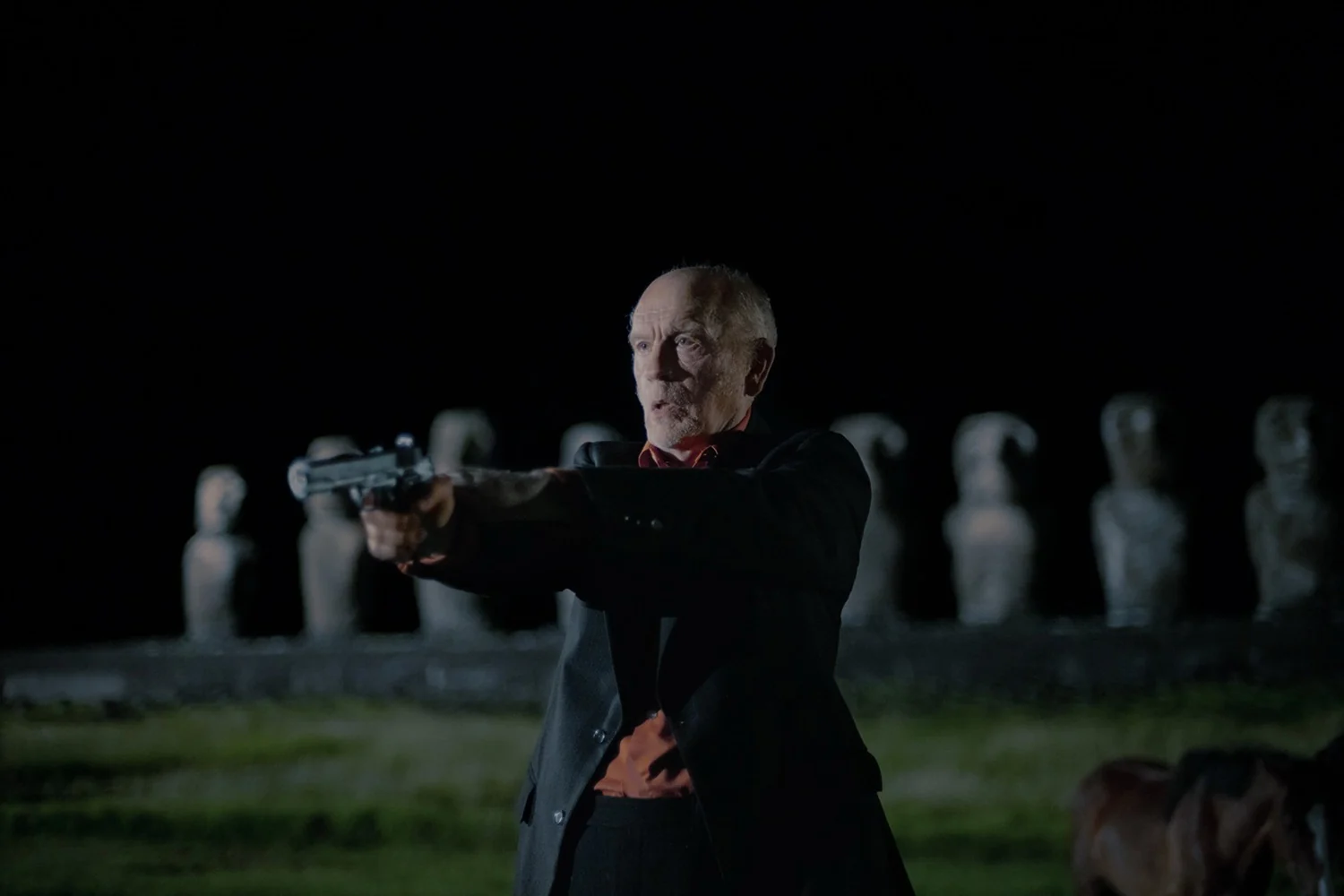
Chris, however, is dying of cancer and has begun to feel pangs of guilt over his involvement in some of these covert operations. On Easter Island, he has nothing but time to wrestle with his regrets. He wonders whether horses, moths, or even Nazis make it to heaven. Lee assures him that he will get in, since he’s at least better than a Nazi, but neither man sounds convinced. As the pair visit the moai (those big heads), the audience is treated to long shots of rolling hills, steep cliffs, the deep cerulean of the Pacific, and herds of galloping wild horses. The island is small and remote. As a location for spiritual rumination, you couldn’t ask for a better purgatory.
Sam Rockwell and Malkovich in a still from Wild Horse Nine.Searchlight Pictures
Wild Horse Nine is replete with callbacks to McDonagh’s 2008 film, In Bruges, which also starred two mismatched killers philosophizing about sin. These references are undoubtedly a bit of fan service, and they underscore the new film’s ultimate weakness. In Bruges hinged on a smaller-scale crime, the killing of a child, which forced its protagonists to grapple with the immediate, tragic consequences of their actions in a way that is largely absent from a film about toppling a far-off democratically elected government. Wild Horse Nine spends scant time in mainland Chile, which further removes viewers—and our protagonists—from the extraordinary violence and the swift, ruthless consolidation of power under Gen. Augusto Pinochet. Wild Horse Nine mostly speaks in broad language: marching soldiers, menacing black cars, the skin-tingle of surveillance.
The film’s distance from and looseness with its historical context affords its protagonists more leeway to discuss abstract questions of regret, redemption, and human connection—matters that benefit from being set at a remove from everyday life. Yet in doing so, McDonagh squanders the opportunity to consider what made the 1973 coup—and the U.S. government’s involvement in it—so tragic. Though not as hands-on by the time of Allende’s downfall, the United States was no less instrumental in destabilizing his administration. From earlier efforts in the 1960s up to the day of the takeover itself, successive U.S. presidents funded propaganda campaigns to prevent his election, attempted to foment a military coup to block his ascent, and then spent years impeding Allende’s ability to govern.
History buffs may know that U.S. National Security Advisor Henry Kissinger played a central role in Allende’s downfall, yet he is never mentioned in the film—nor is anyone else who was involved. Among President Richard Nixon’s most vocal Chile hawks, Kissinger spoke about the country with a callousness that would have made Chris blush. “I don’t see why we need to stand by and watch a country go communist due to the irresponsibility of its own people,” he said in June 1970, as he approved hundreds of thousands of dollars in funding to prevent Allende’s election. After Allende won, the CIA attempted to block him from taking office, leading to the assassination of Chilean Gen. René Schneider in a botched kidnapping attempt.
The effort to block Allende’s rise in 1970 was not the CIA’s first operation against him. Covert action began in 1962, with funding for anti-Allende operations totaling some $3 million by the time of Chile’s 1964 presidential election. After the CIA’s failed 1970 mission, the agency diligently spent three years funding right-wing agitators, such as the El Mercurio newspaper, while outwardly maintaining a “very cool and very correct” posture toward the Allende administration, as Nixon instructed his aides in November 1970.
Concurrently, the United States enacted a sweeping “invisible” blockade against Chile that severely repressed trade and financial aid to the country (the Chilean military excluded), hamstringing Allende’s ability to enact his economic agenda. This was all straightforwardly anti-democratic, which Nixon officials acknowledged. But it was also understood that a successful Allende administration would be a bad look for Washington, politically speaking, and so should be prevented at all costs.
For a film styling itself as a black comedy, the CIA’s handling of its operations in Chile is a rich vein. So why exclude, well, all of it? With few onscreen details of the coup at hand, viewers are left to trust Chris, whose paranoid ramblings and memory lapses suggest he is either succumbing to the gravity of his past transgressions or suffering from dementia.
Chris lectures the leftist college students he has befriended, Monica (Mariana di Girolamo) and Alicia (Ailín Salas), on the impotence of street protest, and later monologues to Monica about what to do if she wants to stop the ascent of fascists and dictators. The latter scene is powerful, and di Girolamo delivers an incredible performance as an idealist who must reckon with the ugliness of the world. Monica grounds Chris: “She’s life, and I’m leaving it,” he says to Lee. Drawn to her youth and hope, Chris is reluctant to disabuse her of her optimistic beliefs but does so anyway, perhaps to prepare her for what’s ahead.
At one point, Chris says he wishes he had spent more time reading about the history of the places where he’s worked before arriving, a nod to CIA agents’ documented misunderstanding of the environments, cultures, and societies they upended. This could have built into a deeper, sustained introspection about Chris’s role in inflicting immense violence at the behest of the U.S. government. But a stronger current pulls against this meditation: the assassination of President John F. Kennedy.

Steve Buscemi in a still from Wild Horse Nine.Searchlight Pictures
Almost immediately after Kennedy’s death in November 1963, conspiracies around his assassination mushroomed. The U.S. government, and the CIA in particular, did not help matters: The agency obstructed investigations and withheld information about the event and its aftermath, fueling the spread of such theories to this day.
It is suggested early and often in Wild Horse Nine that Chris played a crucial role in the assassination, though he is reluctant to talk about it at length. It is also one of the only missions he seems to feel no remorse over—perhaps because Kennedy, like Chris, played a central role in perpetuating the foreign interventionism and violence that Chris has come to regret.
Who killed Kennedy, and how, ultimately becomes a bigger narrative question in the film than anything to do with Allende or Chile—and that’s a shame. There is an effort at moralizing here, and Chris seems to realize his life wasn’t best spent toppling fragile democracies. But centering the Kennedy conspiracy ultimately dilutes the film’s moral clarity. Instead of reckoning with the CIA’s involvement in Chile and elsewhere and the mass suffering that resulted, the audience is served a superficial story about the CIA as a tentacle of the deep state. Chris cannot shake the Kennedy plot, and neither can the film disentangle itself long enough to let us sit with the seriousness of his actions.
As with In Bruges, McDonagh is clearly fixated on a Catholic kind of guilt, one from a conscience suddenly alight with remorse as death approaches. But where that film kept a narrow moral focus and interrogated that guilt rigorously, Wild Horse Nine spreads itself too thin trying to take on institutional ethical failure. Like our protagonists waiting on Easter Island for the coup to play out in Santiago, we as viewers spend much of the film in a bucolic liminal space waiting—for judgment, for an opportunity to absolve ourselves. Of what we need to be cleansed, though, is something McDonagh doesn’t cleanly answer.
History has an answer, and a well-documented one. The film keeps turning away from it, toward a conspiracy that is far easier to accept. I enjoyed the twists and turns, and Rockwell and Malkovich make the wait a pleasure, but I couldn’t help feeling that the film could have viewed this episode in history with clearer eyes, less clouded by the fantasies of conspiracists, no matter how satisfying and easy their answers may be.
