


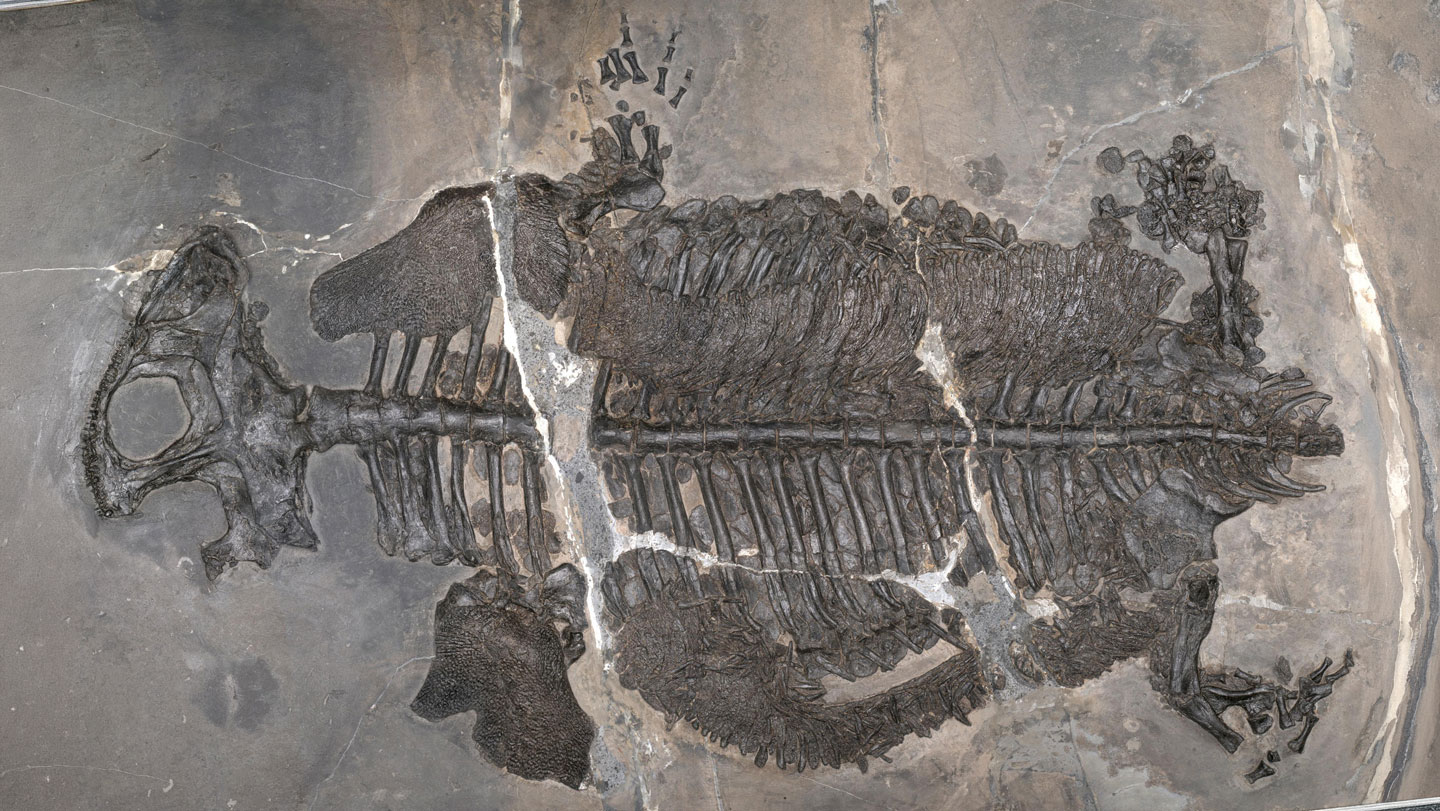
Most amphibians shrivel or suffocate in saltwater. But long ago, an oddball armored amphibian may have dwelled deep in the ocean.
Scientists have found evidence that an ancient amphibian with a flattened body and upturned eyes may have once stalked the seafloor. The animal, Gerrothorax maritimus, is the first ever amphibian known to have lived without access to land or freshwater, researchers report October 26 in Nature Ecology & Evolution.
G. maritimus, which lived 237 million years ago, was rather unlike today’s amphibians, which breathe and drink through their porous skin. The creature’s lifestyle was unimaginable for an amphibian, says Ryosuke Motani, a paleobiologist at the University of California, Davis. Of the more than 8,000 amphibians known today, none live solely in saltwater.
Motani and his colleagues inspected two well-preserved G. maritimus fossils from the late Triassic Period, which spanned roughly 237 million to 201 million years ago. Each creature measured around 70 centimeters, about as long as a skateboard, and was swathed in armor made of bony plates. The specimens appeared nearly identical to their closest relatives, other amphibians that dwelled in freshwater, Motani says. But the fossils’ location was unusual: They were found in what was once a seabed, roughly 30 kilometers from any ancient land.
It wasn’t clear whether the creatures lived in the ocean or were landlubbers that got buried there after they perished. So the team performed a chemical analysis. Levels of different forms of strontium in the fossil bones matched those of the Triassic ocean. This telltale sign revealed that G. maritimus ate seafood and drank seawater. “That means it lived there,” Motani says.
For amphibians, “this is the first time that that we have hard evidence that they were actually adapted for long-term life in the sea,” says Lachlan Hart, a paleobiologist at the University of New South Wales in Sydney who was not involved with the new study. Hart and his colleagues previously suggested that a different ancient amphibian may have been seafaring but probably did not dwell in the ocean.
Scientists have long searched for a marine amphibian. The fossil record is littered with skeletal fragments revealing how some mammals, reptiles and birds have adapted to a salty lifestyle. “Amphibians were always the problem because they did not really follow the rule,” Motani says.
The same skin that makes today’s amphibians vulnerable to disease and toxins also makes saltwater fearsome. Key adaptations allowed G. maritimus to skirt these issues. G. maritimus and its relatives evolved bony body armor, probably for defense. But these hard plates would have helped the seafloor dwellers prevent water loss. And unlike modern amphibians, which typically lose their internal gills after the larval stage, this creature and its close relatives retained a fishy breathing strategy suitable for life in the depths.
G. maritimus fossils hint that the animal lurked on the seafloor as an ambush predator. Its jaw lifted upward like a toilet seat so that it could unleash a suction attack on fish and other small creatures.
There may yet be other amphibians hiding in ancient oceans, environments ignored by paleontologists studying these creatures. “Because they’re amphibians, we would be looking for them in terrestrial freshwater environments,” Hart says. Perhaps there are more amphibians that have gotten their sea legs.
