


“If we want to reduce pollution, we need to set targets for every sector – including power generation, industry and transport – not just vehicle entry, construction and stubble burning,” says Manoj Kumar, an analyst at the Centre for Research on Energy and Clean Air.
“We know how much each sector and each state contributes to pollution. We can set targets to reduce emissions from each of them over the next five years.”
Bosu points out that an issue which does not get enough attention is secondary pollutants – when gases in the air react with sunlight, water vapour and other substances to form harmful particles that contribute to pollution.
“Pollution is not just caused by biomass burning or vehicles,” he says. “Dust being stirred up from the ground, coal and fly ash, materials burned at brick kilns and the large-scale burning of urban waste are also contributing to the problem. And much of this is still not being stopped.”
Delhi’s pollution problem is also affected by what happens outside the city. Pollutants travel into Delhi from neighbouring states and other parts of northern India, worsening the situation, Bosu explains.
This means that measures taken by Delhi can achieve only so much. Tackling the problem requires neighbouring states and the wider northern region to work together, he adds.
In the meantime, pollution is harming people’s health every day.
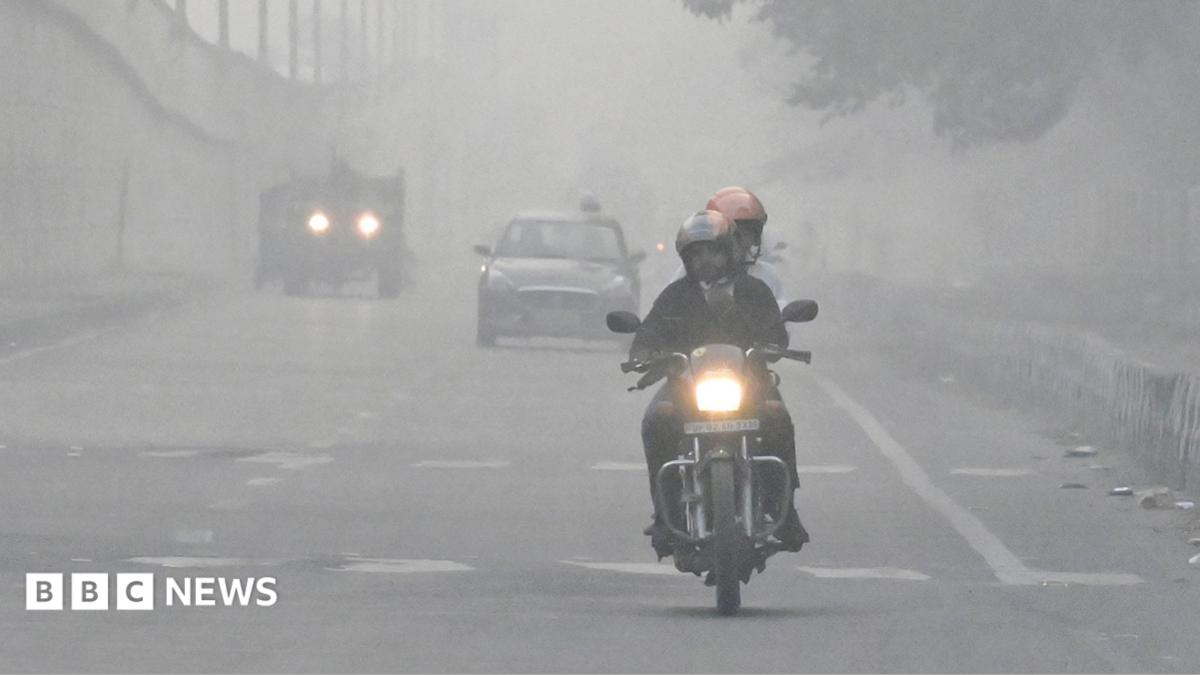
During winter, government monitoring stations in Delhi frequently record Air Quality Index (AQI) readings above 300, classified as “very poor”.
On particularly bad days, readings can reach 500, the highest point on India’s scale. That does not mean pollution cannot rise further, only that domestic trackers do not record it. International trackers such as Swiss-based IQAir have recorded readings close to 1,000 on some days.
The World Health Organization recommends average PM2.5 levels over 24 hours should not exceed 15 micrograms per cubic metre. In Delhi, levels are often at more than 25 times that limit during pollution season.
Dr Manoj Goel, pulmonology unit head at Fortis Memorial Research Institute near Delhi, says these tiny particles “can penetrate deep into the lungs and enter the bloodstream, triggering inflammation and affecting multiple organs”.
Even short-term exposure can cause throat irritation, coughing, wheezing and breathlessness. It can also worsen existing heart and lung conditions.
A 2025 report, external by the Energy Policy Institute at the University of Chicago estimated that air pollution could reduce life expectancy in Delhi by up to 8.2 years.
