


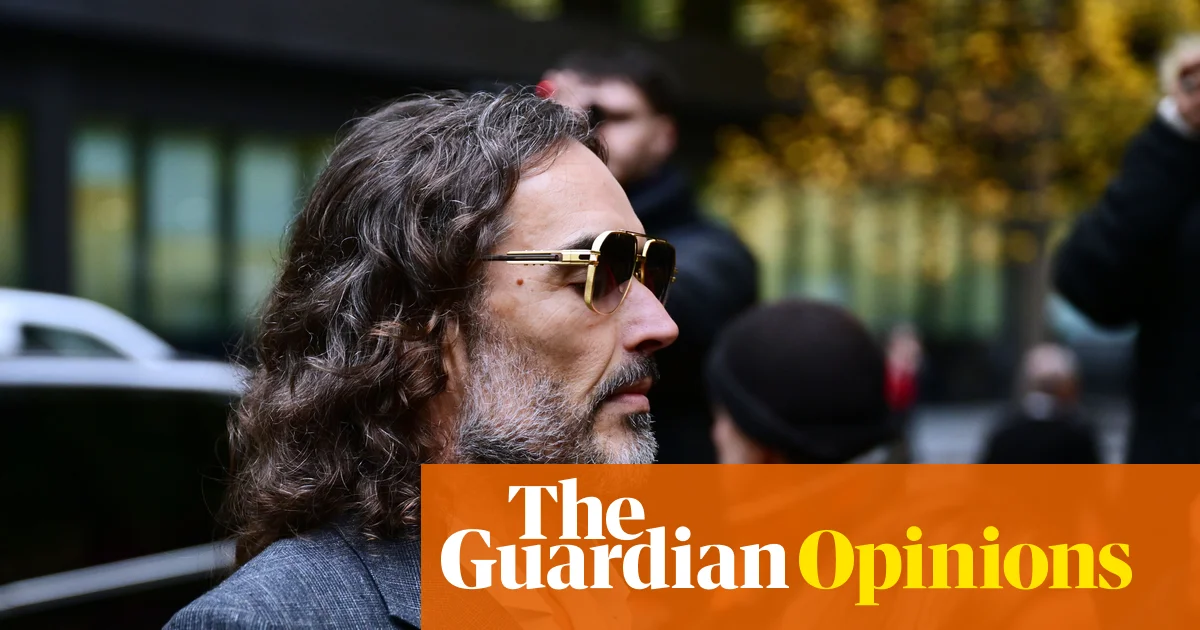
With all the sanctimony a born-again Christian rapist can muster, Russell Brand paused on his way into court last week to address reporters. Britain was, he told them piously, “blessed” to have a legal system capable of accommodating truth and justice. Well, amen to that: the former comedian learned today that he will now serve a substantial jail sentence, after being convicted of one count of rape and three counts of sexual assault, in what looks like a genuinely landmark victory for the understanding of consent.
Back in the days when comedy was the new rock’n’roll, and he would casually cherrypick girls from the crowd at his gigs, Brand could surely have had all the willing sex he wanted. Yet he seemingly got his kicks from the unwilling, who were forced over boundaries they did not want to cross. “You’re dirty and I wanna push you further,” he texted one victim, months after raping her anally and callously saving her number in his phone under T for “Tart”. The woman – who was in her early 20s when she first gave him oral sex backstage after a gig, and had gone a few days later to his house for what began as consensual sex but soon became something very different – responded angrily via text that he’d treated her “like an animal”.
For too long, cases involving young women alleging rape after going initially willingly to the bedrooms of rich or famous men have ended in sour, uneasy acquittals. Well, not any more. This verdict upholds the vital principle that consent to one thing is not consent to absolutely everything; that women still absolutely have the right to say no, even if they have in the past said yes.
Not all of his six accusers – strangers to each other, until this case brought them together in the most wretched of circumstances – got the verdict they wanted. The jury acquitted Brand of two further counts of rape and one of attempted indecent assault. But in the court of public opinion, there will be little mercy for Brand, nor perhaps for the industry that for too long sheltered and indulged him. After his conviction, the police revealed that he is under investigation for two further rape allegations.
How did he get away with it for so long? In exactly the same way as all the other celebrities you have seen belatedly exposed, along with some you haven’t yet: expensive lawyers, corporate tolerance for the excesses of men making big money, the misplaced shame of women worrying that somehow it might have been their fault, and toxic workplaces where junior women knew it was pointless even complaining.
Several of his victims worked in the media in the 2000s, and I remember that era well. The nagging fear wasn’t just that you might not be believed if you complained of sexual harassment, but that you might be, and that then it would be you rather than him who got sacked. One victim, groped in front of four of Brand’s entourage of hangers-on, said none intervened to help her; instead one started laughing, as if to break the tension. I knew precisely what she meant when she explained that she hadn’t reported it to her boss because it was the sort of workplace where they rated the women on how they looked.
His former PA, Helen Berger, told the court he would interrupt work on a deadline to ask if he could “go and have sex now”, like a spoilt child whining for an iPad; yet his behaviour was normalised and dismissed by everyone around him. Think about that when the usual suspects are complaining, as they invariably do, about new laws that came into force at the end of October requiring employers to take all reasonable steps to protect staff from sexual harassment, both by colleagues and clients of the business. That change in the law didn’t just fall out of the sky: it’s the result of years of bitter female experience of just how little some employers care.
As the BBC’s Lorraine Heggessey once said of Brand, his transgressions were always followed by promotion. The outrage he created was the very thing that mainstream media, desperate to seem more louche and edgy, craved: the more he pushed the boundaries, the more he seemed to be professionally in demand, even as he spun obviously out of control.
At the height of a raging heroin addiction, he was sacked by MTV after arriving at work in the aftermath of 9/11 dressed as Osama bin Laden, accompanied by his drug dealer. Hired instead by XFM, he was promptly fired again, this time for reading porn on air. After getting sober, he went on to present Channel 4’s Big Brother spinoff shows, write a football blog for this very newspaper, and present a show for staid old Radio 2 – from which he had to resign after he and his co-star Jonathan Ross made crude prank calls to the actor Andrew Sachs.
When his luck ran out with the mainstream media, Brand simply reinvented himself as a radical-left guru on YouTube, where people who should have known better still paid homage. (Ed Miliband, who as Labour leader went on Brand’s show in 2015, has since stressed that he wouldn’t have done so if he’d known about the rape allegations.)
after newsletter promotion
Even after Channel 4’s Dispatches aired Russell Brand: In Plain Sight in the autumn of 2023, he moved to Florida and found a new niche on the Maga circuit, seemingly discovering both religion and a range of populist conspiracy theories. Did all those resurrections make him feel untouchable? Only towards the very end of the trial, in a rambling appearance in the dock where he begged the jury’s forgiveness for what he called “reckless philandering” did something seemingly start to unravel.
In court, one of his victims said of being raped by him that, because they had previously had consensual sex, “I didn’t feel I had as much right to feel as bad about it as I did.” Now a jury of her peers has given her that precious right back, along with so many other women down the years who will recognise the feeling she describes. If Russell Brand’s world felt like to him one delightful “amusement park of orgasms”, as he once said, for too many women it must have been more like being trapped in a fairground house of horrors. Now, at last, a jury has set them free.
-
Gaby Hinsliff is a Guardian columnist
-
Information and support for anyone affected by rape or sexual abuse issues is available from the following organisations. In the UK, Rape Crisis offers support on 0808 802 9999 in England and Wales, 0808 801 0302 in Scotland, or 0800 0246 991 in Northern Ireland. In the US, Rainn offers support on 800-656-4673. In Australia, support is available at 1800Respect (1800 737 732). Other international helplines can be found at ibiblio.org/rcip/internl.html
-
Do you have an opinion on the issues raised in this article? If you would like to submit a response of up to 300 words by email to be considered for publication in our letters section, please click here.
