


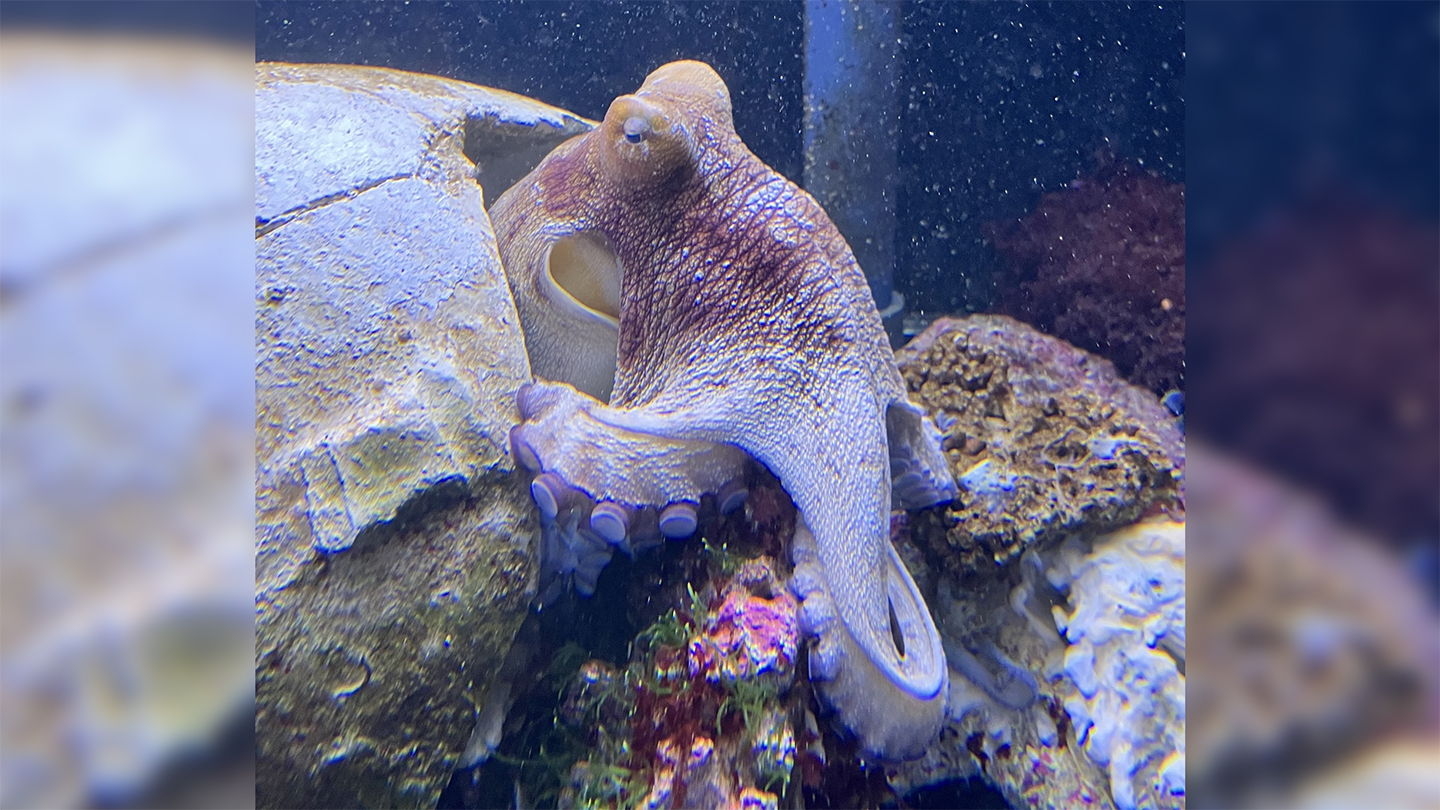
Octopuses have made many a great escape. Remember Inky, who fled from New Zealand’s national aquarium?
The cephalopods can Houdini their way out of tanks and off boats by squeezing through narrow slits and incredibly tiny holes. Now researchers know exactly how some octopuses pull it off. These masterful getaways involve a consistent, step-by-step game plan, researchers report November 5 in the Journal of Experimental Biology.
Octopuses are mostly squishy muscle, allowing them to shape-shift, though they do have some rigid body parts. Not many scientists have studied how these animals squirm through small openings, says Robyn Crook, an evolutionary biologist at San Francisco State University who was not involved in the research. “It’s one of the most characteristic behaviors of octopuses in popular awareness, but the strategies octopuses use have not really been examined systematically.”
Sneaking through small spaces isn’t just a party trick for octopuses, says Michael Kuba, a biologist at the University of Naples Federico II in Italy. The animals use that skill to find hidden food and to avoid becoming food themselves.
Kuba and his colleagues observed how three common octopuses (Octopus vulgaris) and four Mayan octopuses (Octopus maya) approached small holes. For each individual, the team measured the distance between the octopus’s eyes as an indicator of the size of their most rigid cartilage around their brain. Then the researchers designed acrylic boxes with holes that were slightly smaller or larger than that eye-to-eye measurement. They plopped the octopuses inside and watched what happened.
Common octopuses used one of two escape strategies depending on the hole’s size. When the hole was wider than the distance between their eyes, the octopuses pushed themselves through it in three steps. First, they snuck one or two arms through the hole and then threaded a couple more arms through. Finally, they used the arms that they had already snaked through the hole to push against the box and yank their head and the rest of their arms through in one fell swoop. The whole operation took a few seconds.
When the hole was narrower, common octopuses added a fourth step. They shoved all of their arms through the hole first and then squished their head and bulbous mantle through.
Mayan octopuses behaved more cautiously than the common octopuses. When confronted with the narrower hole, Mayan octopuses didn’t even attempt to fit inside of it. They usually ignored it. This difference between the species could stem from their biology or how they’ve adapted to their environments, Kuba says. Mayan octopuses live in sandy, rocky areas, so while they might disappear under rocks, they don’t often need to cram through holes, he says.
The team hopes these escape artists will inspire new soft robots that can morph their shape to fit through tiny spaces, says Wenci Xin, a robotics researcher at the National University of Singapore. “This incredible capability could enable robots to overcome environmental limitations and enter spaces that are difficult to reach.”
Studying how octopuses navigate different types of holes may provide additional clues for robots, Crook says. For instance, the cephalopods may take a different tack for openings that are more like slits or tubes than holes.
Currently, robots built to fit through tiny holes tend to be snake-shaped, but further research on these eight-armed contortionists could unlock other configurations.
