


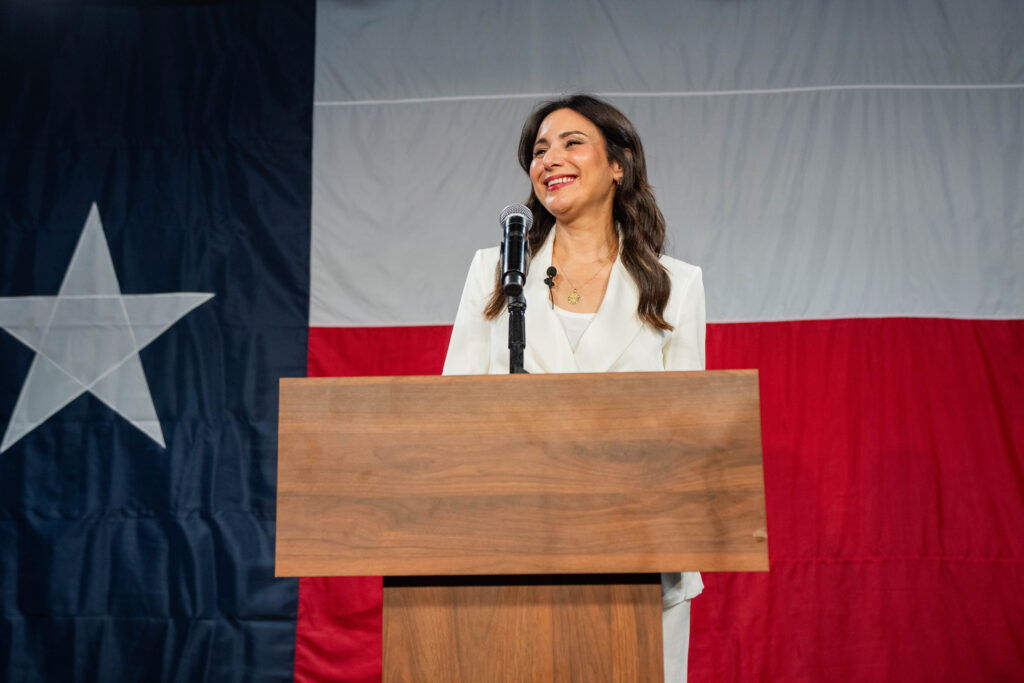
Democrats’ historic sweep of Texas on Tuesday raises new possibilities of environmental reform after more than 30 years of Republican rule in the home of the nation’s oil and gas industry.
That includes opportunities to cement safeguards for data center development, lower energy costs and, over time, appoint new commissioners to the state’s regulatory agencies and boost environmentally protective standards.
“We have a generational shift in leadership here,” said Adrian Shelley, state director of Public Citizen, a consumer advocacy group. “I think there’s going to be a real appetite for reform.”
Both the U.S. Senate and governor races were called before midnight Central Time, quickly crushing the longheld skepticism of the potential of a Democrat-led Texas. Democrats also took the House in the state Legislature.
The blue wave in Texas resulted, in part, from an upswell of public outrage over the state’s booming buildout of data centers for artificial intelligence that are gobbling massive amounts of electricity and failing to disclose their water use, experts said Wednesday. When the Democratic administration takes office in January, data centers will sit at the center of its political crosshairs.
“The new state leadership has a clear mandate to rein in the data center industry,” Shelley said. “I think the days of Texas being unequivocally open for business are over.”
Gina Hinojosa, a Democratic state representative who was largely unknown earlier this year, unseated three-term Republican Gov. Greg Abbott, who was backed by some of the richest and most powerful forces across the country.
Hinojosa will be the first Hispanic politician to lead the state, where Latinos make up the largest population, and will preside over the second-largest state economy in the country, after California.
The victory of James Talarico against Attorney General Ken Paxton ends decades of Republican rule in the U.S. Senate, with the last Democratic senator elected in 1988. It was also the most expensive Senate race in history, with the richest man on earth, Elon Musk, contributing more than $160 million to secure Paxton’s victory.
Democrat Jon Rosenthal defeated a former Tarrant County GOP chair with a storied record of extremism, Bo French, for one of three seats at the state’s oil and gas regulator, the Railroad Commission.
“Pretty much everyone who won the statewide level is a champ on the environment,” said Luke Metzger, executive director of Environment Texas. “That’s really exciting.”
Midterm Shift Signals Big Risk for Data Centers in Texas
Hinojosa’s election has panicked the data center industry over its future in one of the largest markets in the U.S. While Abbott switched from issuing an enthusiastic invitation for data centers to invest and develop in Texas to a list of stringent directives, Hinojosa has campaigned on calling an immediate moratorium on new data centers.
Voters clearly want the data center industry to be held accountable, said the Lone Star Chapter of the Sierra Club’s legislative director, Cyrus Reed.
“For a long time, they’ve had not only a seat at the table, they’ve actually been creating the table with some of the laws that have been passed,” Reed said.
Hinojosa’s election signals a significant shift in Texas’ data center policies, global analysis firm Wood Mackenzie said Wednesday.
Even so, the state will remain a leading market for data center investments, given its renewable resources, natural gas infrastructure and regulatory autonomy from the Federal Energy Regulatory Commission, Wood Mackenzie added.
Jess Heck, the director of Texas government affairs for the Data Center Coalition, the industry’s largest trade group, said its members will continue to engage with residents and local leaders to understand community priorities and ensure the growth of digital infrastructure delivers clear benefits for Texans.
“Enhancing affordability, creating jobs, and keeping the state’s economy strong are top priorities for Texans,” Heck said in a statement to Inside Climate News. “Data centers can continue to play a crucial role in advancing those priorities by bringing investment to local communities and generating critical tax revenue to support local governments and school districts across the state.”
The Dallas-Fort Worth region has the largest concentration of data centers in the state. The most rapid expansion of the industry is in Ellis County, some 30 minutes south of downtown Dallas.
On Election Day, Lacey Hamel, 39, and Jazmin Villegas, 44, stood outside the Red Oak Municipal Center waving at voters driving in and out of the building’s lot. The two wore bright yellow shirts that said, “No More Data Centers.” They’re members of Save Our Red Oak, a group tracking and trying to slow down the expansion of data centers across seven campuses in the city.
As in other rural Texas counties with swaths of land, data centers emerged as a critical issue for the election in Red Oak.
Members of the Red Oak group had asked Abbott to call a special legislative session over the industry’s rapid growth. “That ship has sailed,” Hamel said.
Among their data center protest group, set in a staunchly Republican county where nearly two-thirds of residents voted for President Donald Trump in 2024, several people crossed party lines over frustrations on data centers, Hamel said. It informed how she voted, too.
“This is one of those issues where it’s affecting our air, it’s affecting our land, it’s affecting our water, it’s affecting our kids,” Hamel said.
This story is funded by readers like you.
Our nonprofit newsroom provides award-winning climate coverage free of charge and advertising. We rely on donations from readers like you to keep going. Please donate now to support our work.
A survey published a week before Election Day by the University of Houston’s Hobby School of Public Affairs found that nearly 80 percent of Texas voters would support a policy limiting the number of data centers that can be built in the state.
Those who intended to vote for Hinojosa were significantly more likely than Abbott voters to be extremely or very concerned about data centers’ impact on electricity prices, water supply, power outages, noise and air pollution, the survey found.
Hinojosa can chart a new course and safeguard natural resources, Colin Leyden, Texas state director of the Environmental Defense Fund, said in a statement. “Voters made clear that they expect their governor to put the health, safety, and well-being of Texas families first,” Leyden said.
Environmental Policy Changes
As governor, Hinojosa will appoint commissioners to lead state regulators like the Texas Commission on Environmental Quality, the Public Utility Commission and the Texas Parks and Wildlife Department.
Every current commissioner was appointed by Abbott. New appointees might take a more aggressive approach to enforcing air quality standards, limiting industrial water pollution or expanding land conservation, said Environment Texas’ Metzger.
Hinojosa’s record suggests an interest in environmental enforcement. In 2021, Hinojosa and 15 Democratic colleagues proposed a “Texas Climate Plan,” a package of 41 bills aimed at reducing carbon emissions and increasing regulation of the state’s fossil fuel industry.
She celebrated proposed legislation, part of their climate plan, that sought a 25 percent tax on gas flared in production fields.
While the oil and gas industry widely opposed the proposed legislation, Democrats and environmentalists saw it as an opportunity to incentivize infrastructure for energy producers to capture and transport the gas, rather than pollute the air. The bill, authored by Lt. Governor-Elect Vikki Goodwin, never made it to a vote on the House floor.
Reed, with the state Sierra Club chapter, said Texas has never taken methane pollution very seriously. There aren’t state rules on it, nor is there a statewide implementation plan as Trump seeks to roll back the Biden administration’s methane rule.
But with the combination of a new commissioner at the Railroad Commission, the potential for new commissioners at the Texas Commission on Environmental Quality and emboldened Democrats in the Legislature, there’s potential to take action on pollution, Reed said.
“Hopefully there’s more attention to the impacts on communities,” Reed said. “Instead of always seeing additional regulation as a bad thing, maybe it’s seen as a way to protect communities from pollution.”
About This Story
Perhaps you noticed: This story, like all the news we publish, is free to read. That’s because Inside Climate News is a 501c3 nonprofit organization. We do not charge a subscription fee, lock our news behind a paywall, or clutter our website with ads. We make our news on climate and the environment freely available to you and anyone who wants it.
That’s not all. We also share our news for free with scores of other media organizations around the country. Many of them can’t afford to do environmental journalism of their own. We’ve built bureaus from coast to coast to report local stories, collaborate with local newsrooms and co-publish articles so that this vital work is shared as widely as possible.
Two of us launched ICN in 2007. Six years later we earned a Pulitzer Prize for National Reporting, and now we run the oldest and largest dedicated climate newsroom in the nation. We tell the story in all its complexity. We hold polluters accountable. We expose environmental injustice. We debunk misinformation. We scrutinize solutions and inspire action.
Donations from readers like you fund every aspect of what we do. If you don’t already, will you support our ongoing work, our reporting on the biggest crisis facing our planet, and help us reach even more readers in more places?
Please take a moment to make a tax-deductible donation. Every one of them makes a difference.
Thank you,

Reporter, Texas Renewables
Arcelia Martin is an award-winning journalist at Inside Climate News. She covers renewable energy in Texas from her base in Dallas. Before joining ICN in 2025, Arcelia was a staff writer at The Dallas Morning News and at The Tennessean. Originally from San Diego, California, she’s a graduate of Gonzaga University and Columbia University Graduate School of Journalism.

Reporter, Austin
Dylan Baddour covers the energy sector and environmental justice in Texas. Born in Houston, he’s worked the business desk at the Houston Chronicle, covered the U.S.-Mexico border for international outlets and reported for several years from Colombia for media like The Washington Post, BBC News and The Atlantic. He also spent two years investigating armed groups in Latin America for the global security department at Facebook before returning to Texas journalism. Baddour holds bachelor’s degrees in journalism and Latin American studies from the University of Texas at Austin. He has lived in Argentina, Kazakhstan and Colombia and speaks fluent Spanish.
