


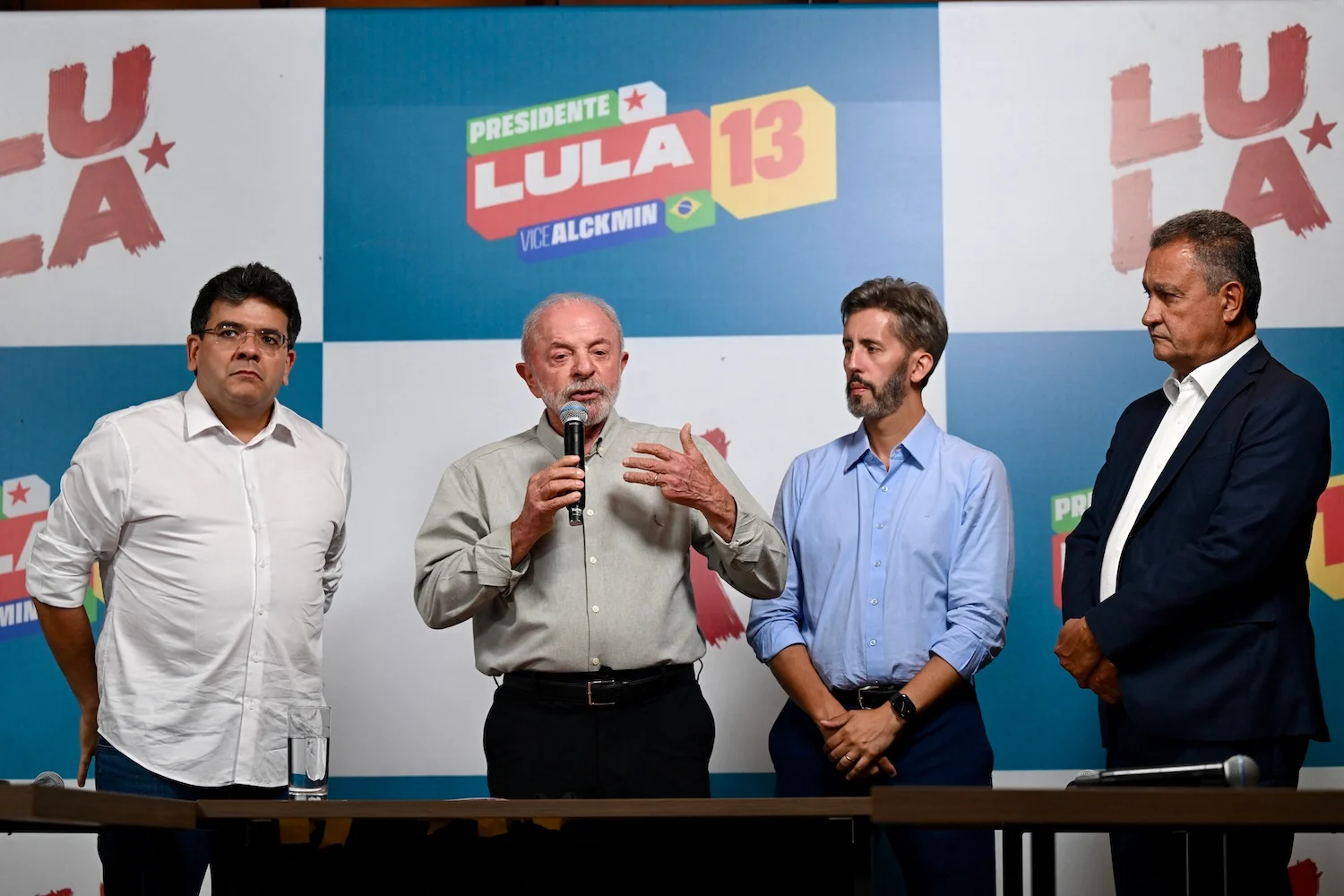
Since Brazilian President Luiz Inácio Lula da Silva’s surprise Oct. 25 reelection victory, global attention has focused on his opponent, Sen. Flávio Bolsonaro. Flávio—the son of former President Jair Bolsonaro, who was convicted of plotting a coup after losing to Lula in 2022—promptly fled to the United States, where he declared himself the “leader of Brazil.” The younger Bolsonaro is under criminal investigation for alleged corruption and money laundering.
Flávio’s departure from Brazil will have consequences for the country’s right. But for now, the more intriguing question is about the future of Brazil’s left. Lula turned 81 on Tuesday. Although he is fresh off an electoral triumph, he will need to start cultivating viable successors immediately—a task that he has struggled with in the past.
Lula’s political resilience and longevity are unmatched by most democratically elected politicians. He first ran for president in 1989 and won on his fourth attempt, in 2002. After two presidential terms lasting from 2003 to 2010, a corruption conviction kept him out of the 2018 race that brought Jair Bolsonaro to power. Brazil’s Supreme Court annulled Lula’s conviction in 2021, and he defeated Bolsonaro the following year by less than 2 points. Lula won his fourth term in the contest against Flávio by roughly twice that margin. Since Brazil’s redemocratization in the 1980s, no other politician has been elected president more than twice.
Lula has shown a remarkable ability to adapt to new political realities and change his policy programs without losing his base. In government, he has traditionally moved to the center, building coalitions with parties that share few positions with his Workers’ Party (PT). His first vice president in the early 2000s was a textile mogul who helped assuage concerns among economic elites about Lula’s candidacy. His current vice president, Geraldo Alckmin, was the center-right presidential candidate whom Lula beat in the 2006 runoff. Whenever out of power, Lula has returned to lead the left—and occupied that space so that no rival could emerge.
Those who tried to challenge Lula and the PT’s dominance on the left have failed spectacularly. Marina Silva, Lula’s environment minister from 2003 to 2008, left the PT and became a serious presidential contender in 2014 under the banner of the Brazilian Socialist Party. She ran on a platform that combined a progressive social agenda with market-friendly economics.
When polls showed that she was likely to win a runoff against President Dilma Rousseff—Lula’s chosen successor—the PT aired vicious television ads against Silva. Her candidacy never recovered. In 2023, while in office for a third time, Lula brought her back as environment minister.
Ciro Gomes, who served as minister for regional development in Lula’s first cabinet, attempted to run for president in 2010. Yet Lula maneuvered to keep his governing coalition united behind Rousseff, and Ciro’s own party dropped his candidacy. Four years later, the PT drew the Gomes family back in, with Ciro’s brother serving as Rousseff’s education minister. Lula’s strategy has been consistent: contain and weaken the rival, then bring them or their allies back into the fold.
That method has kept Lula at the center of Brazilian politics for four decades. It also deprived the left of anyone who had the national visibility to succeed him. For years, the PT’s best-known alternative candidate was Fernando Haddad, who served as education minister under both Lula and Rousseff and, until March, as Lula’s finance minister. But he has now lost four elections in a row: for reelection as mayor of São Paulo in 2016, for president in 2018, and for governor of São Paulo in 2022 and again this month.
Lula will have to address his succession problem in what is likely to be the most challenging of his four terms. Starting in February, the Bolsonaro-backed Liberal Party will hold 121 of 513 seats in Brazil’s Chamber of Deputies and 28 of 81 seats in the Senate, making it the largest caucus in both. That will make it hard for Lula to pass legislative priorities or get Supreme Court nominees confirmed.
According to the International Monetary Fund, Brazil’s fiscal deficit will be close to 8 percent of GDP this year. Gross public debt stands at above 80 percent of GDP, by the central bank’s measure—and at above 90 percent by the fund’s assessment. That leaves very little room for the spending increases that Lula promised during his campaign. U.S. tariffs on Brazil remain in force, and with the Strait of Hormuz still under threat, oil prices climbed above $115 a barrel this month, feeding energy costs and inflation across Latin America.
Lula is thus bound to face high public rejection rates from day one. And since, as an incumbent, he won’t have the honeymoon period that recently elected presidents usually enjoy, he risks becoming a lame duck early. A president governing under these constraints has every incentive to keep power close. Yet Lula’s political legacy—and the left’s capacity to remain competitive without him—now depend on him doing what he has avoided throughout his career: letting others grow and, ideally, outshine him.
Lula’s one previous attempt at developing a successor was not encouraging. Choosing Rousseff to run for the presidency in 2010 was perhaps the gravest political error of his career. Rousseff had previously served as energy minister in Lula’s first government and later became his chief of staff. But she had never run for office, lacked the skills to work with Congress, and pursued an interventionist economic program that helped produce a deep recession.
Brazil’s GDP fell 3.5 percent in 2015 and 3.3 percent in 2016, its worst two-year stretch in more than a century. Rousseff was impeached that year. After a period of commodity boom-fueled growth and optimism, the economic downturn led to widespread discontent and ultimately opened the way for Bolsonaro to win in 2018.
Lula is hardly alone in mishandling a potential successor. Former U.S. President Joe Biden tasked Vice President Kamala Harris with addressing the root causes of migration from Central America, an assignment with few chances of visible success. That made it harder for her to be competitive when he withdrew from the 2024 race.
Now, Lula should build a bench instead of anointing an heir. There are several younger politicians in the PT and allied parties who could become nationally known and tested over the next several years.
The most obvious candidate is Rafael Fonteles, the 41-year-old governor of Piauí. Elected in 2022 at the age of 37, he became the youngest governor in the state’s history after serving as its finance secretary from 2015 to 2022. He belongs to the PT’s more market-friendly wing. This month, he was reelected with 70.9 percent of the vote. Piauí now has the lowest homicide rate of the nine states in Brazil’s northeast. After losing the first round of the presidential race to Flávio, Lula put Fonteles in charge of his campaign’s communication—which markedly improved as a result.
If Fonteles left the governorship, Lula could make him finance minister, a post now held by Dario Durigan, who replaced Haddad in March. The ministry would expose Fonteles to the national and international business communities and increase his name recognition. The downside of serving as finance minister is that the next four years will require the government to make unpopular economic decisions, and Lula would have to make sure that whoever gets the job does not absorb all the political cost.
The Foreign Ministry is an alternative: Fonteles is known to have a keen interest in international affairs and has actively sought to attract foreign investors to Piauí. Making him foreign minister would carry fewer risks and be an opportunity to present a younger, progressive Brazilian leader to the world.
Camilo Santana, a two-term governor of the state of Ceará and former education minister, leads the PT in the Senate. At 58 years old, he was the political coordinator of Lula’s runoff campaign. João Campos, 32, of the Brazilian Socialist Party, and Renan Filho, 47, of the centrist Brazilian Democratic Movement, both lost governor’s races this month. Ministry posts would keep both in national politics; Lula himself has mentioned Campos as a possible candidate for 2030. Durigan is in his early 40s, but as a technocrat, he lacks a base of his own.
Giving key ministerial posts to all these contenders would be difficult. Countless allies of the president—including Haddad; former PT President and Federal Deputy Gleisi Hoffmann, who until this year was Lula’s chief negotiator with Congress; and Rio de Janeiro Mayor Eduardo Paes—lost their election races and may expect Lula to give them positions in his cabinet.
Rather than specifically aiming to nurture leaders for the presidential contest in 2030, Lula should view his succession strategy as a long-term project to keep the PT competitive. Given pervasive anti-incumbency sentiment and little hope for sufficient economic growth to offset it, the right is favored to win Brazil’s presidency four years from now—particularly since the scandal-ridden Bolsonaro family appears to have exited the political scene. Unless a new generation of left-wing leaders can use Lula’s final presidential term to gather executive experience, progressive forces risk being the underdogs for several electoral cycles.
Whoever emerges as Lula’s successor will inherit a party that is difficult to manage and that many voters reject outright. In a March Ipsos-Ipec survey of Brazilians, 27 percent cited the PT as their preferred party, and 37 percent said they would never vote for the party.
The PT is also split between a hard-left wing and a social-democratic one. The party’s relationship to Venezuela under former President Nicolás Maduro provided a vivid example. Hoffmann, who led the party from 2017 to 2025, attended Maduro’s 2019 inauguration and described the country’s 2018 presidential vote as legitimate—well after Maduro had become authoritarian. She and Haddad, a leading member of the social-democratic camp, clashed over the trip.
A future candidate will have to constantly manage these tensions without being seen as flip-flopping or opportunistic. But Lula must give them the space to grow. Unless he provides a new generation with the opportunity to gain national and international visibility, the Brazilian left is bound to become an underdog.
