


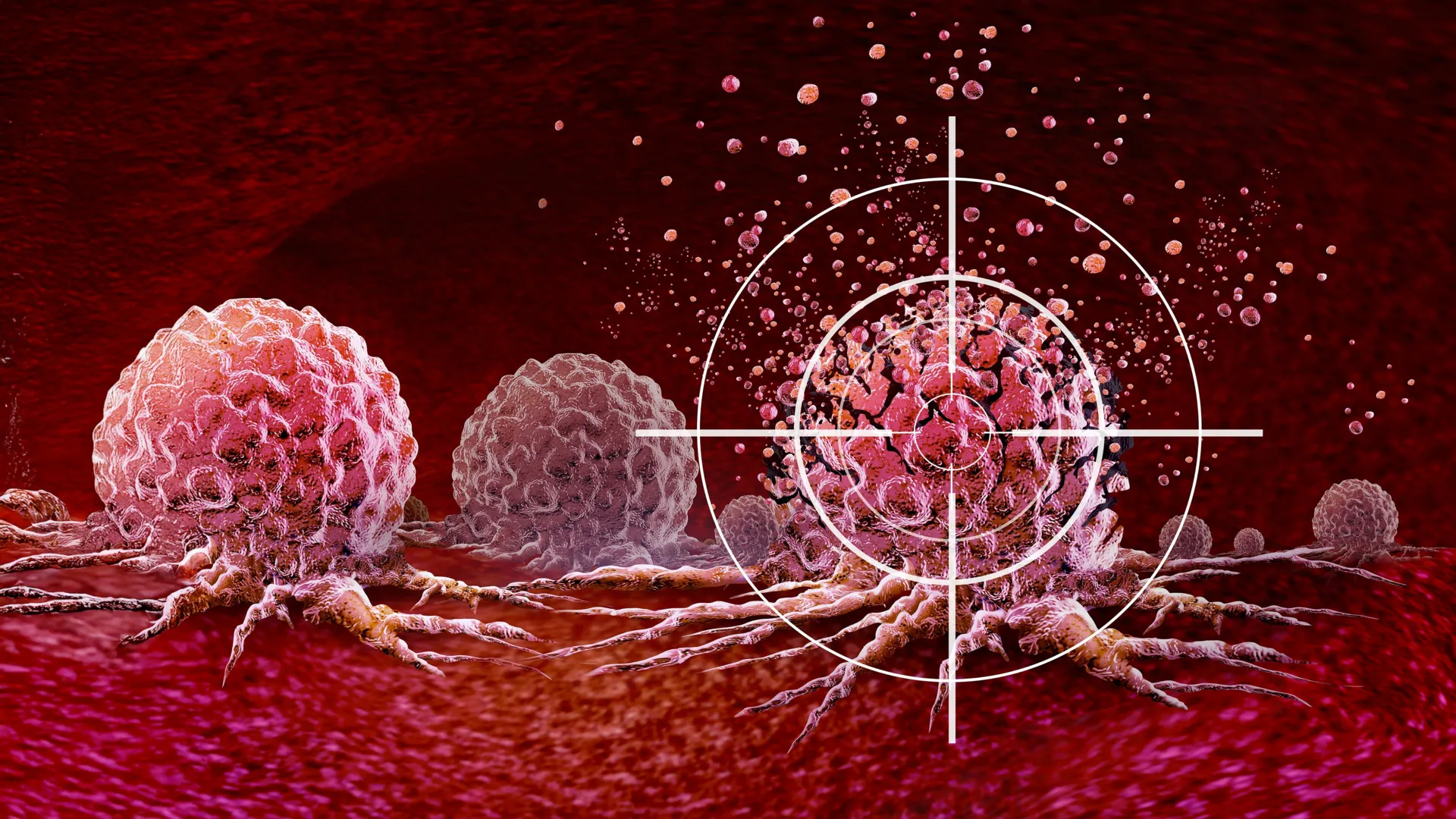
Scientists at the University of Virginia Comprehensive Cancer Center have developed a promising experimental strategy for treating glioblastoma, the most common and aggressive malignant brain tumor in adults. The new approach could help overcome some of the biggest obstacles that have limited the effectiveness of existing brain cancer treatments.
The research team, led by UVA’s Roger Abounader, MD, PhD, identified tiny genetic molecules known as “microRNAs” that can interfere with several genes responsible for the development and growth of glioblastoma. To deliver these molecules into the brain, the researchers combined specialized nanoparticles, focused ultrasound and microscopic bubbles. Together, these technologies offer a way to temporarily cross the brain’s protective barrier, which normally prevents many treatments from reaching brain tumors and other neurological conditions.
“This new approach could help target numerous molecules that promote cancer growth, including those for which no drugs exist, at the same time to achieve better therapies,” said Abounader, a professor at UVA’s School of Medicine in the Department of Microbiology, Immunology and Cancer Biology, as well as its Comprehensive Cancer Center and Center for RNA Science and Medicine. “We are hoping to translate our findings into future clinical trials for patients with glioblastoma and other brain tumors.”
Why Glioblastoma Is So Difficult to Treat
Glioblastoma is the most common malignant brain tumor in adults and one of the most aggressive forms of cancer. It claims more than 13,000 lives in the United States each year. One reason it is so difficult to treat is that cancer cells spread into surrounding healthy brain tissue, making it nearly impossible for surgeons to remove the entire tumor.
Another major challenge is the brain’s natural “blood-brain barrier.” This protective system helps shield the brain from harmful substances, including toxins and infectious agents. Unfortunately, it also blocks many drugs that could otherwise be used to attack brain cancer.
Current treatment generally begins with surgery to remove as much of the tumor as possible. Patients then receive radiation therapy and chemotherapy to help control the remaining cancer and extend survival. Despite these efforts, glioblastoma remains exceptionally difficult to manage.
The UVA researchers are pursuing a different strategy. Instead of relying on drugs that target individual cancer-related processes, their approach uses microRNAs, small pieces of genetic material capable of suppressing the activity of multiple problematic genes at the same time.
By disrupting several genes that help glioblastoma grow and survive, the treatment could potentially slow or even stop tumor growth. This ability to target multiple cancer-driving mechanisms is especially important because combining several conventional cancer drugs can produce harmful side effects. In addition, many of the molecules involved in cancer growth cannot currently be targeted by available medications.
Using Ultrasound to Deliver Cancer-Fighting Molecules
Getting these genetic molecules into the brain presents another major challenge. To overcome it, Abounader’s team uses focused ultrasound guided by magnetic resonance imaging (MRI), allowing researchers to direct sound waves precisely toward the intended area.
The ultrasound works with tiny “microbubbles” to temporarily open the blood-brain barrier. This creates a brief opportunity for nanoparticles carrying the microRNAs to pass through the barrier and enter the brain, where they can act on genes involved in tumor growth.
The researchers tested this approach in laboratory experiments and animal models of glioblastoma. Their findings showed that the microRNA treatment slowed tumor growth and helped the animals survive longer.
Although these results are encouraging, the strategy remains experimental and will require additional research before it can be evaluated in human patients. Abounader believes the findings provide an important early indication that the technology could eventually benefit people with glioblastoma and potentially those with other types of cancer.
“This approach could have broad applications for several brain and other human diseases,” Abounader said. “We and many others are intensively working to lighten the burden of cancer, and hopefully also completely cure it, but this requires a continued investment in cancer and medical research.”
UVA Expands Focused Ultrasound Cancer Research
UVA Health has been at the forefront of focused ultrasound research since the technology’s early development. Over the years, its scientists have built an extensive research program investigating how precisely directed sound waves might be used to treat a wide range of medical conditions.
Recognizing the technology’s potential in cancer care, UVA partnered with the Charlottesville-based Focused Ultrasound Foundation to establish the Focused Ultrasound Immuno-Oncology (FUSION) Center. It is the first center in the world devoted specifically to investigating how focused ultrasound can be combined with cancer immunotherapy. Researchers believe this combination could lead to major advances in cancer treatment during the 21st century.
The effort also supports the broader missions of UVA Comprehensive Cancer Center and UVA’s Paul and Diane Manning Institute of Biotechnology, both of which are working to improve care through new medical discoveries.
UVA Comprehensive Cancer Center is among just 57 cancer centers nationwide to receive the National Cancer Institute’s prestigious “comprehensive” designation. The recognition reflects its excellence in cancer research and patient care.
The Manning Institute was established to speed the discovery and development of new medicines and potential cures for some of the most difficult diseases. Its work is supported by a statewide clinical trials network designed to make emerging treatments more accessible to patients as they move through research and testing.
Study Findings and Research Support
Abounader and his colleagues published their experimental approach and initial laboratory findings in JCI, the Journal of Clinical Investigation. The study is open access and can be read free of charge.
The research team included Shekhar Saha, Ying Zhang, Myron K. Gibert Jr., Collin Dube, Farina Hanif, Elizabeth Qian Xu Mulcahy, Sylwia Bednarek, Yunan Sun, Pawel Marcinkiewicz, Xiantao Wang, Gijung Kwak, Ahsan H. Polash, Haolin Li, Kadie Hudson, Manikarna Dinda, Tapas Saha, Matthew McCord, Fadila Guessous, Nichola Cruickshanks, Rossymar Rivera Colon, Lily Dell’Olio, Rajitha Anbu, Wenjie Liu, Songy Choi, Benjamin Kefas, Pankaj Kumar, Alexander L. Klibanov, David Schiff, Jung Soo Suk, Justin Hanes, Jamie Mata, Markus Hafner and Abounader. The researchers reported having no financial interest in the work.
Funding came from the National Institutes of Health’s National Cancer Institute through grants U01 CA220841 and P30 CA044579, along with the NIH’s National Institute of Neurological Disorders and Stroke through grants R01 NS122222 and R21 NS122136. Additional support was provided by a UVA Comprehensive Cancer Center pilot grant, a Schiff Foundation grant, the Ben and Catherine Ivy Foundation, and the Focused Ultrasound Foundation.
