


TAYLOR, Texas—A red thresher cuts across the countryside off County Road 401 in Taylor, leaving behind tufts of discarded stalks as farmers prepare to plant seeds for the next year’s harvest.
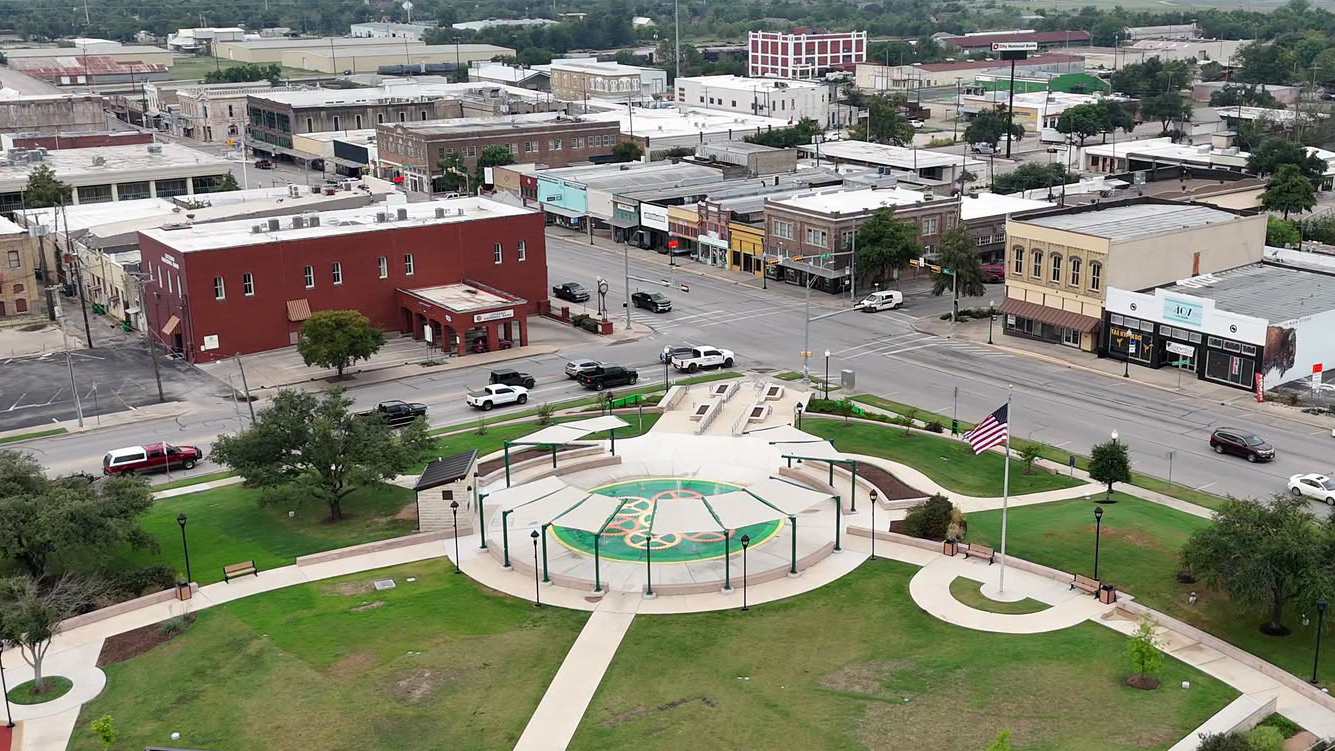
Less than five miles away, mom-and-pop antique shops open their doors on North Main Street, welcoming residents and tourists alike to glance into the city’s historic past as a 19th-century railroad town known for its cotton fields.
The day has begun in what seems to be, at first blush, an iconic rural town of roughly 17,000.
It was that idyllic picture that drew many of the city’s newer homeowners post-pandemic to the area about 35 miles northeast of Austin, the booming Texas capitol, including Sarah Medina and her family.
“We wanted some land, and so we had looked in different pockets outside of Austin,” said Medina, 38, a creative director for an Austin-based hospitality group who bought land in south Taylor with her husband five-and-a-half years ago. “It just seemed like it was potentially up-and-coming and cool, and had some kind of artsy fun stuff happening. We found some affordable land, so that was really what did it.”
Medina and her husband, Tate Green, a career and technical teacher at the junior high and high school in Coupland about 10 miles south of Taylor, nurtured a garden on about an acre of land, raising pigs, chickens, guinea hens, goats and geese. They built their homestead intending for it to be theirs for the rest of their lives—a place to raise their two kids, continue their careers and eventually retire.
But that vision has been slowly fracturing over the past few years as they’ve faced the impacts of Samsung breaking ground in 2022 on a semiconductor facility, a $17 billion project on a sprawling 1,200-acre campus, around a mile from their house.
“We moved for a small-town feel, for a tighter-knit community, for the ability to afford some land and do some agricultural stuff, and to have space for our kids to run around,” Medina said. “We did not move here to be closer to any kind of tech. It’s not part of the appeal.”
Now, that same county road surrounded by farmers working their land is clogged by delivery trucks, concrete mixers and flatbeds hauling building materials to the Samsung facility site. The beeping of construction equipment echoes across the flatland, with construction visible and audible from Taylor High School and the newly built houses surrounding it less than two miles away.
But Samsung’s arrival was only the beginning of Taylor’s transformation from small town to big tech. Since then, the city has approved the development of three data centers south of the railroad tracks cutting through the city, raising resident concerns about what the constructions mean for the community. Together, the three projects by some estimates would consume 1.42 gigawatts of electricity, enough to power 950,000 Texas homes a year, or about the annual electricity footprint of Austin.
Texas has seen an influx of data center construction over the past few years, with almost 600 separate facilities operating or planned as of September, according to analysis by The Texas Tribune.
Work on the Samsung plant is slated to end as construction on the first of Taylor’s three planned data centers, Blueprint Projects, begins later this year. When built, the 135,000-square-foot data storage and AI processing complex would use 60 megawatts at full capacity.
At the same time, Linde PLC will build a $271 million air separation unit and industrial gas facility for chip making on the site of the Samsung campus. The electronics company is also planning a second facility next to the first, with construction starting by the end of the year, according to a July earnings call.
Taylor gave initial approval to the Blueprint Projects data center in 2024. When it first started releasing information online about the project, residents like Samia Brand, a 39-year-old graphic designer, responded to the posts by questioning water sources for the project and asking what could be done to stop the development. But the city’s unclear responses only weakened trust, she said.
“Even when I had that little conversation on Instagram, I tried to ask my questions and they just recopied and pasted what was already in the post, and I was like, ‘That’s not what I asked, though,’” said Brand, who moved to Taylor shortly before the announcement. “I’m actually trying to get an answer here, and it took a few tries before I did.”
In March, Taylor introduced KDC Project Comal, a $2.5 billion, 360-megawatt hyperscale AI data center campus, which would be built near the Samsung facility, though it requires rezoning before any development can progress.
Then, on Oct. 8, the city authorized a development agreement with Big Watt Digital and PowerHouse Data Centers, co-owners of the third data center project, now named Taylor Technology Campus but formerly called Project Mustang. The City Council approved the 664-acre property’s annexation into city limits, giving the city jurisdiction over regulation and construction as well as opening the door for construction to begin in 2027. The companies had requested annexation before, but withdrew their request two weeks after the city tabled all discussions mid-August for 90 days.
“It’s something different,” said James Brand, Samia’s husband. “I don’t think it’s what we envisioned when we moved here.”
But one data center, on top of the massive Samsung factory, set in motion a full-blown residents’ opposition movement, now known as the HALT Taylor coalition.
The Deed and the Data Center
The Brands live a few miles away from any of the proposed data center developments, but they still have concerns over health and safety. For other residents like Pamela Griffin, the threat is more imminent. A born-and-raised Taylor native, Griffin, a 58-year-old retired learning center director, lives in her recently rebuilt childhood home in the neighborhood around First and Second avenues and Royal Street, less than half a mile from Blueprint Projects site.
She knew nothing about the proposed data center until she found a flyer on her door last year warning of the planned construction out on vacant acreage several hundred feet behind her home. “We didn’t know what a data center was,” Griffin said. “None of us did.”
She started thinking about the land.
After passage of the Fair Housing Act in 1968, which prohibited discrimination on the basis of race, skin color, religion or nationality when purchasing, renting or financing a home, Griffin’s family was one of many that seized the chance to purchase property in the neighborhood. It was the only place people of color could purchase land in Taylor at the time, she said.
Griffin said he father also purchased a vacant lot in back of the family’s home as a safe space for children to play after the closest city park, opened in 1955 as the first recreational space open to people of color—a former landfill—started sickening children.
The vacant lot bordered 87 acres of undeveloped land owned by the descendants of a prominent 19th-century local businessman and lawmaker, Howard Bland, Sr. Because Griffin and her siblings would often chase baseballs out onto the Bland tract, Griffin said members of the Bland family promised her father and the rest of the community that they would preserve the green space for future generations.
This story is funded by readers like you.
Our nonprofit newsroom provides award-winning climate coverage free of charge and advertising. We rely on donations from readers like you to keep going. Please donate now to support our work.
As Griffin started researching the Blueprint Projects, she discovered that the Bland family’s promise about preserving the land was not just an offhand remark. In 1999, his descendants sold the property for $10 to the Texas Parks and Recreation Foundation, with this clause in the grantee’s specifications—“to be held in trust for future use as a parkland by Williamson County.”
Members of the Bland family “told my dad and the rest of the community,” Griffin said, that they were going to give the community the tract as parkland. They did so, she said, “but the city did not let us know.”
The Williamson County Park Foundation acquired the land in 2003 for $10, and held onto it for a little over a month before it transferred ownership to the city of Taylor for the same price. The property deeds state that five years later, the city sold the 87-acre property to the Taylor’s Economic Development Corporation for $15,000 and 39 additional acres, which included 16 acres that would become a proposed buffer zone between the data center site and the nearest neighborhood.
The EDC then held onto the land until April 2025, when it sold the property to the Blueprint Project data center’s parent company, NCP Travis TPP Project, LLC, for $10 million.
The company did not respond to a request for comment.
In all ownership deeds written after the initial sale, the original clause stipulating that the land would be used “in trust” as parkland was excluded.
The city informed residents of buildings and homes located within 200 feet of the property of the construction per state law. But because of the 16-acre buffer zone that changed hands as part of the EDC purchase located between the proposed site and Griffin’s neighborhood, no residents received a notice of the data center’s construction, according to a map the city published.
The city says on the project’s website that it recognizes the first deed notes the property was to be set aside for future parkland, but claims it was not a deed restriction. However, it was enough of a gray area for Griffin and four other residents to file a lawsuit in August 2025 on the basis of land misuse.
Judge Ryan D. Larson of the 395th District Court in Williamson County dismissed the lawsuit in October 2025 on the grounds of the plaintiffs not owning the land or having the direct legal standing to enforce the deed, but did not rule on the deed itself. The plaintiffs filed an appeal that same week and are currently awaiting action.
Griffin’s lawyer, Chris Osborn, said that under Texas law, the original landowners who placed the land in trust for specific use stand in a different position from Griffin and the other plaintiffs in a way that might be enforceable in court if they choose to pursue that avenue. The Bland family is exploring their legal options and supports the neighborhood’s opposition, Griffin said.
“They’re not young people, and they want to live out their lives,” Griffin said. “They don’t want to get in a fight, and that’s hard for old people, because it’s hard for me.”
Fighting Blueprint
In late February 2026, dozens of residents began a campaign gathering signatures for their petition calling for the Taylor City Council to add a measure on the November ballot that would impose a moratorium on all data center development until the city developed a new type of zoning for the construction and regulation of digital infrastructure. It would include data centers, cryptocurrency mining and battery energy storage systems as well.
After gathering 1,400 signatures over 130 days, the HALT Taylor coalition submitted the petition to the City Council on June 11, and the council members discussed it during executive session with no action taken on June 25. Two weeks later, it went before the City Council for approval.
Exactly 15 minutes into the meeting and before residents were able to present public comments on the item, the city uploaded its decision to Facebook with no announcement to those in the council chamber—a move denying the measure’s addition to the ballot because state law “does not allow a city to enact or change its zoning by popular vote,” according to the post.
Instead, the city would continue the plan it had announced June 30 to amend its existing land development code to incorporate digital infrastructure construction and regulation requirements. Citizens would be given the opportunity to comment on the new infrastructure before any requirements were codified, with the city’s current timeline placing the code ratification date in 2027. However, under state law, the new amendments would not apply to already-approved data center developments.
“Our approach focuses on establishing permanent regulations that limit the concentration of data centers and provide long-term environmental protections for our community,” wrote Jerrod Kingery, a spokesperson with the city of Taylor, in a September email statement. “Unlike a temporary moratorium, which would take months to put in place, these proposed regulations could be adopted within the next month and would create a lasting framework for where and how future data centers can be developed.”
The city issued an apology the next day for the “untimely online announcement” and said the council had “no prior knowledge that this announcement would be published at that time.”
If data center development had clearly come to dominate public discourse in Taylor, it exploded at summer’s end when Attorney General Ken Paxton announced an investigation on Sept. 17 into the data center development on the former Bland family land and whether the construction can continue based on the clause in the original deed that it be used as parkland.
If that was found to be a restriction on the deed, the state will take steps to ensure it is not “disregarded,” said Paxton, an embattled Republican who was in the midst of a tight Senate race against Democrat James Talarico in which his past support for data center development had become a hot issue.
Kingery said while Taylor is not a part of the Paxton action, it will take all necessary steps to cooperate with the investigation. The city declined to comment further on the pending litigation.
Griffin, along with fellow Taylor resident and coalition member Carrie D’Anna, traveled to Austin Sept. 24 and submitted a petition to the Office of the Attorney General for the state to request an injunction to stop any development from progressing while the investigation is pending.
“Everybody’s very focused on whose fault and who did it, who was the mayor and who gave it away, and I don’t care,” D’Anna said. “What I care about right now is that there’s a community that is about to be disenfranchised. We’re not even fighting for money—we’re fighting just to maintain the status quo.”
The Future of Taylor’s Environment
All three proposed data center developments are major worries across Taylor, given their proximity to neighborhoods and environmental concerns. The unprecedented construction of the centers creates a fear of the unknown, Medina said, as data centers trigger controversies across the country. In Tennessee, there have been reports of potential emissions from unauthorized gas turbines installed at operating data centers. In Oregon, news reports chronicle the contamination of hundreds of potable water wells.
Property values in Taylor, which have already been hurt by the announcement of the developments, could decrease further once construction starts, D’Anna said, making it harder for homeowners to move away from the area.
Under the new proposed digital infrastructure zoning amendments the city is currently discussing, which wouldn’t impact any of the already approved facilities, the permitted noise from data centers between 7 a.m. and 10 p.m. would be 50 decibels, equivalent to the steady buzz of a refrigerator. The allowed noise production would decrease to 45 decibels at night.
For the neighborhood directly bordering Blueprint Projects, the nonstop hum could impact residents’ health, productivity and sleep, Griffin said.
The Samsung chip factory, KDC Project Comal and Taylor Technology Campus data center all occupy prairie land that has historically been used for agriculture, growing acres of corn, cotton and grain sorghum and supporting the rearing of livestock. While homeowners still own farmland surrounding those projects, they fear the impact of potential runoff or contamination.
While Medina said her family has already downsized the number of livestock they tend, she said they run a small-scale side business, named Little Doe Dairy, selling byproducts from their goats. But animal behavior, such as migratory patterns and mating activity, can be disrupted by persistent sounds starting at 40 decibels, which she worries could impact the business.
Residents also raised concerns about how suitable the land is for a data center. A stream running through the Blueprint Projects property, the Mustang Creek Tributary, is marked as a flood risk on FEMA’s flood map.
In 2015, flash floods damaged 280 homes in the city, with many of those impacted living in Griffin’s neighborhood. While many residents have recovered, others are still worried about how the proposed industrial construction could increase the chances of recurring flash floods.
“Taylor’s in a hole, so all that pollution is going to come into the area,” Griffin said. “We’re going to be sick, literally sick, and then the people say, ‘Well, you can turn around and start suing the city,’ but it’d be too late. We’d be sick.”
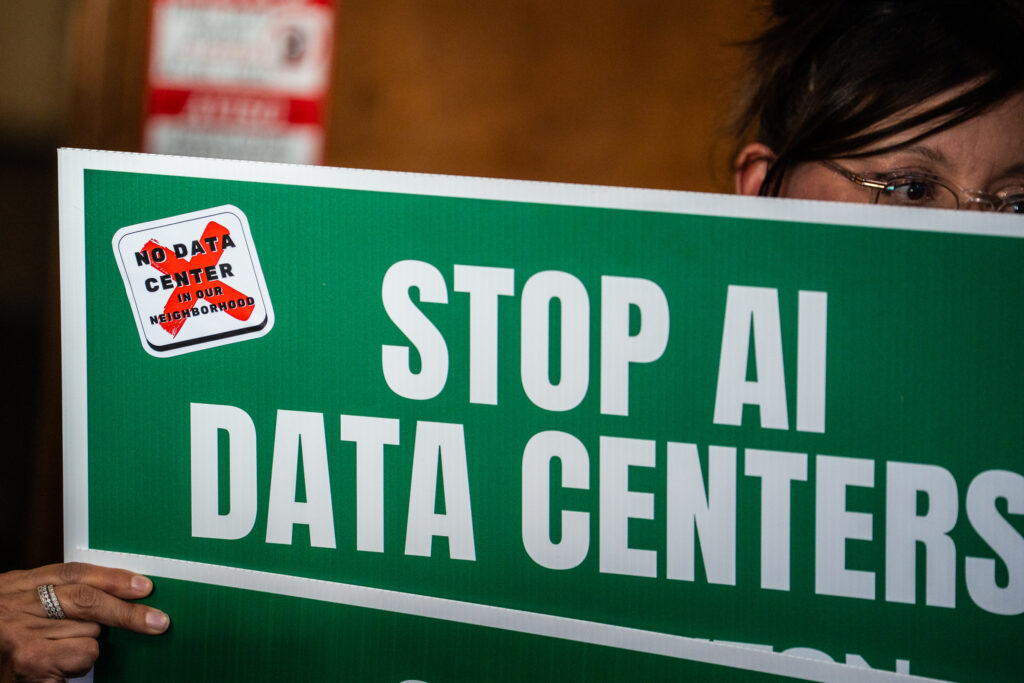
Taylor’s data center future remains in limbo, but residents have not given up hope, Griffin said. White signs with a giant red “X” and the words “No data center in our neighborhood” stand in yards opposite the empty land sold by the Bland family for the Blueprint Projects data center—a reminder, Griffin said, of promises made decades ago to future generations.
About This Story
Perhaps you noticed: This story, like all the news we publish, is free to read. That’s because Inside Climate News is a 501c3 nonprofit organization. We do not charge a subscription fee, lock our news behind a paywall, or clutter our website with ads. We make our news on climate and the environment freely available to you and anyone who wants it.
That’s not all. We also share our news for free with scores of other media organizations around the country. Many of them can’t afford to do environmental journalism of their own. We’ve built bureaus from coast to coast to report local stories, collaborate with local newsrooms and co-publish articles so that this vital work is shared as widely as possible.
Two of us launched ICN in 2007. Six years later we earned a Pulitzer Prize for National Reporting, and now we run the oldest and largest dedicated climate newsroom in the nation. We tell the story in all its complexity. We hold polluters accountable. We expose environmental injustice. We debunk misinformation. We scrutinize solutions and inspire action.
Donations from readers like you fund every aspect of what we do. If you don’t already, will you support our ongoing work, our reporting on the biggest crisis facing our planet, and help us reach even more readers in more places?
Please take a moment to make a tax-deductible donation. Every one of them makes a difference.
Thank you,
