


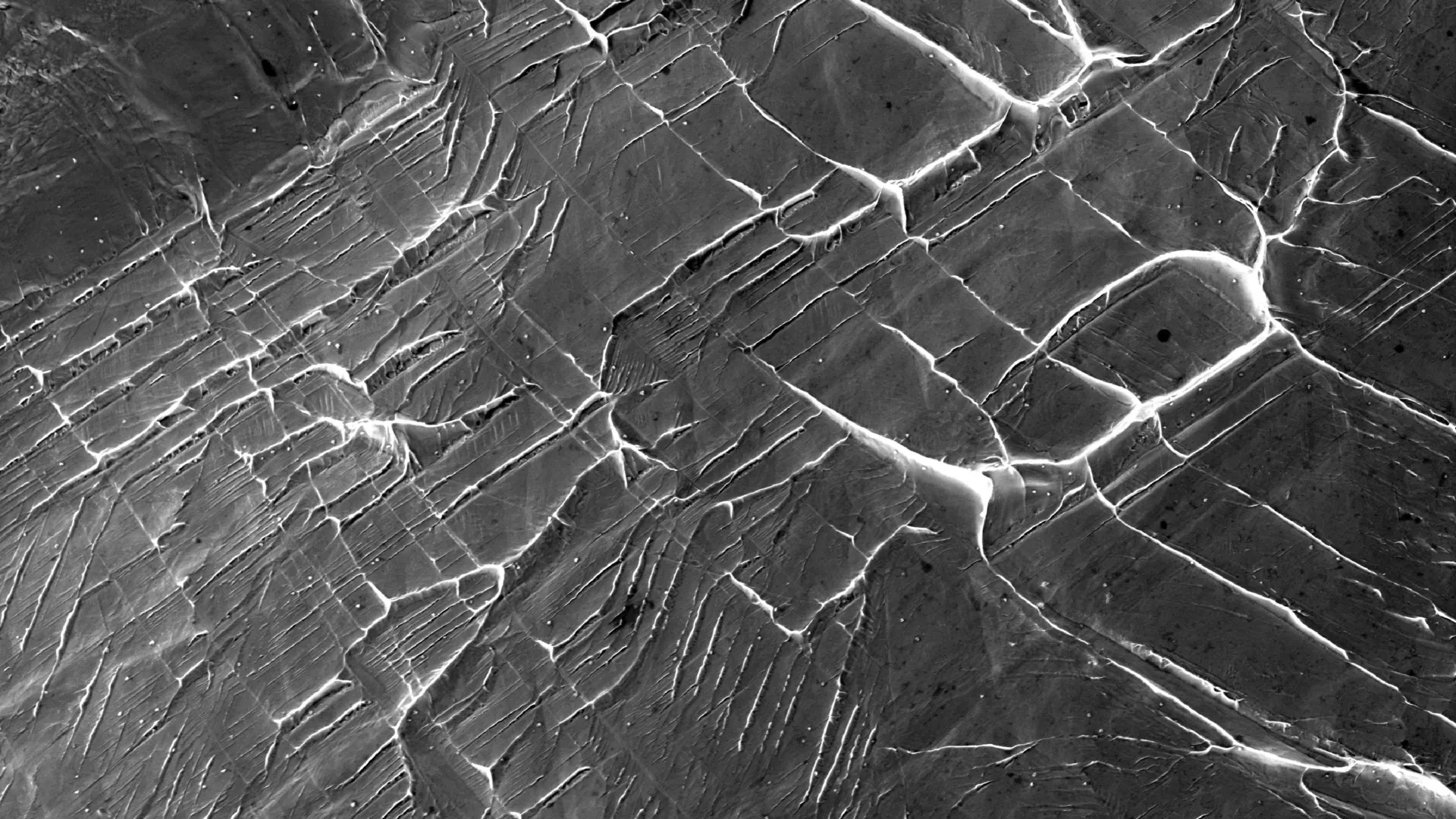
Scientists have uncovered an unexpected way certain metals can withstand extreme cold without becoming dangerously brittle. The discovery challenges long-standing ideas about how metals behave at extremely low temperatures and could help engineers develop tougher materials for some of the harshest environments imaginable.
The findings, published October 14 in Nature, reveal a previously unknown microscopic process that allows two experimental metal alloys to remain remarkably resistant to damage at just 20 kelvin, or -253°C (-424°F). The research was led by an international team from the University of California, Berkeley, Lawrence Berkeley National Laboratory, and the University of Oxford.
Why Extreme Cold Makes Some Metals Brittle
Cooling a metal generally increases its strength, but this improvement can come with a serious drawback. Certain metals become increasingly brittle as temperatures fall, making them more likely to crack or break instead of bending under pressure.
This problem is particularly important for a family of materials known as body-centered cubic metals (such as iron, tungsten, and chromium). Their atoms are arranged in a specific crystal pattern that can make them especially vulnerable to brittle failure in extreme cold. At temperatures approaching absolute zero, a small crack that might ordinarily be accommodated by the metal changing shape can instead spread and cause a fracture.
However, researchers discovered that two experimental alloys made from niobium and titanium behave very differently. Even when cooled to -253°C, both materials maintained an impressive ability to withstand damage. Neither showed a measurable shift toward brittle behavior at the lowest temperature tested.
The explanation lies in a surprising change in how the metals respond to stress. Rather than relying on their usual method of deformation, the alloys activate a different microscopic process that helps prevent cracks from spreading.
A Hidden Mechanism Helps Metals Resist Cracking
Under normal conditions, body-centered cubic metals bend and change shape through the movement of tiny defects within their crystal structures. These defects, called dislocations, allow layers of atoms to shift relative to one another, helping the material absorb stress without breaking.
As temperatures drop, however, these dislocations become increasingly difficult to move. With fewer ways to accommodate the forces concentrated around a crack, the metal becomes more likely to fracture.
The newly studied alloys have another way to respond.
Researchers observed a process called nanoscale ‘twinning’, in which tiny sections of the metal’s crystal structure rearrange into mirror-image patterns. This occurs alongside a localized change in the crystal structure itself.
When these newly formed regions encounter the boundaries separating neighboring crystals, they produce concentrated areas of stress. Those stress concentrations generate additional defects, giving the metal new opportunities to deform rather than crack.
The researchers compare this behavior to a road system finding alternative routes when its usual roads become blocked by ice. As extreme cold makes conventional deformation increasingly difficult, the newly formed crystal structures provide other pathways for the metal to accommodate stress.
By creating these new pathways, the material can continue absorbing forces around potential fractures instead of failing abruptly.
A Breakthrough for Metals Used in Extreme Environments
The findings suggest a new approach to developing structural metals that can withstand exceptionally low temperatures. Such materials could be valuable in energy systems, transportation, and aerospace engineering, where components may encounter severe thermal conditions.
Oxford corresponding author Professor Dong Liu (Department of Engineering Science, University of Oxford) said: “For decades, the ductile-to-brittle transition has been viewed as a fundamental limitation of body-centered cubic metals. What surprised us is that these alloys remain remarkably damage tolerant even at 20 kelvin. By uncovering how twinning and phase transformation work together to generate plasticity before conventional dislocation motion, we identified a new pathway for designing structural body-centered cubic metals that can operate in extreme cryogenic environments. This class of materials will be extremely useful for components experiencing extreme hot and cold temperatures in one application.”
The discovery also changes how scientists may need to think about what determines whether a metal becomes brittle. Previously, much of the emphasis was placed on how easily existing defects could travel through a material. The new results indicate that generating fresh defects may be just as important.
Lead author Dr. David Cook (University of California, Berkeley at the time of the study, now University of Cambridge) said: “Our results suggest we should change how we think about what governs the transition to brittleness for these metals. Traditionally, the focus was on how readily existing dislocations can move through a metal, but now it appears that the ability to create new dislocations at interfaces may also be critical. Using these insights, we may be able to design underlying microstructural conditions that allow a material to create its own routes to remain ductile at extreme temperatures.”
How Scientists Tested Metals at -253°C
To investigate how the alloys performed under such punishing conditions, the team conducted experiments using the Engin-X instrument at the ISIS Neutron and Muon Source in Oxfordshire.
The researchers used gaseous helium to cool metal samples to approximately -253°C. While directing a beam of neutrons through the materials, they used a specialized testing machine to stretch the samples by pulling from opposite ends.
This setup allowed the team to measure the forces the metals could withstand and determine how far they could stretch before breaking. The neutron measurements also helped researchers investigate what was happening inside the materials as they were deformed.
Afterward, the scientists examined the tested samples using powerful electron microscopes. These instruments revealed extremely small structural changes within the metal, including those near cracks that helped explain its unusual resistance to damage.
The team also used atom-probe analysis to determine how individual elements were distributed throughout the alloys. Combined with computer modeling, these measurements helped establish how the different microscopic processes worked together to prevent brittle failure.
The results offer more than an explanation for the surprising behavior of two experimental alloys. They identify a potentially useful strategy for designing metals that can remain tough even when conventional methods of deformation stop working, opening new possibilities for technologies that must operate in extreme cold.
The international collaboration included researchers from the University of California, Berkeley; Lawrence Berkeley National Laboratory; the University of Oxford; the University of Bristol; the ISIS Neutron and Muon Source, Science and Technology Facilities Council; the University of California, Irvine; Pacific Northwest National Laboratory; Texas A&M University; and Nanyang Technological University in Singapore.
