


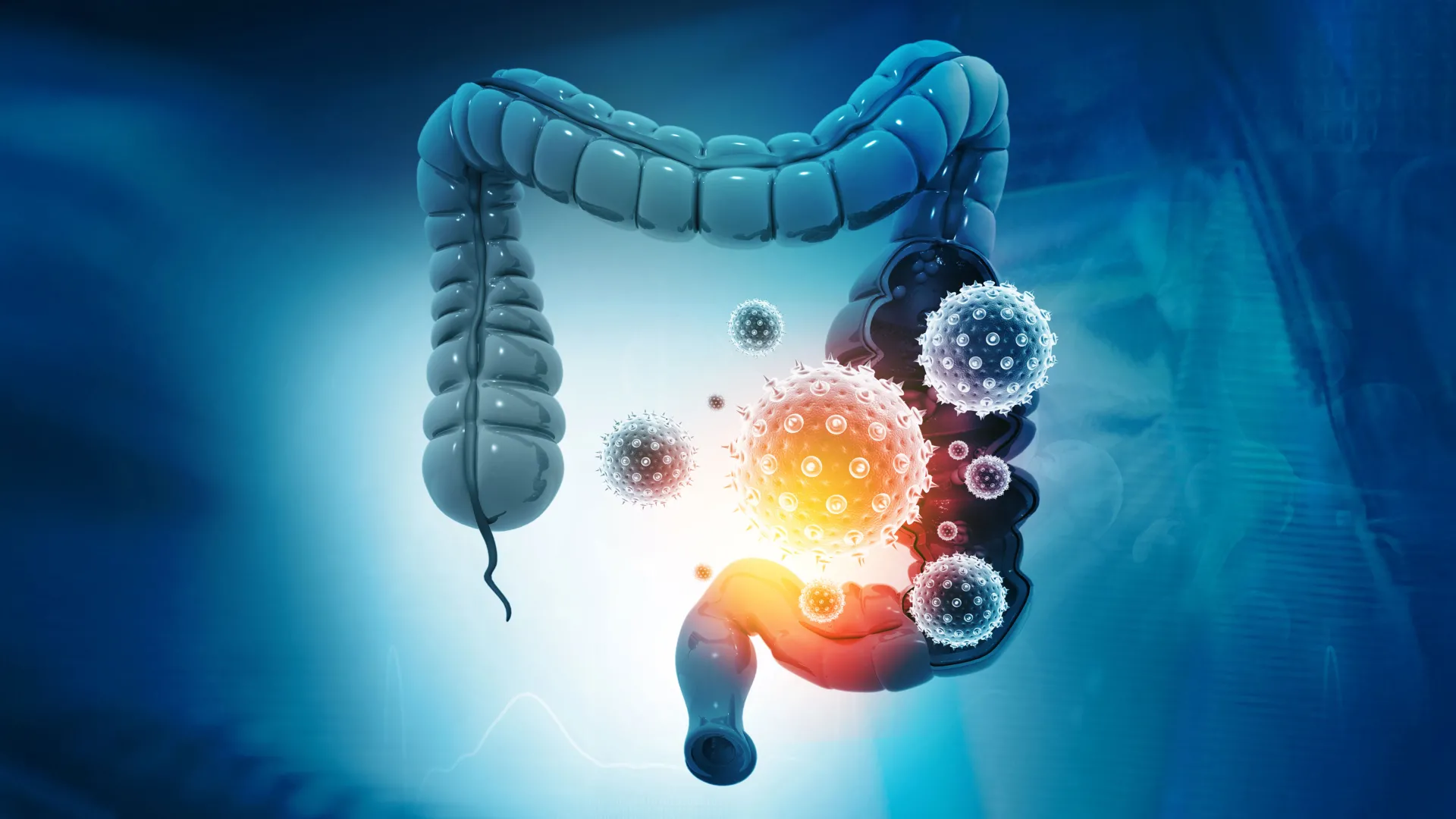
For nearly two decades, scientists have known that a common gut bacterium can produce a toxin that damages the colon and helps drive the formation of tumors. What they could not explain was how the toxin first attaches to intestinal cells and begins its attack. Now, researchers have uncovered that missing step, revealing a surprising vulnerability that could lead to new ways of protecting the colon.
The breakthrough comes from a team led by scientists at the Johns Hopkins Kimmel Cancer Center, its Bloomberg~Kimmel Institute for Cancer Immunotherapy, and the Johns Hopkins University School of Medicine. Their findings, published in Nature, identify a protein called claudin-4 as the essential docking point for a bacterial toxin known as BFT.
Even more promising, the researchers have already used this discovery to develop a molecular decoy that intercepts the toxin before it can damage colon cells. The strategy successfully protected mice from the toxin’s harmful effects, suggesting a possible new approach to preventing bacterial damage associated with colorectal cancer. The research received partial support from the National Institutes of Health.
“We’ve made several attempts over time to identify the receptor, so this is an exciting moment,” says senior author Cynthia Sears, M.D., Bloomberg~Kimmel Professor of Cancer Immunotherapy and professor of medicine at Johns Hopkins. “Understanding how bacterial toxins work can open doors to new approaches for detection and therapy for associated diseases, including diarrhea, colorectal cancer and bloodstream infections.”
How a Common Gut Bacterium Can Promote Colon Cancer
The investigation centers on Bacteroides fragilis, a bacterium that can be found in the intestines of up to 20% of healthy people. Although the presence of this bacterium does not automatically mean someone will develop cancer, certain strains produce a powerful toxin capable of disrupting the colon’s protective lining, causing inflammation, and encouraging tumor growth.
The toxin, known as B. fragilis toxin or BFT, has been under investigation for years. In a landmark 2009 study published in Nature Medicine, Sears and her colleagues demonstrated that the toxin could promote the development of colon tumors. Their work helped establish an important connection between toxin-producing gut bacteria, chronic inflammation, and colorectal cancer.
Earlier experiments also revealed that BFT damages a protein called E-cadherin, which helps hold neighboring cells together and maintain the colon’s protective barrier. When this protein is broken apart, the barrier becomes compromised, potentially allowing harmful substances and bacteria to interfere with the surrounding tissue.
However, one critical question remained unanswered. Although BFT could break down E-cadherin, the toxin did not appear to attach directly to that protein. Researchers suspected that another molecule was helping the toxin reach its target, but repeated attempts to identify it had failed.
Scientists Identify the Missing Link Using CRISPR
To solve the mystery, the researchers turned to CRISPR, a powerful gene-editing technology that allows scientists to selectively disable genes and investigate what they do.
Maxwell White, an M.D./Ph.D. candidate working in Sears’ laboratory, led a genome-wide CRISPR screening effort in collaboration with Matthew Waldor’s laboratory at Harvard Medical School. The team systematically switched off genes in colon epithelial cells, the cells that form the inner lining of the colon, to determine which ones were necessary for the toxin to attach and cause damage.
One gene stood out dramatically. It produces claudin-4, a protein that helps neighboring cells form tight junctions, the seals that limit the movement of substances between cells and help maintain the intestinal barrier.
When the researchers disabled the gene responsible for claudin-4, BFT could no longer bind to the colon cells. Without that initial attachment, the toxin was unable to attack E-cadherin.
The finding revealed that claudin-4 acts as a receptor for the bacterial toxin. In effect, the toxin must first latch onto this protein before it can carry out its damaging activity.
“It took a while to get the assay working and validate the approach, but once we were able to do the screen, claudin-4 was a clear, resounding top hit,” says White. “That was an exciting moment.”
An Unexpected Discovery Reveals a New Bacterial Attack Strategy
The identity of the receptor surprised the scientists.
Sears and other researchers had expected BFT to interact with a protein involved in cellular signaling, such as a G protein-coupled receptor. These receptors act somewhat like communication switches, allowing cells to respond to signals from their surroundings.
Claudin-4, however, serves a very different purpose. Rather than functioning primarily as a signaling receptor, it helps maintain the physical connections between neighboring cells.
The discovery also revealed an unusual way for a bacterial toxin to operate. BFT belongs to a class of enzymes called proteases, which cut other proteins. Most proteases act directly on their targets, but BFT appears to require a separate receptor before it can reach and damage E-cadherin.
When the team reviewed previous scientific research, they could not identify another toxin known to use the same mechanism.
To establish that BFT and claudin-4 truly bind to each other, the Johns Hopkins researchers collaborated with structural biologists F. Xavier Gomis-Rüth and Ulrich Eckhard at the Molecular Biology Institute of Barcelona.
Using techniques that measure how molecules interact, White and the Barcelona team showed that BFT and claudin-4 form a tightly bound complex in laboratory experiments. Each toxin molecule paired with one receptor molecule, providing direct physical evidence of the connection.
A Clever Molecular Decoy Blocks the Dangerous Gut Toxin
Identifying the receptor did more than explain how the toxin works. It also gave the scientists an idea for stopping it.
If BFT needs claudin-4 to attach to colon cells, perhaps a substitute could lure the toxin away from its intended target.
To test that possibility, the team developed a molecular decoy. This was a soluble protein carrying sequences from claudin-4, designed to attract BFT without allowing it to attack the colon’s protective lining.
The researchers then worked with Min Dong’s laboratory at Harvard Medical School, including Kang Wang and colleagues, to investigate the approach in mice. These experiments allowed the scientists to examine how the toxin behaves in the more complicated environment of a living intestine.
The results were encouraging. Instead of binding to claudin-4 receptors on colon cells, BFT attached to the decoy proteins. By intercepting the toxin, the decoys successfully protected the mice from BFT-induced damage.
The finding suggests that it may be possible to interfere with the toxin’s first step rather than trying to repair the damage after it occurs.
“This approach could be iterated upon with small molecules or other biologics that have better pharmacological properties,” says White. The team is now exploring which molecular approaches might be most successful to block the toxin.
Small molecules are compounds that can sometimes be developed into medicines, while biologics are treatments made from or involving biological materials, such as proteins. Future versions of the decoy strategy could potentially be designed to work more effectively in the body or be easier to administer.
What This Discovery Could Mean for Colon Cancer Prevention
Although the findings identify a promising new target, important questions remain.
Scientists have established that BFT attaches to claudin-4 and that blocking this interaction can protect mice from toxin-induced damage. However, they have not yet captured the exact experimental three-dimensional structure showing how the two molecules fit together.
Even advanced artificial intelligence tools, including AlphaFold, have been unable to fully resolve the interaction. Understanding its precise structure could help researchers design more effective compounds that prevent the toxin from binding.
Further experiments will also be needed to determine whether the decoy approach can safely and effectively prevent toxin-related disease in humans. The mouse experiments demonstrated protection against tissue damage, but they did not establish that the strategy prevents colorectal cancer.
Nevertheless, the discovery resolves a major question that has persisted since the connection between BFT and colon tumor formation was established in 2009. By identifying the toxin’s previously unknown point of attachment, researchers have uncovered a potential way to interrupt a harmful biological process before it begins.
The findings could ultimately support new strategies for detecting or treating conditions associated with bacterial toxins, including colorectal cancer, diarrhea, and bloodstream infections.
Study Authors, Funding, and Disclosures
Additional researchers who contributed to the study include Jason Chen, Shaoguang Wu, Abby L. Geis, and Jessica Queen of Johns Hopkins, along with Hailong Zhang, Karthik Hullahalli, and Jie Zhang of Harvard Medical School.
Funding was provided by the Bloomberg~Kimmel Institute for Cancer Immunotherapy, Janssen Research and Development, Cancer Research UK, the National Institutes of Health (grant numbers R01 AI042347, R01 NS080833, R01 NS117626, R01 AI170835 and R01 AI189789) and the Howard Hughes Medical Institute.
