


BANDAR ABBAS, Iran—Along Iran’s main highway south, debris lies scattered across the road, while bridges and tunnels are damaged or destroyed. Half-buried in the dirt, a broken road sign points toward Bandar Abbas, Iran’s main port city and the gateway to the Strait of Hormuz.
“The war has never stopped here,” said Khaleh Zeynab, 51, a food vendor working alongside Bandar Abbas’s corniche. She gestures toward the beach and the strait. “My son Reza is out there fighting. He’s been working on a ship since the beginning of the war. I know he could be killed at any moment, and that scares me, but he’s a soldier. If he doesn’t do his job, somebody else has to. We have to defend our country.”
When the U.S.-Israeli attack on Iran began on Feb. 28, residents in Bandar Abbas watched ships burn, missiles streak across the sky, and fighter jets fly overhead. Months later, explosions from the strait can still be heard almost daily, though it is not always clear whether they are air defense interceptions or fresh attacks.
What is clear, however, is that the war has made life increasingly difficult for communities whose livelihoods depend on the Strait of Hormuz.
Khaleh Zeynab sells bread in Bandar Abbas on Sept. 19.
“It’s been tough to make ends meet,” Zeynab said. Before the war, Bandar Abbas drew tourists from across Iran as well as abroad. Since the fighting began, visitors have largely disappeared, while many residents—seeking safety after repeated attacks on the city—left for smaller villages elsewhere in Hormozgan province. At the same time, prices have surged across Iran, especially in urban centers. Food costs have risen sharply, often even doubling, adding to the pressure on families already struggling to get by.
Pouring dough onto a makeshift stove propped up on the sidewalk to make tomoshi, a thin flatbread popular in southern Iran, Zeynab said she is now helping her daughter-in-law care for her three children while Reza is away. He has returned home only once since the war began and has yet to meet his youngest daughter, born just two months ago.
“That’s what this war is doing to us,” Zeynab said with a shrug.

A road sign pointing toward Bandar Abbas, damaged in the U.S. attack on the Shur River bridge, on Sept. 19.
The war has left its mark on Bandar Abbas, too, home to roughly 700,000 people and the economic powerhouse of southern Iran. A critical gateway for imports and exports, the city handles up to 90 percent of Iran’s container shipping, and more than half of the country’s maritime trade passes through its ports.
Several ports, including the city’s fishing port, have been targeted in attacks. So has the Shur River bridge outside the city, which connects Hormozgan to neighboring Kerman province, as well as the provincial center of Iran’s state broadcaster, IRIB. The latter was “completely destroyed by 24 missiles,” said Ahmad Hosseini, a 64-year-old construction worker who witnessed the attack. “So what?” he added. “We will just rebuild it.”

Workers rebuild the Shur River bridge outside Bandar Abbas on Sept. 19.

The Shur River bridge, which was destroyed in a U.S. attack, on Sept. 19.

Ahmad Hosseini, a construction worker, shows us missile fragments he collected from around a damaged building, where they had been scattered by the impact, in Bandar Abbas on Sept. 20.
In recent weeks, attacks on tankers transiting the Strait of Hormuz have intensified, pushing oil prices once again above $100 a barrel. U.S. President Donald Trump has threatened further strikes against Iran after the U.S. midterm elections on Nov. 3. Tehran, meanwhile, has signaled that it is preparing for a possible resumption of hostilities and issued threats against Washington and its allies. At the same time, Iran continues to seek a diplomatic solution. Iranian Foreign Minister Abbas Araghchi said recently that Tehran’s proposal to reopen the Strait of Hormuz within seven days remained on the table—an offer that Iran submitted in mid-September, following the collapse of an interim cease-fire. Negotiations have stalled, however, with Iran’s security chief saying the United States had failed to address all seven conditions Tehran had set for reopening the waterway.
For coastal Iranians, however, the strait is more than a geopolitical chokepoint or negotiation tool; it is their lifeline. Fishermen, shipbuilders, tour guides, port workers, and smugglers all depend on the sea—which has now become the war’s front line—for their livelihoods.

Fishermen work by the roadside after a day’s catch in Bandar Abbas on Sept. 22.
Amir, 24, has spent the past five years smuggling alcohol across the strait from Oman and the United Arab Emirates. He declined to give his full name or be photographed, knowing that doing so could get him into trouble with the authorities. He grinned sheepishly as he explained how the operation worked.
Smugglers on either side of the strait use small speedboats to meet at sea, coordinating their movements over radios. Sometimes, Amir and his small crew travel deep into the strait, and on other trips, they cross all the way to the opposite shore.
It is dangerous work, even for someone who knows these waters as well as Amir does. The war has made the business even more precarious, but the income is good, he explained, especially amid soaring inflation and a battered economy.
Amir was still smuggling booze when the war broke out but was caught by the Omani coast guard and spent two months in prison in Khasab, Oman, he said. “After my release, I was deported to Afghanistan. The Taliban then sent me back to Iran,” he said, adding that he didn’t know why he was first sent to Iran’s eastern neighbor.

Twelve-year-old Mohammad works for Amir, who asked not to be photographed, selling shisha along the water in Bandar Abbas on Sept. 19.
Since returning, Amir has been serving shisha at a seaside park in the city. He still regularly hears explosions from the strait, which is why he has taken a break from smuggling. But despite the risks, he wants to return.
“My father is a smuggler, too,” he said. “This is where the money is.”
For Ahmad Mokhtari, a shopkeeper in a small village just outside Bandar Abbas, the conflict has brought an unexpected opportunity to make money.
“Many people have moved out of the city to be safer, and this has given many villages a strange boost. I used to come to the city once a month to shop. Now I’m traveling here every single day. Demand in the village has grown so much.”
Bandar Abbas, meanwhile, has yet to return to full capacity. Fishermen cannot venture as far into the strait as they used to, and some ports are operating at reduced capacity. Still, a kind of normalcy has returned.

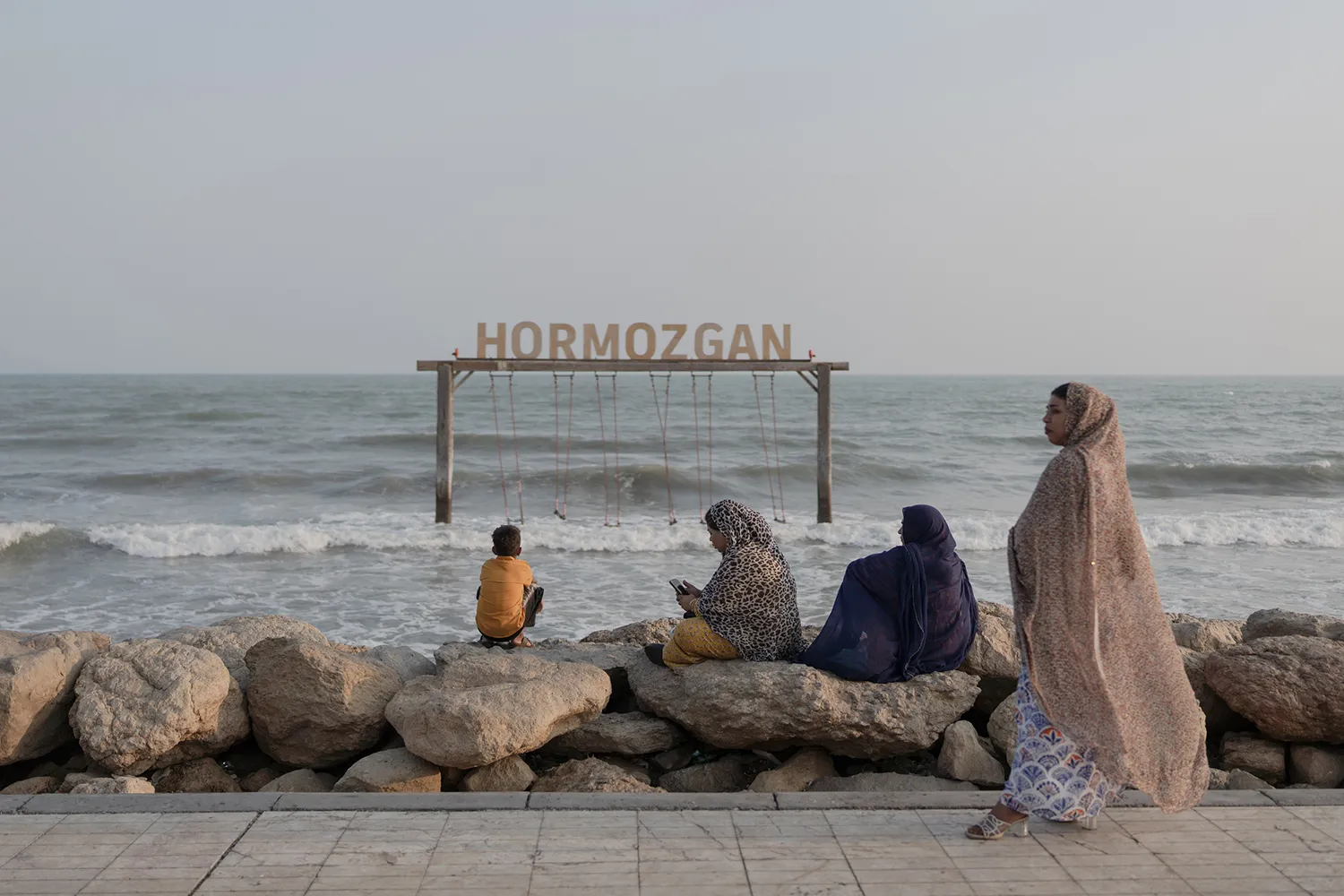
The beach in Bandar Abbas on Sept. 19, where crowds gather for picnics after sunset as the weather cools down.

Twenty-three-year-old Kiana (foreground) poses for a portrait at the seaside on Sept. 19. She traveled to Bandar Abbas from Kerman with her family for a holiday.

The beach in Bandar Abbas on Sept. 23.
In the evenings, when the heat and humidity become more bearable, people venture out along the corniche to meet friends, catch the sea breeze, grab a snack, or pose for photographs. It’s a laid-back atmosphere as the streets fill up. There’s music in the air, and occasionally, some people even dance.
But farther out, tankers remain stranded in the strait, some of them visible from the shoreline. The occasional sounds of explosions are carried across the water.

A beached boat near the shore of Bandar Abbas on Sept. 20. Locals offer conflicting accounts of its provenance; some say it was not there before the war and others that something happened to it during the conflict with the United States and Israel.
“We’ve gotten used to it,” Zeynab said. “The explosions and fighter jets are normal to us now.”

A woman wades offshore in Bandar Abbas on Sept. 23.
