


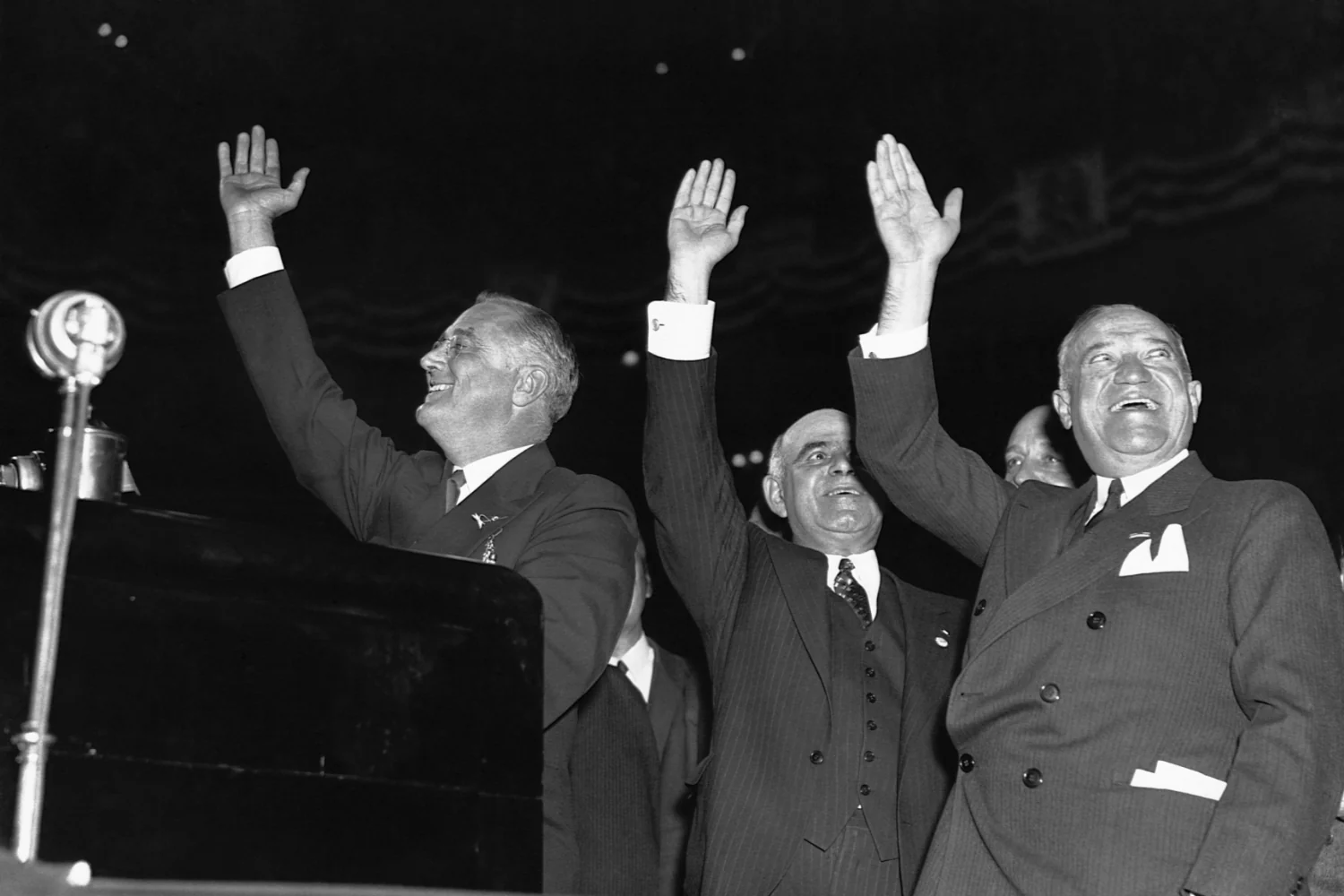
As Election Day approaches, the president of the United States is onstage, lambasting the powerful forces ranged against him—the judges, the media, the ultra-wealthy. Addressing 20,000 of the millions of regular Americans who love him, he defies his enemies, declaring, “They are unanimous in their hate for me—and I welcome their hatred!” The crowd roars.
Oct. 31 marks 90 years since President Franklin Delano Roosevelt delivered that speech at Madison Square Garden, as the 1936 presidential race neared its climax. In a world again beset by angry populists stoking economic distress, the rise of autocrats, and the floundering of moderate politicians, Roosevelt’s barnburner speech has come to seem relevant once more.
Roosevelt had entered office ready to work with established power as he launched his reflationary, state-expanding New Deal. Yet the president had grown increasingly frustrated by the obstructiveness of the Supreme Court—which had blocked programs such as the National Recovery Administration, designed to end “cut-throat” competition—and by the hostility of newspapers and tycoons. His enemies insinuated that he was a communist, and a would-be dictator. He also faced the rise of the radical right, which sought to exploit the public’s fear and frustration.
Roosevelt realized that by facing down the “economic royalists,” as he put it in his acceptance speech at the 1936 Democratic National Convention, he could cast himself as the people’s tribune, uniting the disparate groups supporting him. In that speech on Halloween, he warned that “powerful influences” were striving to bring back leaders who were “indifferent” to ordinary Americans’ economic plight. “Government by organized money,” he charged, was “just as dangerous as government by organized mob.” He hoped in his second term to become such forces’ “master.” Three days later, almost 61 percent of voters backed him, in one of the most decisive presidential election victories in U.S. history.
The speech resonates today even in that land of actual royalists, the United Kingdom. In the 2019 general election, the left-wing Labour Party leader Jeremy Corbyn quoted Roosevelt’s speech. But since then, political commentators, most of whom were never keen on Corbynism, have done the same. Their overarching goal is to ensure, as Roosevelt did, that power does not fall to the radical right.
In 2024, Corbyn’s successor, Keir Starmer, lead Labour to back into office, in an election marked by widespread public frustration with the long-dominant parties. From the left, the Greens and “Gaza independents” made gains, while support for the far-right party Reform UK hit 14 per cent—and has continued to rise. When it became clear that the new prime minister’s response was to remain stolidly managerial while at times adopting the language of Reform’s own arguments, liberal-left fears rose too.
In the two years that followed, a series of voices—in the Guardian, the London Times, and elsewhere—called for Starmer to learn from Roosevelt’s tub-thumping at Madison Square Garden. The prime minister, they argued, should pick battles with entrenched interests, carving out a clear narrative about how overcoming those interests would improve voters’ lives.
Labour Party leader Jeremy Corbyn speaks at Birmingham City University in Birmingham, England, on Nov. 21, 2019.Christopher Furlong/Getty Images
Writing in Prospect magazine, Ben Ansell, professor of comparative democratic institutions at Oxford, was one of those arguing that the speech offered the center-left a model for beating the radical right by using its own populist means against it. In January, as Starmer’s popular support plumbed terminal new depths, the veteran pollster Peter Kellner called on him to learn from Roosevelt’s speech by “declaring war” on the champions of Brexit. “Would he be taking a risk?” Kellner added. “Absolutely — and that’s the point.”
Starmer didn’t have it in him, but this was never just about his personal skillset. Across the democratic world, the center-left has been under pressure for a decade to find effective ways to respond to right-wing populism, as exacerbated by social media. Now that Starmer has been replaced by the former mayor of Greater Manchester, Andy Burnham (a politician much more ready to talk about power), those same voices reiterate their case. They point to the punchier approach taken by the prime ministers of Spain and Australia, and the success of Manuela Schwesig, the Social Democratic premier of the east German state of Mecklenburg-Western Pomerania, in holding back the advance of the extreme right Alternative for Germany (AfD).
Political scientist Robert Ford is the author of books on the radical right and Brexit. He plays his students at the University of Manchester footage of Roosevelt’s speech, he told me, because “it shows us how much bolder a center-left politician was 90 years ago.” As the center-right loses ground to its more populist rivals, he argued, the left and the radical right are “coalescing around in-group/out-group politics at a mass level, whatever politicians do.” This is forcing center-left politicians to ask themselves, “How can we best make use of this?” Roosevelt’s us-against-them speech offers a useful example, Ford suggested, because the genial president delivered “a polarizing message in a non-polarizing tone”—a trick he thinks Burnham is well-placed to copy.
Within weeks of Starmer’s election, the Guardian columnist and historian Andy Beckett exhorted him to emulate Roosevelt’s speech. Now, nearly two and a half years later, Beckett told me that the more consensual tone struck so effectively by social democrats in the buoyant 1990s has been “tested to destruction.” In a period of widespread economic insecurity and visibly extreme inequality, “if social democracy has any chance now, as in the 1930s, it’s got to be much more aggressive rhetorically.” Roosevelt’s example, he said, offers a way for center-left leaders to unite with their more left-wing colleagues against a common enemy.
Each of those pointing back to the speech appears to have alighted on it independently, as they combed history for ways out of the British center-left’s constraints. This makes it all the more striking that they all homed in on the same oration, and a U.S. one at that. But then, Britain’s political pantheon lacks a figure like Roosevelt: at once centrist by instinct, radical by necessity, and charismatic by nature. Perhaps the nearest equivalent is Tony Blair, but he was never driven to declare war on entrenched power in the midst of economic crisis.
The question Roosevelt’s example raises for today’s Labour leaders is: which enemy? Ansell said that Burnham tried targeting the bond markets, which “didn’t work quite so brilliantly.” He might focus more fruitfully on exploitative gambling companies, Ansell suggested, or right-wing British tycoons who denounce their home country from tax exile. Or the heads of the United Kingdom’s notoriously inefficient privatized utility companies.
Ford, however, contends that Labour should concentrate its fire on perhaps the most aggressive expression of private power: big tech, and specifically Elon Musk. As populists have demonstrated, putting a face on the enemy can help dramatize political fights, and bolster public support. In the wake of a series of inflammatory interventions over such issues as immigration and free speech, Musk is very unpopular in the U.K. In 2025, he appeared by video link at an extreme right rally in London and told the crowd that “you either fight back or you die.” A few months later there came the scandal over Musk’s AI, Grok, producing images of child sexual abuse. Ford suggests Musk’s public stances make him “a golden opportunity for any center-left populist looking to do a bit of an FDR.”

Roosevelt signs the Glass-Steagall banking reform act at the White House in Washington on June 16, 1933.Universal Images Group/Getty Images
In the United States itself, where the radical right is already in power, Roosevelt’s speech has been pressed into service too—but not by the sort of moderates from whom critics long to hear it. In 2018, Maureen Dowd of the New York Times used it to criticize Barack Obama for failing to take an Roosevelt-style approach to the bankers who caused the 2008 crash. While this was historically unfair—Roosevelt, like Obama, initially bailed the banks out—it highlights the fact that Roosevelt’s controversial address remains the province of those to Obama’s left.
Elizabeth Warren has embraced the speech since at least 2015; Bernie Sanders has repeatedly conjured it too, as in a speech on June 13, 2019, where it triggered a raucous standing ovation. In 2025, Jamie Raskin clipped the speech in a tweet endorsing the “Rooseveltian” now-Mayor of New York City Zohran Mamdani.
In April, Democratic Rep. Greg Casar used it to help launch the Congressional Progressive Caucus’ 10-plank agenda for this year’s mid-term elections, which is focused on stopping “price gouging” by corporations and “[abolishing the unlimited spending power of Super PACs.” Much more contentiously, the far-left streamer Hasan Piker used the line on X to fend off accusations of antisemitism, after saying that “if Jews in America keep putting this idea out there that they are singularly invested in Israel, eventually someone is going to come around and take action.”

U.S. Sen. Bernie Sanders delivers a speech in Washington, D.C., on July 17, 2019. Cheriss May/Getty Images
Casar’s approach seems much more effective than Piker’s, explicitly aiming to bring left and moderate Democrats together around economic policies intended to re-channel populist anger away from the targets that President Donald Trump attacks, toward those the left blames for the cost-of-living crisis. For this to work, however, moderate Democrats might need to go beyond their attacks on “billionaires” and “the Epstein class,” and strive to match the bravura of their most successful ancestor.
The real lesson of the speech is not that welcoming the hatred of plutocrats is always effective, no matter who says it. Those lines landed precisely because they were not delivered by an angry leftist, but a cool-tempered centrist, driven finally to declare that the vested interests had gone too far.
In the United States, as in the U.K. and elsewhere, the potential impact of adopting Roosevelt’s strategy lies in that clarifying surprise.
