



In the Alaska Senate race, the candidacy of retired teacher Daniel J. Sullivan Jr. — not the incumbent Republican senator, Dan S. Sullivan — has been the subject of months of legal wrangling. But the issue took on increased national prominence this past week.
At the behest of President Donald Trump, the Department of Justice took the unusual step on Oct. 22 of filing a preemptive lawsuit arguing that if Sen. Sullivan doesn’t win reelection, and if he loses to his Democratic opponent Mary Peltola by fewer votes than Daniel J. Sullivan gets, the state should “not certify any election result that may be impacted by voter confusion.”
Then, on Oct. 28, the New York Times dropped a story saying it had uncovered evidence that “operatives aligned with Mary Peltola” helped to recruit Daniel J. Sullivan and others to run for the Senate seat in an attempt to siphon votes away from the incumbent Sullivan. The next day, in response to the Times story, Alaska Gov. Mike Dunleavy, a Republican, ordered a criminal investigation to determine if any Alaska criminal laws were violated.
Trump, meanwhile, has weighed in, calling the issue “voter fraud at the highest level” and saying, “Peltola should resign from the race. I think she should be prosecuted criminally for what she did.”
On Oct. 29, Peltola denied she had any knowledge of or participation in recruiting another Dan Sullivan to run in the race.
“I just want to clear the air,” Peltola said. “I knew nothing about any other candidates on the ballot except for me and the incumbent. That is all I have ever known about. I am not interested in tricking voters.”
With less than a week until Election Day, we’ll lay out the facts of what’s known so far, and the legal history leading up to this point.
The Primary Fight
Shortly after Daniel J. Sullivan officially declared his candidacy in late May, Sen. Dan Sullivan objected, saying that he was a sham candidate.
“His whole purpose of running is to confuse Alaskans,” Sen. Sullivan told CNN on June 7, to make Alaskan voters think, “that somehow he’s me, so they could rig the vote in favor of Mary Peltola.”
Acting on a complaint from the state GOP, Alaska Lt. Gov. Nancy Dahlstrom, a Republican who supervises the state’s Division of Elections, announced on June 8 that the state had opened an investigation into the legitimacy of Daniel J. Sullivan’s campaign.

“I’m troubled by the allegation that you filed for office in coordination with another campaign with the intention of confusing Alaskan voters in a way that will benefit one candidate over another,” Dahlstrom wrote in a June 8 letter to Daniel J. Sullivan. “If true, it suggests that your declaration of candidacy, which was submitted under penalty of perjury, was not genuine and not properly filed.”
Daniel J. Sullivan responded in a letter to Dahlstrom two days later, saying the allegations were “entirely false.”
“I am running for U.S. Senate as a Republican under my lawfully given name,” Daniel J. Sullivan wrote. “It is a name and party affiliation that I share with my father and my grandfather. I am not a registered Democrat, and I have had no conversations whatsoever with the Peltola campaign about my candidacy. The law forbids your office from denying me access to the ballot just because Senator Sullivan and the NRSC [National Republican Senatorial Committee] would prefer I not be allowed to run. This investigation by your office – and coordination of it with the press – is an unprecedented affront to my rights as a candidate and the rights of Alaska voters to select their own representation in the U.S. Senate.”
On June 15, Carol Beecher, director of the state’s Division of Elections, released the division’s final determination that “the preponderance of evidence [did] not support” Daniel J. Sullivan’s eligibility to run for the Senate. Beecher said she concluded that his bid was not “an actual good-faith candidacy for the office of United States Senator, but was instead filed with a purpose to confuse or mislead.” Beecher noted that Daniel J. Sullivan had “requested to be designated on the ballot as affiliated with the Republican Party” even though “[u]ntil two days before you filed your declaration of candidacy, you had never—according to the Division’s records—been affiliated with the Republican Party in Alaska.”
Daniel J. Sullivan appealed, and on June 27, Alaska Superior Court Judge Thomas A. Matthews overturned Beecher’s decision, saying that the Division of Election’s “decision to exclude Mr. Sullivan from the primary ballot was based on a ‘good-faith’ requirement that does not appear in the U.S. Constitution, the Alaska Statutes, or the implementing regulations adopted by the Division.”
The ruling to allow Daniel J. Sullivan to appear on the primary ballot was later affirmed by the state Supreme Court. During oral arguments, Alaska Public Media reported, the justices “repeatedly returned to the idea that the division could just differentiate the two candidates, with, for example, middle initials.”
Chief Justice Susan Carney said the Division of Elections had chosen “the most extreme remedy possible” when it removed him from the ballot.
And so Daniel J. Sullivan was among 16 candidates on the ballot for Alaska’s Aug. 18 primary. The top four voter-getters to move on to the general election, in order, were: Peltola, 49.54%; Sen. Dan. S. Sullivan, 41.4%; Daniel J. Sullivan Jr., 2.47%; and Gerald L. Heikes, 1.05%. (Another Democratic candidate was originally in the top four but dropped out of the race.)
Ranked Choice Voting
Alaska has nonpartisan primaries, meaning that the top four vote-getters advance to the general election, regardless of political affiliation. The general elections are determined by ranked choice voting, which allows voters to rank their preferred candidates in order.
If no candidate gets more than 50% of the vote in the initial round, the last place finisher is eliminated, and votes on ballots cast for that candidate then go to the voter’s second choice, and so on, until one candidate crosses the 50% threshold.
The race, according to polling, is extraordinarily close, and the Cook Political Report rates it a toss-up.
The lawsuit filed by DOJ argues, “[T]here is a realistic chance that, even if a majority of Alaskans wish to vote for Senator Sullivan, Daniel J. Sullivan’s presence on the ballot will result in a victory for Peltola.”
The suit claims the election would be deemed “impacted by voter confusion” if Sen. Sullivan does not win the election but would have if all the votes cast for Daniel J. Sullivan were instead cast for Sen. Sullivan. In such an event, the lawsuit asks the federal court to prohibit the state from certifying the election results “pending an investigation to determine whether votes cast for Daniel J. Sullivan were meant to be cast for Senator Sullivan.”
Trump has criticized the state’s ranked choice voting as “crooked as can be” and said that without it, incumbent “Dan Sullivan would win easily.” But some election experts say that system could actually blunt the effect of a spoiler candidate.
“The scheme is much less impactful in Alaska than just about anywhere else,” Nicholas Stephanopoulos, a professor at Harvard Law School who specializes in election law, told us via email. “If an Alaska voter ranks the wrong Dan Sullivan first, it’s not a big deal if she ranks the right Dan Sullivan second. In any state without [ranked choice voting], on the other hand, that voter would actually end up wasting her vote.”
The DOJ Lawsuit
The day after the DOJ filed its complaint, Trump confirmed the lawsuit was filed at his behest. “I’m the one that said do it,” Trump told reporters.
The lawsuit alleges a violation of a provision of the National Voter Registration Act that concerns “protect[ing] the integrity of the electoral process.”
“Given the substantial likelihood that the inclusion of Daniel J. Sullivan will confuse or mislead voters looking to cast a vote for Senator Sullivan, and thus distort the will of Alaskan voters, there is a substantial likelihood that a certification of the election will reflect an electoral process that lacked integrity,” the lawsuit states.
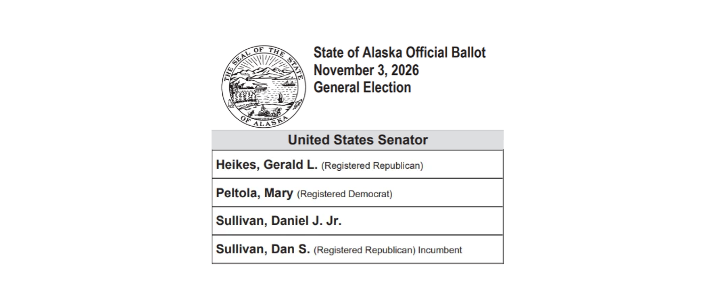
Peltola told MS NOW that the way the names will be displayed on the ballot should alleviate any confusion. The lawsuit is “sending a message that Dan Sullivan does not believe that Alaskans are sophisticated enough to know exactly who they’re voting for,” she said.
Trump, however, opined that the ballot at least ought to say “Senator” Dan Sullivan “as opposed to ‘incumbent’ because a lot of people don’t know what ‘incumbent’ means.”
Here’s how the names will appear on the general election ballot on Nov. 3, per the Division of Elections:
Several election experts doubt the DOJ lawsuit will be victorious, though it could delay the process of certifying a winner.
In a Q&A with the Harvard Gazette, Stephanopoulos, the Harvard law professor, said he thinks the complaint “has zero legal merit and is one of the weakest lawsuits that I can ever remember seeing.”
He noted that the DOJ invoked the National Voter Registration Act, “which is exclusively a law about voter registration. The lawsuit has nothing to do with voter registration. There’s no allegation that anybody is improperly registered in Alaska; there’s no claim that Alaska isn’t in compliance with the NVRA’s requirements for voter registration. Instead, the DOJ found a provision in the preamble to the NVRA that mentions ‘election integrity.’ … It’s preposterous to argue that this random snippet in the preamble somehow entitles the DOJ or anybody else to sue over concerns about election integrity.”
“There’s no relevant federal law. It’s exclusively a matter of state law whether to allow this or not,” Stephanopoulos wrote.
In a statement released in response to the DOJ lawsuit, David Becker, executive director of the Center for Election Innovation & Research, a nonpartisan nonprofit, said, “The Justice Department’s lawsuit in Alaska represents an unprecedented intervention by the federal government. This is purely a matter of state law, and the administration has absolutely no authority to tell Alaska when or how to certify the results of its Senate election. The DOJ attempting to intervene at this late stage is entirely against department policy, as there is no legitimate enforcement of federal law here, and it raises serious concerns about political interference.”
The New York Times Story
The Oct. 28 New York Times story, sourced to “interviews and text messages, along with documents prepared for a potential lawsuit against the campaign,” concluded that “not only did Ms. Peltola’s team work with people trying to recruit Mr. Sullivan to run for Senate, but the effort was much broader. The group worked to coax other would-be spoilers into the race, to dilute the incumbent’s support and help catapult the Democrat to victory.”
The story said a Peltola campaign staffer was tasked with finding as many people named Dan Sullivan in Alaska as possible. The story also documented the involvement of a Midwestern political operative who met with a number of potential spoiler candidates to convince them to enter the race.
The story said that in addition to Daniel J. Sullivan, Gerald Heikes, another candidate who will appear on the ballot as a Republican, was recruited into the race.
“Ballot-stacking tactics are common in politics and generally considered legal — and have been employed by both parties in Alaska,” the Times story said. “But this operation … reveals the lengths to which Democrats went to seek advantage in a Senate race that could determine control of the chamber.”
The Times story quoted Peltola’s former campaign manager, who was fired in August, saying that while Peltola was not directly involved in the scheme, she was “definitely aware.” (The former campaign manager later tried to retract her statements to the Times.) As we said, Peltola has denied any knowledge of or participation in recruiting another Dan Sullivan to run in the race. And the Peltola campaign and Democratic Senatorial Campaign Committee both told the Times they had no involvement in recruiting any candidates into the race either.
The DOJ has amended its complaint to include reporting in the Times’ story. In a post on X on Oct. 29, Dunleavy, the state’s governor, also cited the Times’ reporting, saying the story revealed “disturbing new evidence of an organized effort to manipulate Alaska’s elections by recruiting candidates … to deliberately confuse voters and misdirect their votes.” Dunleavy said he had directed the Department of Public Safety “to investigate whether this scheme violated Alaska’s laws and whether criminal charges or civil action are warranted. The evidence will determine what happens next.”
According to the Election Rumor Research team at the University of Washington’s Center for an Informed Public, “Past elections have seen contestation over similarly named candidates — though often with the political parties reversed.” The blog post cited the 2024 example of two people named Bob Ferguson recruited by a conservative political activist to challenge the Democratic frontrunner, Bob Ferguson, in a Washington gubernatorial race. It also referenced a 2024 Utah gubernatorial race, a Republican primary, in which two other people with the last name Lyman joined Phil Lyman as write-in candidates.
“The practice of standing ‘ghost candidates’ is not illegal,” the researchers wrote. But there have been instances — such as in a Florida state Senate race in 2020 when improper payments were made to a “ghost” candidate’s campaign — when such schemes have run afoul of the law.
Ballot-stacking schemes are “unsavory,” Harvard’s Stephanopoulos told us, “but it’s not illegal (and it’s a familiar practice in past elections).”
Editor’s note: FactCheck.org does not accept advertising. We rely on grants and individual donations from people like you. Please consider a donation. Credit card donations may be made through our “Donate” page. If you prefer to give by check, send to: FactCheck.org, Annenberg Public Policy Center, P.O. Box 58100, Philadelphia, PA 19102.
