


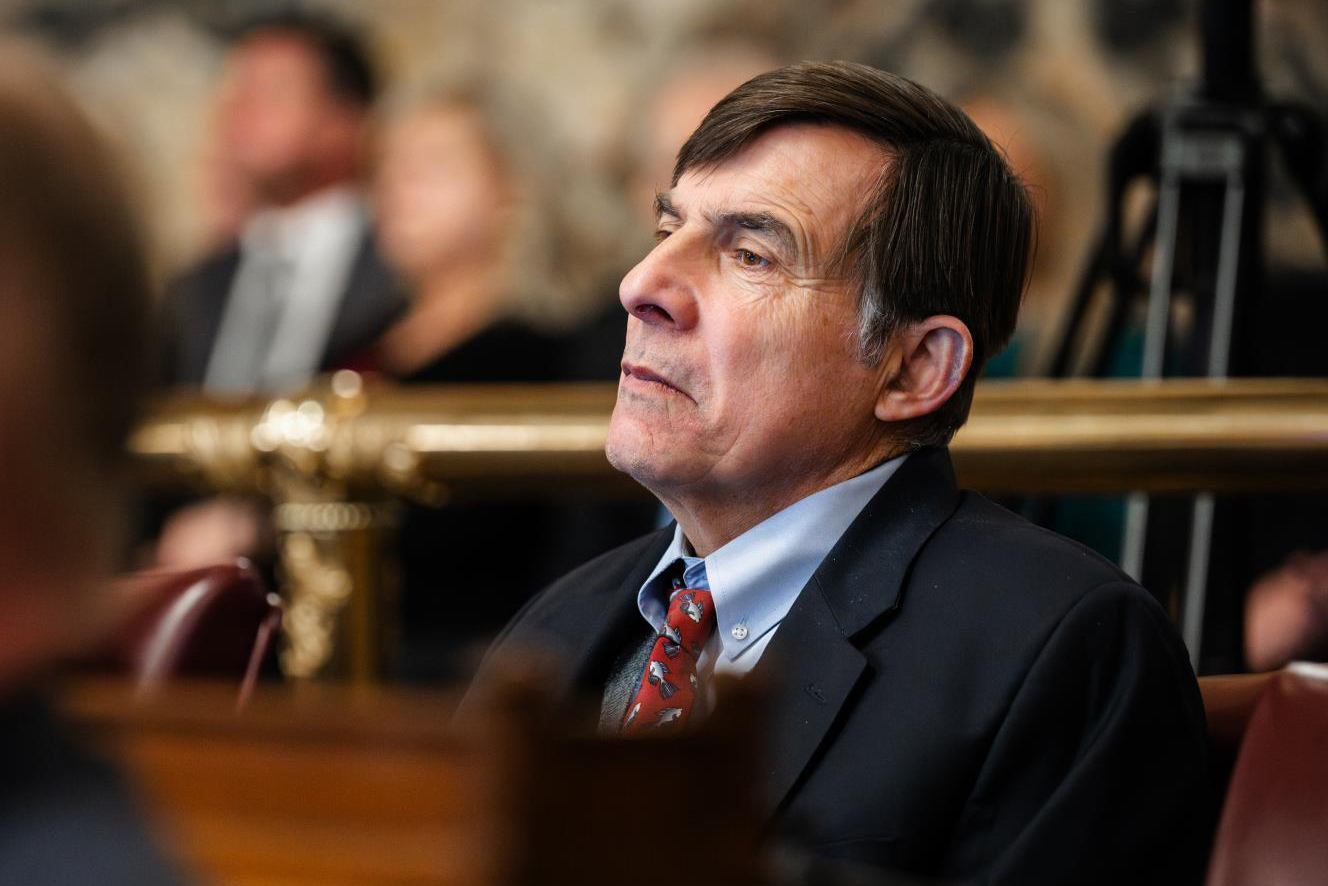
In what might have been his last hearing as chair of Pennsylvania’s House Environmental and Natural Resource Protection committee, long-time Democratic state Rep. Greg Vitali seemed to have little interest in soaking it all in.
During the October hearing, Vitali instead furrowed his brow as he watched a parade of witnesses discussing “roadspreading,” a practice in which some oil and gas companies dump waste brine from drilling on rural roadways, ostensibly to help control dust.
The regulations governing roadspreading are riddled with complex loopholes, and Vitali called the hearing after state officials issued a roadspreading permit he took issue with. That move proved the most recent example of a recalcitrance that may have contributed to ending Vitali’s decades-long career in Pennsylvania’s legislature earlier this year.
But if his loss in a competitive primary in his suburban Philadelphia district was humbling, Vitali seems determined to keep advocating for the climate and environmental issues he has always cared about. For the past 34 years, no one in the state legislature has spoken out more consistently or forcefully for fossil fuel regulation or clean energy alternatives in Pennsylvania, even as political polarization and the rise of the gas industry made those positions increasingly embattled. Vitali was the first Pennsylvania lawmaker to introduce climate change legislation and a chief advocate pushing for a “severance” tax on gas drilling in the state during the fracking boom.
David Hess, a former secretary of the Pennsylvania Department of Environmental Protection, said what really sets Vitali apart is his willingness to act as a thorn in the side of even his own party’s leadership.
“I think, in some ways, he became sort of the conscience of the Democratic caucus on a lot of environmental issues,” Hess said. “Some people admired him for that. Some people didn’t admire him for that because he was very plain-spoken.”
Now Pennsylvania will find out what it’s like not to hear his voice in Harrisburg at all. Some of Vitali’s critics welcome his impending exit at the end of November, contending that his principled stands made it more difficult to forge the kind of compromises that are necessary to pass laws in a divided government. His allies think the state will be worse off without his dedication to the environment and sense of moral clarity.
With the House’s current term winding down, Democratic state Rep. Danielle Friel Otten said Vitali’s calling of the October hearing was like a teacher assigning homework on the penultimate day of school: Otten was one of just six lawmakers present from the 27-member committee. Even after Republican Minority Chair Rep. Jack Rader Jr. closed the hearing by thanking Vitali for his time in office, which began in 1992, Vitali signaled he still has miles to go.
“Oh, we’ve got almost two months left,” Vitali said with a wry smile. “You’re not done.”
Filling a Leadership Vacuum
Vitali’s career in politics began with a recycling regulation. In 1988, Pennsylvania passed Act 101, requiring large municipalities to provide curbside recycling for the first time. In Vitali’s view, his local Haverford Township was only doing the “bare minimum” the law required. He said he had an interest in environmental topics dating to when they rose to the top of the priority list for Democratic activists following the Vietnam War. Then a young lawyer, Act 101 became his personal call to action.
“I actually set up my mother’s card table by a recycling center and got signatures on a petition for the township to do more recycling, and took those to a township meeting,” Vitali said, adding the effort was ultimately successful. “It struck me that people wanted to make a contribution, but not be the prime mover or leader. And I felt I was filling a leadership vacuum.”
That solo effort grew into a drive to push surrounding Delaware County to establish a household hazardous waste collection program, which in turn provided the political base on which Vitali launched his first campaign for the State House in 1992. That year, he won the open seat for Pennsylvania’s 166th House District, previously held by a Republican. When the next session began, Vitali made the environment committee his first choice and got the assignment.
The first half of his career in Harrisburg was relatively fruitful. In 2004, he was among the Pennsylvania House members who voted for the Pennsylvania Alternative Energy Portfolio Standards, among the first regulations in the country to require electric utilities to purchase power from renewable sources like wind and solar. That same year, he introduced the legislature’s first-ever climate specific bill to require the state DEP to develop an inventory of greenhouse gas emissions, and in 2008 co-sponsored a similar bill that passed both chambers and became law.
That same year also saw the passage of Act 129, a so-called “smart metering” bill that supported statewide energy efficiency measures for utilities. John Hanger, then secretary of the DEP, said Vitali played a “significant role in its passage.”
Then came seismic shifts: Pennsylvania’s Marcellus Shale natural gas boom took off, enabled by advances in hydraulic fracturing, just as national political discourse began to polarize in the wake of the Obama presidency. Since then, even Vitali acknowledges his legislative track record has been more limited.
“It’s very difficult doing climate policy in Pennsylvania. Obviously, it has a lot of coal and oil and natural gas. So when you choose climate policy as the most important thing to work on, your life is not going to be filled with victories,” Vitali said. “It’s been frustrating. I like to give myself credit for being at the plate swinging.”
Exhibit A is Vitali’s crusade to pass a severance tax. As Pennsylvania shale gas production took off in the late aughts, efforts to institute a tax on its production followed soon after. Democrats managed to approve a House measure to institute a tax when they controlled the chamber in 2009, but the measure died acrimoniously when negotiations between the Republican-controlled Senate and outgoing Democratic Gov. Ed Rendell broke down.
Vitali introduced another severance tax proposal the next session. But by then Republicans had won full control of state government, and a separate, less-lucrative impact fee on natural gas wells was instituted. (Vitali, like most Democrats, was a “No” vote.)
Before long, Vitali also found himself battling it out with members of his own party. In June 2016, three years after he became minority chairman of what was then the House Environmental Resources and Energy Committee, Vitali blasted then-Gov. Tom Wolf, a Democrat, over his perceived wavering on oil and gas regulations. He also criticized the governor for the exit of DEP secretary John Quigley, who left office a month earlier after emails surfaced in which Quigley forcefully urged environmental groups to fight for the regulations. Later that year Vitali again criticized Democratic colleagues in the legislature, including over a proposal to ban fees on plastic bags.
He found himself in the office of then-House Minority Leader Frank Dermody, who stripped Vitali of his chairmanship and stuck him in a different committee. But if the goal was to teach Vitali a lesson, it failed.
The Costs of Consistency
Two years after his demotion, Vitali returned to his committee position because, he said, no one else wanted the job. In 2023, he had another stroke of luck when the Democrats won the House, and Vitali suddenly found himself for the first time as majority chair of the committee he’d served on for two decades.
Democratic colleagues on his committee speak favorably of his leadership. Friel Otten recalled how Vitali helped her navigate her own low point as a freshman lawmaker in 2018, when she was criticized for posting controversial statements on social media. Vitali, she said, offered advice to regularly connect with constituents in order to cut through the noise of the internet and politics. Vitali told her that he tries to knock on 25 doors every day he’s in his district in order to take the pulse of people’s opinions.
“I share that advice with people all the time,” Friel Otten said.
State Rep. Joe Webster, another Democratic committee member, said he believes that respect for Vitali crosses party lines due to the consistency of his principles, even when others don’t agree with them.
“I think because he’s faithful to that, that they respect that,” Webster said of Republican lawmakers.
This story is funded by readers like you.
Our nonprofit newsroom provides award-winning climate coverage free of charge and advertising. We rely on donations from readers like you to keep going. Please donate now to support our work.
But as is often the case for political firebrands of all stripes, there are persistent questions about how effective Vitali has proven at converting ideas into actual policy in Pennsylvania. Legislation he introduced focusing on natural gas drilling, roadspreading, and the tech industry over the past four years failed to become law, including a bill to remove hundreds of millions of dollars in tax breaks for data centers that passed the House 197-5 this year before stalling in the Senate.
The commonwealth is currently one of just four states with a divided legislature, as Democrats hold the House and Republicans the Senate. Democrats also hold just a three-member majority in the lower chamber, a razor-thin margin that requires policy buy-in from centrist Democrats hailing from gas-rich communities.
State Rep. Paul Takac, a Democratic member of Vitali’s committee from the center of the state, said the political landscape has proven tricky to navigate.
“We have a very diverse caucus in the House Democrats. We have everybody from urban and suburban to rural,” Takac said. “It’s difficult to build consensus around some of these highly politicized issues.”
Others argue that Vitali has demonstrated an ability to cut a deal. The 2004 Pennsylvania Alternative Energy Portfolio Standards also created subsidies for fossil fuel sources like waste coal, which environmental advocates have worried about ever since.
Hanger, who served as DEP secretary from 2008 to 2011, said Vitali’s “Yes” vote on the bill shows he could compromise when there were willing partners. But since that time, Hanger argued, the Republican Party drifted nationally toward climate denialism, while there are now fewer centrist Republicans in Pennsylvania willing to cut a deal.
“I know he does make compromises,” Hanger said of Vitali. “But he was also fearless about saying things that needed to be said, fearless in challenging powerful industries and powerful figures that needed to be challenged.”
In his four years as majority chair, allies said, Vitali was more effective than some may realize.
Rob Altenburg, a former senior director of energy and climate for the nonprofit PennFuture, notes that in 2023, Vitali sought to eliminate similar tax breaks for cryptomining operations as part of a larger regulatory package that ultimately received pushback, including from his own party, and failed to pass. The next year, Vitali managed to slip language eliminating the tax breaks into another bill anyway.
“So there wasn’t a formal sponsorship there on his part,” Altenburg said. “But on issues like that, he’s been willing to sit down and think, ‘What’s the right [strategy] in this situation?’”
Vitali also said he saw a lot of his job while committee chair as playing defense, including advocating against cuts to DEP funding come budget time. Regardless, the job slipped from Vitali’s grasp.
In 2025, House Democratic leadership created a new Energy committee, removing that aspect of Vitali’s portfolio and giving it to state Rep. Elizabeth Fiedler, a Philadelphia Democrat with a swift-rising reputation as an effective lawmaker whose wins include bipartisan measures that provide funding to put solar panels on schools and require utilities to consider energy efficiency measures.
Things got worse for Vitali when a 41-year-old township commissioner named Judy Trombetta announced this January she would run for his seat.
Trombetta went on to win the endorsement of the local Delaware County Democratic Committee and defeated Vitali handily in a May primary. Some insiders speculate Trombetta’s candidacy was championed by the party establishment in retaliation for Vitali’s outspokenness.
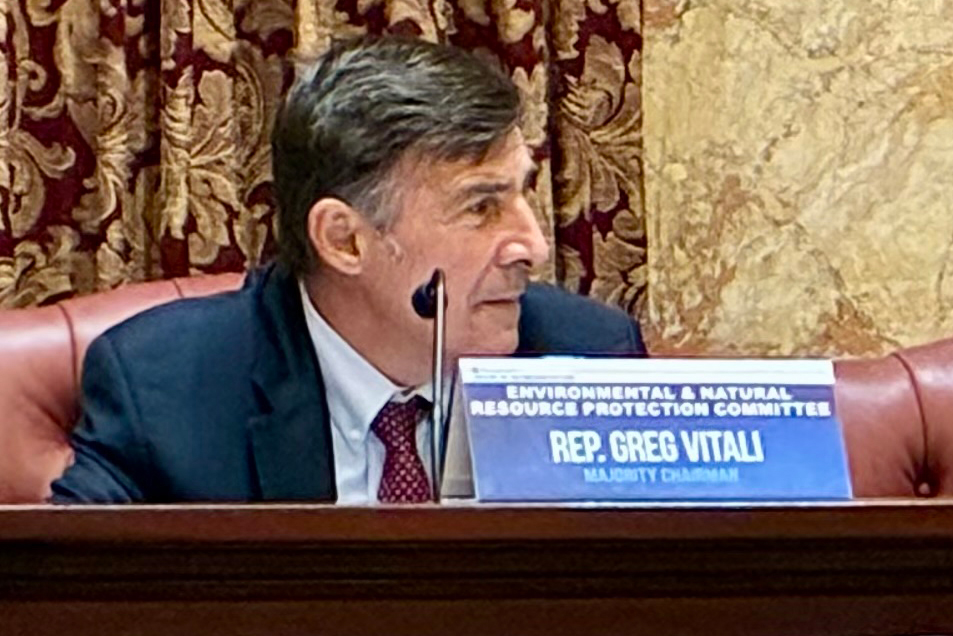
State Sen. Katie Muth, another Southeast Pennsylvania Democrat and firebrand on environmental issues, said she believes Vitali’s ousting was retributive and will have a chilling effect on other members.
“He’s being taught a lesson: ‘If you don’t [expletive] fall in line, we’re going to teach you a lesson. We’re going to make an example out of you,’” Muth said.
The Delaware County Democrats did not respond to a request for comment about their endorsement. The group also endorsed Vitali’s opponent in 2022, unsuccessfully, and Trombetta told local media outlets that while she respected Vitali as an environmental champion, she also believed he had “neglected numerous other constituencies on numerous other topics.”
Spokespersons for Democratic Gov. Josh Shapiro and House Speaker Joanna McClinton both spoke favorably of Vitali in emailed statements to Inside Climate News.
If Vitali holds any animosity about his fall from power, he doesn’t show it.
“Nothing retributive,” Vitali said of his ousting. “My primary opponent had her own career ambitions.”
Looking Ahead
Vitali said during an October interview in Harrisburg that he believes the state will struggle to pass stronger environmental policy even if Democrats win a trifecta in next month’s elections, and even if he was still part of the legislature in January.
The state’s oil and gas lobby has always been powerful, even among Democrats, he said.
He believes labor interests have also amassed too much power within his party in recent years, and that Shapiro is focused on running for president in 2028. (The governor has not yet declared his intentions and consistently says he remains focused on his current job.)
“Unions look at all issues through the lens of their own jobs. … They won’t let basic stuff pass,” Vitali said. “And the governor looks at all issues through the lens of his presidential ambitions, quite frankly. He values being aligned with labor more than he values being aligned with enviros.”
Rosie Lapowsky, Shapiro’s spokesperson, said the governor wishes Vitali well and “appreciates his long standing commitment” to environmental issues.
“Governor Shapiro is proud of his Administration’s record of protecting clean air and water, plugging abandoned wells, expanding clean energy, and holding polluters accountable,” Lapowsky wrote in an email. “There is more work to do, but the biggest obstacle to further progress has been Senate Republicans, who have repeatedly blocked commonsense proposals to expand clean energy and lower costs.”
The true impact of Vitali’s legacy may be borne out in the years ahead. Vitali said he sees promise in younger lawmakers, like Fiedler and several members of his committee.
“No one is irreplaceable,” he said.
But for advocates who have fought for years beside Vitali for better environmental and energy policy in Pennsylvania, his absence will be noticeable, especially as the state confronts a newer threat to clean air, water and land: data centers.
Altenburg said many Pennsylvania lawmakers on both sides of the aisle believe that building even more natural gas infrastructure should be the preeminent policy solution to power the controversial industry.
Vitali has been one of the few challenging that narrative, and it’s not clear who will pick up the mantle once he leaves office in late November, Altenburg said. “I think if we don’t have a voice like Greg’s, if we don’t have somebody telling people that that’s not the only solution, it’s hard to see a pathway to change.”
About This Story
Perhaps you noticed: This story, like all the news we publish, is free to read. That’s because Inside Climate News is a 501c3 nonprofit organization. We do not charge a subscription fee, lock our news behind a paywall, or clutter our website with ads. We make our news on climate and the environment freely available to you and anyone who wants it.
That’s not all. We also share our news for free with scores of other media organizations around the country. Many of them can’t afford to do environmental journalism of their own. We’ve built bureaus from coast to coast to report local stories, collaborate with local newsrooms and co-publish articles so that this vital work is shared as widely as possible.
Two of us launched ICN in 2007. Six years later we earned a Pulitzer Prize for National Reporting, and now we run the oldest and largest dedicated climate newsroom in the nation. We tell the story in all its complexity. We hold polluters accountable. We expose environmental injustice. We debunk misinformation. We scrutinize solutions and inspire action.
Donations from readers like you fund every aspect of what we do. If you don’t already, will you support our ongoing work, our reporting on the biggest crisis facing our planet, and help us reach even more readers in more places?
Please take a moment to make a tax-deductible donation. Every one of them makes a difference.
Thank you,
