


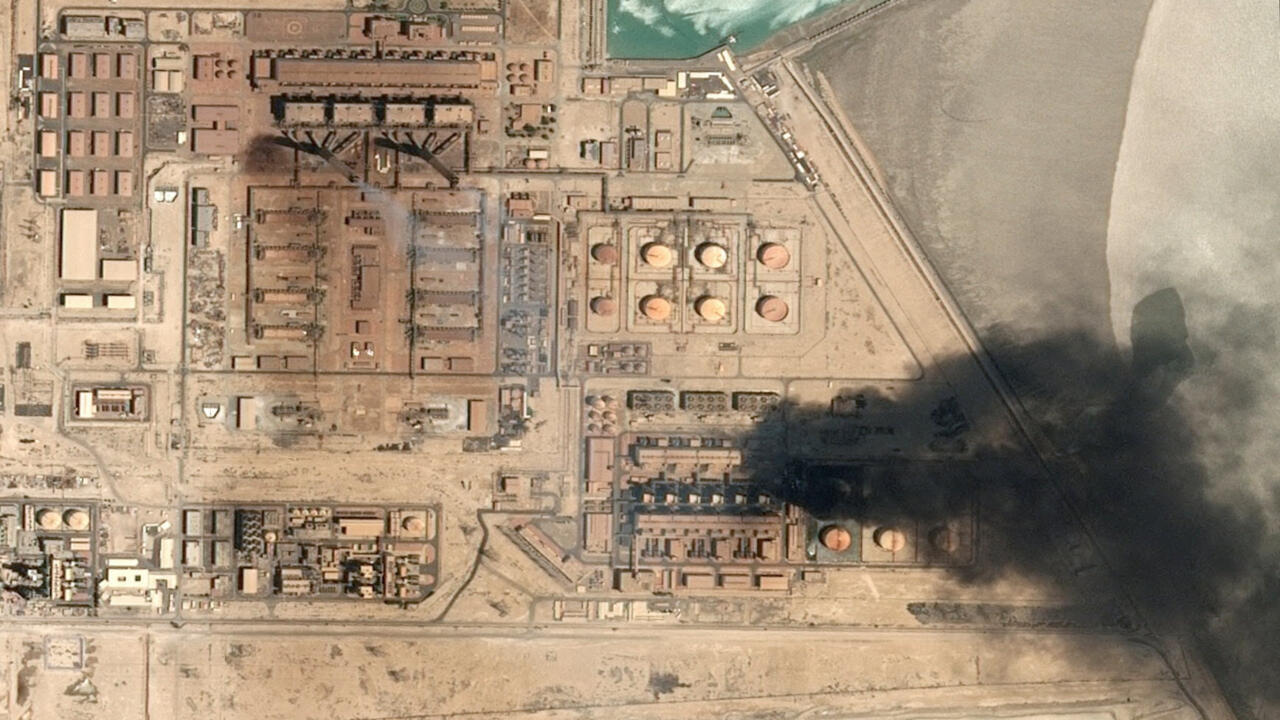
Concerns are mounting over Kuwait’s water supply after Iran once again struck power stations and desalination plants on Monday, sparking fires in a fourth consecutive day of attacks.
In response, authorities have asked the public to reduce their electricity consumption – particularly the use of energy-hungry air conditioning – to ensure an uninterrupted power supply.
Water anxieties in a desert region
Bahrain and Kuwait already saw Iranian strikes against their desalination plants back in March. But by striking these plants in the middle of summer, Iran has dealt a particularly painful blow to Kuwait.
Kuwait has virtually no freshwater resources and 90 percent of its drinking water is generated by seawater desalination plants. Moreover, Kuwait relies on cogeneration to produce both electricity and desalinated water at the same plant; with a single strike, Iran can cut off both water and power.
One of your browser extensions seems to be blocking the video player from loading. To watch this content, you may need to disable it on this site.
Tehran justifies these attacks by citing the US military presence in the country. With some 13,000 American troops on its soil, Kuwait hosts one of the largest US contingents in the region.
But Kuwait “also suffers the consequences of its geography”, said Raphaël Le Magoariec, an expert who specialises in geopolitics of the Gulf region. Located just a few hundred kilometres from Iranian territory, Kuwait is an “easy target” for Iran, which can cheaply and easily strike the country without having to resort to sophisticated technology.
Iran has accused Washington of using similar tactics when the US struck a desalination plant on Qeshm Island on March 7. Tehran said additional US strikes on July 18 destroyed the Bonji desalination plant near Djask and damaged another facility on Qeshm Island, depriving some 10,000 people of fresh water in around 20 villages, according to Iranian television. The United States has denied the accusations.
Read moreIran desalination plant in the Strait of Hormuz out of service following strikes
This type of conflict is “unprecedented in the region”, but foreseeable, according to Pierre Blanc, a lecturer in geopolitics at the Institute of Agricultural Sciences in Bordeaux and Sciences Po Bordeaux. “The major vulnerability of this water supply system is that it relies on a handful of desalination plants, which are extremely sensitive.”
Blanc says this is not the great “water war” that was feared because blocking access to water is not the main motive of these attacks. Instead, this is a war using water as a weapon, a war “fought through water”.
Kuwait unable to retaliate
Iranian media had reported Tehran’s plans to target cogeneration infrastructure as early as the end of January, said Clément Therme, a researcher at the International Institute for Iranian Studies.
Scarred by the trauma of the Gulf War, Kuwait has remained wary of regional geopolitical alignments. The ruling Al-Sabah dynasty has opposed normalisation with Israel but also refrained from threatening rhetoric towards Tehran, in contrast to several of its neighbours.
Nevertheless, Kuwait has been targeted by some 1,400 Iranian missile and drone attacks since February, according to an Israeli think tank, making it the most targeted country after the United Arab Emirates.
Read moreCivilian infrastructure hit as US and Iran escalate attacks across the Middle East
“There is no connection between a country’s political stance and being targeted by Iran,” said Therme.
Kuwait and the US interests stationed there are targeted because Kuwait “has no armed forces capable of retaliating … it is not going to go to war with Iran”, Therme said.
Kuwait’s vulnerability “allows Iran to inflict a cost on it without incurring any military consequences on its own territory”.
Since the US and Israel launched the war in Iran on February 28, Iran’s Foreign Minister Abbas Araghchi and President Masoud Pezeshkian have tried to “reassure” their Arab neighbours. The regional states are “brothers”, Pezeshkian reiterated in March, stating that the purpose of Iranian strikes on Muslim land was only ever to target US interests.
However, “when a desalination plant is targeted, especially in Kuwait, the first victim is not Washington but the civilian population”, noted Rachida-Chachida Ababsa, an independent researcher specialising in US policy in the Middle East.
“What Kuwait is experiencing today is something we did not experience even during the Iraqi invasion in terms of psychological pressure and not knowing where events are headed,” Kuwaiti civil servant, Nasser al-Dhafiri, told AFP.
Iran is also attempting to wage a “psychological war”, according to Ababsa. By showing that it can target such vital infrastructure despite a robust US military presence, Tehran is trying to demonstrate to the Gulf monarchies that Washington’s security umbrella is “neither total nor infallible”.
The ‘Great Satan’
According to Therme, the current conflict is a practical extension of the objectives of the 1979 Islamic Revolution, which called for Gulf States to sever ties with the US – the “Great Satan” – a precondition for good relations with Tehran.
Read moreGulf council blasts “war crimes” by Iran
A broader threat also looms over the region. The volume of naturally occurring freshwater available per capita in the countries of the Gulf Cooperation Council (GCC) – Saudi Arabia, Oman, Kuwait, Bahrain, the UAE and Qatar – is expected to fall to 59m3 by 2050 from 95m3, a contraction of almost 38 percent, according to the Defence and Climate Observatory.
Once dotted with modest fishing villages, the coasts of the Arabian Sea were transformed by skyscrapers amid the oil rush in the second half of the 20th century.
From air conditioning to desalination, modern life in Kuwait and other Gulf states relies on technology made possible by hydrocarbons.
Le Magoariec says climate change is often “swept under the carpet” by the ruling monarchies for this reason: tackling such a vast challenge would call into question the regional regimes that depend entirely on oil revenue to power the technologies that render otherwise uninhabitable areas hospitable.
By targeting desalination plants, Le Mogoariec says Iran is waging a war “against the very habitability of the region”.
This article has been translated from the original in French by Simon Feisthauer Fournet.
