


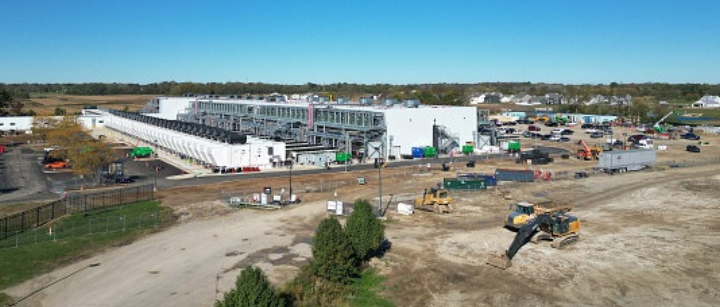
It’s now taken for granted that data centers across the U.S. are driving up electricity prices. As many Americans have soured on the energy-consuming facilities powering digital life and the AI boom, the issue has become central to the midterm elections.
Ad after political ad targets data centers, with many stating as fact that electricity prices have gone up as a result.
“No one asked for that data center to be built here, and no one here is getting a damn thing from it except higher electric bills,” one ad in Ohio, paid for by Democratic Senate candidate Sherrod Brown, says.
Another ad in Texas, from Democratic Senate candidate James Talarico, alleges that his Republican opponent’s support for data centers led to “skyrocketing utility bills.”
Tens of millions of dollars have been spent airing ads that make claims about data centers and electricity prices this cycle, with heavy spending on races in states such as Ohio, Texas, Pennsylvania and Michigan, according to the ad-tracking service AdImpact.
Recent surveys have found that a majority of Americans would not support a nearby data center, making opposition to the facilities a rare area of bipartisan agreement. The top reason to oppose data centers, according to one poll, is rising electricity prices.
At the same time, Department of Energy Secretary Chris Wright has repeatedly claimed that data centers have beneficial effects on electricity prices.
“The actual record of data centers coming on is they almost always are accompanied by a multiyear freeze in electricity prices. So, in real terms, a gradual decline in the cost of electricity,” he said on Sept. 17 at an event hosted by the conservative news outlet the Daily Caller. “These are a massive force to reduce the price of electricity and stop the price rises.”
Wright is correct that in principle, data centers could bring down prices. According to some analyses, that’s even happened in some places. But he fails to mention data, including from his own agency, that show that the opposite is also happening for many Americans.
At least for the PJM Interconnection, the nation’s largest grid operator serving more than 65 million people in the Midwest and mid-Atlantic, prices have likely gone up as a result of data centers.
A July report from the Lawrence Berkeley National Laboratory, one of the DOE’s federal labs, and the economic consulting firm the Brattle Group, found that increased demand, or load growth, including from large data centers, contributed to “significant” price increases in the PJM region in 2025.

Still, the report makes the point that most of the observed price increases in the past few years are not due to data centers — and that overall, at least until 2025, increased load growth was associated with lower retail electricity prices.
Data centers have contributed to, but aren’t the only reason for, price increases in Ohio and other states in the Midwest. In Texas, where prices have risen only modestly, it is not entirely clear, experts told us, but large price increases would not be expected to occur in the same way in part because the state is rapidly deploying new low-cost wind and solar power.
As we’ll explain, whether data centers raise prices depends on multiple factors. It’s not a given that prices will rise if a data center moves in, but the risk is real — and price increases have already occurred in some places.
“Data centers can put either upward or downward pressure on electricity prices,” Jacquelyn Pless, an energy economist at the University of Toronto, told us. “It depends on how much it costs to serve the new demand, whether utilities can use existing infrastructure more efficiently, and who ultimately pays for any required investments.”
“Secretary Wright has been clear that energy subtraction policies, not data centers, have been responsible for rising electricity prices and that when states encourage energy addition policies, growing electricity demand (including with data centers) drives down electricity costs for American families,” DOE spokesperson Ben Dietderich told us, placing blame on closures of coal and natural gas plants and renewable portfolio standards, policies that require a minimum amount of clean energy.
DOE also cited examples of data center agreements that have led to rate freezes, which appear on a White House webpage from July touting President Donald Trump’s Ratepayer Protection Pledge. We’ll share what experts think of the pledge.
What the Data Show
If many Americans think that all of or even the bulk of their recent electricity price increases are due to data centers, that is a misconception.
“To date, except for in the PJM market, load growth and data centers in particular as a sub-sector of load growth, have not been a principal driver of price increases in electric markets around the country,” Douglas J. Arent, a global fellow at the Columbia University Center on Global Energy Policy, told us.
According to the July LBNL report, national average retail electricity prices have risen 29% between 2019 and 2025, but that figure falls to just 3% when adjusted for inflation.
The reason for price increases varies, but Arent said the main drivers are fuel price increases, especially for natural gas, and the cost of replacing and updating grid infrastructure. Much of the U.S. grid is old and due for improvement, just as equipment and labor costs have soared with inflation, supply chain constraints and Trump’s tariffs.
“The politics has certainly grown much larger than the data and the facts on this one,” Arent said.
The LBNL report notes that at the state level, increased demand, in part from data centers, is associated with a decline in electricity prices in recent years, and that residential customers “may have benefited from load growth from 2019 to 2025 in some states.” At least through 2024, North Dakota, New Mexico and Nebraska each significantly grew their load while reducing inflation-adjusted prices.
Multiple other reports, many funded by industry groups, have similarly concluded that there isn’t evidence that data centers have pushed up average electricity prices, or that the price increase is negligible, although some note that data centers are helping to increase prices in the PJM market.
Researchers with the Electric Power Research Institute, a nonprofit largely funded by electric utilities, posted an unpublished study in June that estimated that data centers “caused average retail electricity rates to fall modestly in the United States from 2015 to 2024,” or by 6% for a customer living in an area with average data center growth.
Several other analyses, however, have found that data centers have already raised average costs to a small degree.
Looking at the level of individual utilities rather than at state averages, a working paper from the Massachusetts Institute of Technology’s Center for Energy and Environmental Policy Research, which Pless co-authored, found that between 2010 and 2024, data center entry increased retail electricity rates by 2.7%, with a higher average increase of 5.6% for customers of investor-owned utilities.
Pless said her findings “challenge blanket claims that data centers have not raised electricity prices, but they also don’t suggest that data centers are responsible for all recent increases in electricity bills.”
As we said, even some of the analyses that have not found data centers to have generally raised prices thus far have acknowledged that that could change or that there are important exceptions to the overall pattern.
The LBNL report, for example, cautions that for residential customers, it is less clear that high load growth is associated with lower prices, and that the apparent relationship may not hold into the future. The report also highlights the counterexample of PJM, in which data centers appear to have contributed to rising costs through the grid operator’s capacity market, which pays suppliers for the promise of electricity in the future.
Two separate economic consulting firms also listed PJM as an exception in which data centers did raise prices.
Sanya Carley, a faculty director at the University of Pennsylvania’s Kleinman Center for Energy Policy and an electricity market researcher, told us that data centers “have significantly increased bills already” in the PJM region, adding, for example, at least $10 per month to bills in western Maryland and Ohio starting in mid-2025.
Some experts are also concerned that the existing data on prices is already a bit out of date.
“Studies that examine effects of data centers on prices in the past are largely irrelevant,” Ari Peskoe, director of Harvard’s Electricity Law Initiative, told us in an email. “Today’s data centers use 10 to 100x more electricity than the previous generation of facilities. Some are even larger.”
“Everything’s moving so fast and the data actually just can’t keep up,” Carley said. “So I anticipate going forward that we will see much bigger impacts on electricity markets. It’s just that we don’t have the data at the present to fully track it.”
What Determines Whether Prices Rise or Fall
Multiple experts told us that there is no single answer about whether data centers raise prices.
Carley said a critical factor is whether a grid has extra electricity being produced. “If you’re in a grid that is heavily constrained and there isn’t much wiggle room and demand is growing really quickly, we will see data centers push up the price of electricity,” she explained. If, on the other hand, a grid already has extra capacity, data centers “can pay a greater share of the fixed cost of the grid, and thereby they can actually bring the price of electricity down.”
“Arguments that demand growth could increase or reduce system costs could both turn out to be correct,” authors with LBNL and the Brattle Group similarly wrote in commentary in the energy research journal Joule in June.
Paul Donohoo-Vallett, an independent energy consultant who previously worked at DOE, said that in certain places in the Great Plains in the recent past, data center growth “used up existing capacity that was being underutilitized,” driving down costs.
“What this is not showing is what happens when you don’t have spare capacity,” he said, which is expected to increasingly occur in the future. “If you have to build a bunch of more stuff because you’re already at capacity — in that case, it really depends how the utilities and policymakers divvy up the cost for that.”
Arent noted that what’s happening in PJM now is unique and is being driven by “anticipated data center load, not real data center load.” Prices have shot up in the last year in part because of the operator’s forward-looking capacity market, which saw prices rise nearly 10-fold between mid-2024 and mid-2025.
The capacity market pays suppliers for their commitment to provide future electricity as a way to ensure the grid will have enough power generation in the coming years. High prices signal to industry that demand will be high and more power plants should be built. Once a year, PJM runs an auction to set this price after estimating how much demand will exist.
One problem is that the way PJM estimates future demand is flawed, John Quigley, a senior fellow at Penn’s Kleinman Center who has been following the PJM market, told us. “These capacity auctions are being driven by estimates of future demand, and it’s been proven that these estimates can be wildly overstated,” he said.
Monitoring Analytics, PJM’s independent market monitor, concluded in a June 2025 report that data centers are “the primary reason” for high capacity market prices. Even with a cap now on the market’s price, ratepayers are set to spend an extra $7.3 billion in capacity market charges due to data centers this delivery year and $6.5 billion next year, according to Monitoring Analytics’ January report.
“It is really just a windfall to existing generators who aren’t doing anything different, and it’s just a tax paid by existing customers,” Donohoo-Vallett said, “who need to pay for generation that hasn’t been built yet and to meet demand that hasn’t shown up yet.”
Although capacity prices are many times higher than several years ago, it’s worth noting that household electricity bills have not increased by that same amount, since capacity prices in PJM account for only about 10% to 20% of a person’s electricity bill. The increase, however, can still be substantial, especially for lower-income households.
Carley said that capacity market increases between mid-2025 and mid-2026 added around $18 per month to the average home electricity bill in western Maryland and $16 per month in Ohio, with 63% of those increases estimated to be specifically due to data centers.
A Path Forward
The push now, from both political parties, is to find a way to ensure that data center companies pay for the extra infrastructure their facilities require so that everyday Americans don’t effectively subsidize the projects for big tech. Democrats, and to a lesser extent Republicans, increasingly support pauses or moratoriums on new data centers until rules can be hashed out.
Trump has been a staunch ally of data centers, but in March he issued his Ratepayer Protection Pledge, which called for companies to “agree to protect American consumers from price hikes” by building, bringing or buying their own power supplies and footing the bill for upgrades, among other promises.
In an Oct. 21 Truth Social post, Trump incorrectly said that data centers “are mandated by me to make their own electricity, and give or sell any excess back to the local community, or grid.”
They aren’t. The pledge is just that — voluntary. Some experts told us that the pledge was useful symbolically, but others saw little to no value to it.
“It’s nothing,” Donohoo-Vallett said. “It’s just a messaging document.”
“It was a PR stunt,” Quigley said.
“Compliance is not being monitored or enforced by anyone,” Harvard’s Peskoe said. “It’s a nice sentiment, but what matters are utility contracts and tariffs.”
Tariffs in this context refer to the specialized rules and pricing structures that data centers would have to agree to before being connected to a grid. Some proposed ideas include having data centers pay upfront for infrastructure costs, requiring long-term minimum payments, exit fees if a developer pulls out, as well as the ability to reduce or cut power to a center when a grid is experiencing peak use.
Robin Millican, also with Columbia’s Center on Global Energy Policy, said on X in March that the pledge was “a useful signal,” but that it was “not a new idea” and that “some of the companies have already been doing what it calls for.”
“The real decisions will happen state by state, where regulators will determine how new infrastructure costs are allocated across customer classes. Tariffs for large loads, transmission upgrades, and cost recovery rules will ultimately be resolved PUC by PUC, not through voluntary commitments,” she wrote, referring to public utility commissions.
There is also the Ratepayer Protection Act, which passed the House with broad bipartisan support but has stalled in the Senate, where it was introduced by Republican Sen. Jon Husted of Ohio.
As with the pledge, the legislation aims to make sure ratepayers are not left on the hook for any costs associated with data centers, but as written, it cannot require that. Rather, the bill requires state regulatory authorities to “consider” instituting such controls for facilities that demand 100 megawatts or more of power.
Kenneth Gillingham, a professor of environmental and energy economics at Yale University, told us in an email that “the basic ideas are very reasonable as ways to reduce the likelihood that data centers will raise electric rates,” but he added that “implementation will really determine how much and/or if it will help.”
A more aggressive bill, known as the GRID Act, was introduced by Missouri Republican Sen. Josh Hawley and co-sponsored by Democratic Sen. Richard Blumenthal of Connecticut in February, but it has not made it out of committee. A variety of other bills have also been introduced in Congress.
“Ultimately, the key question isn’t simply whether a data center promises to pay its own way,” Pless said, “but whether new rates and contracts actually ensure that existing customers aren’t left covering the costs.”
Kate Yandell contributed to this story.
Editor’s note: FactCheck.org does not accept advertising. We rely on grants and individual donations from people like you. Please consider a donation. Credit card donations may be made through our “Donate” page. If you prefer to give by check, send to: FactCheck.org, Annenberg Public Policy Center, P.O. Box 58100, Philadelphia, PA 19102.
