


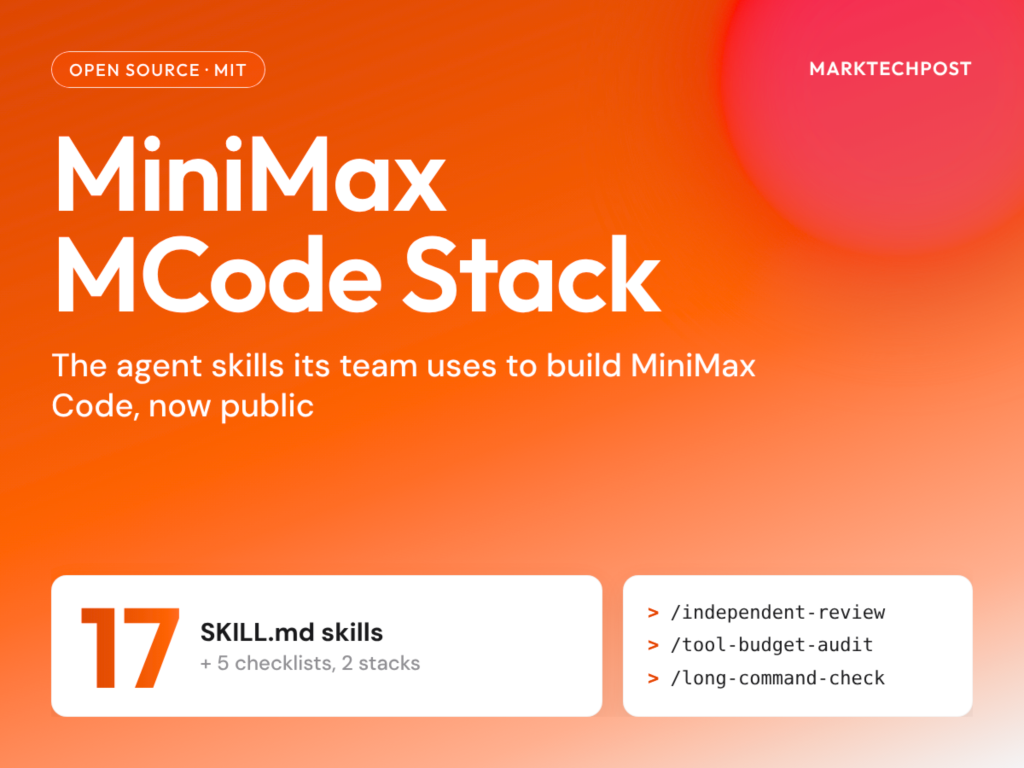
MiniMax has open-sourced MCode Stack, the workflows and agent skills its team uses to build MiniMax Code. The MiniMax MCode Stack agent skills went public on October 28, 2026 under the MIT license. It is not a prompt collection. Each piece is a SKILL.md skill or checklist that installs directly into MiniMax Code. For developers, it turns harness engineering habits into steps an agent can actually run.
TL;DR
- Size: 2 stacks, 17 skills (15 from Ronny, 2 from Jiachen), 5 checklists, 5 companion notes.
- Runs on: Any machine running MiniMax Code (Node.js 22.19+) or Claude Code. No GPU. Skills are plain Markdown.
- Performance: No benchmarks or eval results published.
- Best:
long-command-check, a 10-point audit for long shell commands and background tasks.
What is MiniMax MCode Stack?
MCode Stack is an open-source repo of agent skills from MiniMax’s MiniMax Code team. MiniMax Code is the MiniMax’s open-source terminal coding agent, also MIT-licensed. The stack holds no MiniMax Code source code. It holds only workflows, skills and checklists.
The repo pairs with a column called MCode Engineering Notes. Each note explains one idea. The repo makes that idea runnable. Published notes cover subagents, tool context, compaction versus memory and long bash commands. A note on per-turn context tax is marked upcoming.
What skills are inside Ronny’s stack?
MiniMax’s stack ships 15 skills, grouped by moment in the working day:
- Plan and split (3):
subagent-split-check,engineering-small-prs,engineering-change-descriptions. - Context and tools (2):
tool-budget-audit,context-tax-audit. - Long sessions and commands (3):
long-session-check,handoff-doc,long-command-check. - Review (4):
independent-review,engineering-code-review,engineering-review-comments,engineering-review-feedback. - Experiments and hotfixes (3):
harness-experiment,trajectory-review,engineering-emergency-changes.
A few ideas stand out. independent-review gives the reviewer exactly 3 inputs: the diff, the requirement and test results. It deliberately withholds the author’s conversation. The reasoning: a reviewer inheriting the author’s context repeats the author’s blind spots.
subagent-split-checksays to split work only when context is the measured problem. Splitting by team or question type is not a valid reason.tool-budget-auditseparates 2 costs: tool definitions and tool results. Tool search mainly cuts the first. Programmatic tool calling mainly cuts the second.harness-experimentenforces 1 change per experiment. It tracks flipped tasks, requests per task, tokens, cache hit rate and wall-clock time.- The long-command checklist has 10 items. It asks whether moving a command to background re-runs the process. It also asks whether unread results survive compaction.
The 6 engineering-* skills are adapted from Google Engineering Practices. That material stays under CC-BY 3.0, per the stack’s NOTICE.
