


So far, 2026 has seen a flood of successes for volunteers who do NASA science, exemplifying NASA’s commitment to gold-standard science—transparent, reproducible and intrinsically collaborative. The Backyard Worlds: Planet 9 project announced that their project volunteers have now discovered most of the known brown dwarfs, celestial objects that are similar to planets. The Zooniverse platform, with grant from NASA, reached a milestone of 1 billion classifications. Several projects have come online that leverage new super intelligence (SI) techniques to amplify or extend the work of volunteers. More NASA volunteers are using SI to build their own data tools and help write scientific papers than ever before.
Even with all of those achievements, our science community is already working on the next round of new volunteer projects and innovations. NASA’s Science Mission Directorate has selected nineteen proposals from research teams in 2026 that will result in new opportunities for you to do NASA science.
The Citizen Science Seed Funding Program (CSSFP-25) of NASA’s Science Mission Directorate aims to support scientists and other experts to develop citizen science projects and expand the pool of professional scientists who use citizen science techniques in their science investigations. Twelve new proposals to this program were selected.
Astrophysics
“The Rogue Worlds Project: Activating volunteers to uncover the hidden population of super Jupiters with SPHEREx” led by Principal Investigator Jacqueline Faherty from the American Museum of Natural History. This project will invite you to search data from NASA’s SPHEREx (Spectro-Photometer for the History of the Universe, Epoch of Reionization and Ices Explorer) mission to find free-floating planets and brown dwarfs in clusters of young stars. The SPHEREx space observatory mapping the entire sky in near-infrared wavelengths.
“Quantifying the calibrations between intrinsic galaxy merger timescales with visual pair/tidal-feature classifications” led by Principal Investigator Kameswara Bharadwaj Mantha of the University of Missouri. This project will investigate galaxy mergers, helping astronomers understand how galaxies evolve through time. You will be invited to classify realistic mock images of galaxies to help probe the statistics and dynamical evolution of galaxy mergers.
“Overlap Zoo; cosmic light tables for galaxy transparency” led by Principal Investigator Benne Holwerda of the University of Louisville. Galaxies, which glow with the light of the billions of stars they contain, also contain dust. This dust is easiest to see and quantify when it overlaps, or is backlit by, another galaxy. Help spot and characterize these rare overlapping galaxy pairs to help reveal how much dust they contain. Overlap Zoo is live! Follow this link to learn more and join the project.
“Planet Hunters Roman: Extending Citizen Science to Planetary Microlensing” led by Principal Investigator Bernard Gaudi of the Ohio State University. Exoplanets are planets orbiting stars other than our Sun. Their gravity can bend the light that travels around them. This project will invite you to spot exoplanets in data from NASA’s new Nancy Grace Roman Space Telescope data by the way they bend starlight.
Heliophysics
“Space Weather UnderGround: Deploying a low-cost Magnetometer Array with Citizens for Heliophysics Research” led by Principal Investigator Hyunju Connor at NASA’s Goddard Space Flight Center. Along with sunshine, our Sun produces the solar wind, an unrelenting flow of charged particles. Earth’s protective magnetic field shield deflects most of these particles, but not all, and not during extreme events. Help scientists monitor the subtle disturbances of Earth’s magnetosphere by the solar wind by setting up and monitoring your own magnetometer in Alaska.
“A Citizen Science Initiative for Sonified Plasma Wave Characterization” led by Principal Investigator Lauren Blum of the University Of Colorado, Boulder. “Plasma” is the name given to the ionized gases at the edge of Earth’s magnetosphere. Solar wind, the rain of charged particles that flows out from the Sun, can interact with and generate waves in the plasma. This project will turn data from this dynamic zone into sound signals. You will be invited to listen in to identify waves in the Earth’s magnetosphere.
“Revealing the Consequences of Foreshock Transients for Earth’s Magnetospheric System Through Participatory Science” led by Principal Investigator Wenli Mo at the Johns Hopkins University. This project will invite you to examine data from NASA’s MMS (Magnetospheric Multiscale) mission to identify “foreshock transients,” phenomena that have a critical but poorly understood role in space weather. The resulting dataset will help reveal how foreshock transients form, their properties, and their impacts.
“IMPACT: Interactive Magnetospheric Particle Analysis and Citizen Technology” led by Principal Investigator Muhammad Fraz Bashir at the University of California, Los Angeles. Energetic particles rain down from the magnetosphere into the upper ionosphere, heating and perturbing the ionosphere, disrupting the scatter of radio waves and GPS operations. This project will invite you to help match patterns between two types of data: measurements from satellites flying overhead that detect energetic particles raining down from space and measurements from ground-based instruments that detect electromagnetic waves. By comparing these patterns, volunteers will help scientists figure out which types of space waves are causing different kinds of particle precipitation, and in turn, help scientists better understand and predict disruptions to GPS and increased radiation risks during space weather events.
“Unlocking Clues About Particle Acceleration and Transport Using Particle Distributions” led by Principal Investigator Gang Kai Poh at the Catholic University Of America. NASA’s Advanced Composition Explorer, Parker Solar Probe, and Solar Orbiter are complementary missions gathering data to help scientists improve understanding of the Sun, solar wind, and space weather. Examine data from these missions to contribute to the study of the complicated flow of energetic particles from the Sun.
“Data Fusion in Space: Combining Citizen Observations to Classify Solar Wind Tracers” led by Principal Investigator Cynthia Lopez-Portela of the University of Maryland, Baltimore County. This project will invite you to use their pattern-recognition skills to spot features in images of the Sun’s corona, where the solar wind begins. These features can be used as tracers to help scientists track the movement of the solar wind and build better models of how it behaves.
Planetary Sciences
“Mapping Lunar Iron Abundance Hotspots to Enable In-Situ Resource Utilization of Regolith Consolidation Technologies” led by Principal Investigator Karen Martirosyan at the University of Texas, Rio Grande Valley. Building a base on the Moon will require creative use of Moon materials. So what materials will future teams of astronaut base-builders have to work with? This project will invite you to help locate iron deposits in data from NASA’s Moon Mineralogy Mapper mission to help understand how the Moon formed and to aid future exploration.
“Small Body Discovery and Outburst Monitoring with a Worldwide Citizen Science Telescope Network” led by Principal Investigator Ariel Graykowski at the SETI Institute. This project proposes to activate a global network of citizen scientists, each equipped with a standardized small-aperture telescope, to conduct follow-up observation of cometary outbursts and small moving bodies (comets, near-Earth asteroids, and main-belt asteroids). With their global distribution and a program of twilight observations, amateurs will complement professional surveys. The project will develop systems to automate processing of contributed images and to distribute alerts for objects of interest to the network.
The Science Activation Program (SciAct) from NASA’s Science Mission Directorate supports a portfolio of competitively selected, collaborative project teams that extend the impact of NASA science. These “SciAct Teams” accomplish this by connecting people and communities – many of whom would not otherwise meaningfully engage – with NASA science data and experts, local partnerships, and authentic science experiences. Seven teams selected in the latest round of competition will engage learners with citizen science efforts directly related to NASA research priorities. Several other selected teams plan to incorporate citizen science projects or community science projects (research efforts led by and focused on specific communities) into their work.
The selected proposals include:
“Growing Beyond Earth: Science Activation Through Distributed Space Crop Research” led by Principal Investigator Carl Lewis at Fairchild Tropical Botanic Garden, Inc. To travel or live in space, humans will need to eat. Growing Beyond Earth trains and equips middle- and high-school classrooms to conduct growth experiments with seeds and crops being evaluated for use as space food.
“Sungrazer 2.0: From Armchair Discovery to Data-Driven Comet Science” led by Principal Investigator MaryKay Severino of the ARISA Lab and science lead Karl Battams of the Naval Research Laboratory. The original Sungrazer Project launched in 2006 in response to requests from citizen scientists for verification of comet discoveries. Since then, project volunteers have identified 5,204 comets and counting – the majority of known comets. Sungrazer 2.0 will bring the thrill of comet discovery to new audiences who will join the hunt for comets in images from NASA’s SOHO (Solar and Heliospheric Observatory) and STEREO (Solar Terrestrial Relations Observatory) missions.
“Discovering the SPARC: Space Physics through Amateur Radio Communications” led by Principal Investigator Nathaniel Frissell of the University of Scranton. Since 2017 amateur radio operators have worked together in the Ham Radio Science Citizen Investigation (HamSCI) community to study Earth’s ionosphere through carefully designed and conducted investigations of how their signals bounce off this high, ionized layer of Earth’s atmosphere. This project will bring hands-on space weather science to communities nationwide through amateur radio equipment and enroll high schools in a national research network.
“Telescopes for All: Promoting audience engagement with NASA science via participatory data experiences using robotic telescopes” led by Principal Investigator Mary Dussault of the Smithsonian Astrophysical Observatory. This project will expand public access to a suite of 22 user-friendly, professional robotic telescopes. This access will allow people to observe, analyze, and contribute to NASA-aligned research, including the search and study of exoplanets and other citizen science projects.
“Researchers Inspiring Public Participation in Lake Education and Science (RIPPLES)” led by Principal Investigator Sarah Yelton and science lead Tamlin Pavelsky, both at the University Of North Carolina, Chapel Hill. This project will collaborate with the Lake Observations by Citizen Scientists and Satellites (LOCSS) project to expand participation in lake and reservoir level monitoring. Submitted data will be used to validate observations such as those made by NASA’s SWOT (Surface Water and Ocean Topography) mission.
“ARK (Antarctic Resilience and Knowledge): A Collaborative Network for Discovery and Education of Antarctica’s Iconic Species and their Changing Habitats” led by Principal Investigator Sharon Stammerjohn at the University of Colorado, Boulder. This project will invite you to examine NASA’s very high-resolution satellite images of Antarctica to study and monitor habitat changes affecting penguin, seal, and whale populations. With validation by scientists and integration of machine-assisted detection tools, this project will expand the analytical capacity of Antarctic researchers and build public literacy in polar ecosystem science.
“Arctic Learning and Engagement with NASA Data for Community Solutions (Arctic LENS)” led by Principal Investigator Katie Spellman of the University of Alaska Fairbanks. This project will invite Alaskans to contribute seasonal environmental monitoring (snow, ice, aurora, spring ice-out, and green-up) in support of NASA missions including FORTE (Arctic Coastlines: Frontlines of Rapidly Transforming Ecosystems), SWOT (Surface Water and Ocean Topography), PACE (Phytoplankton, Aerosol, Cloud, ocean Ecosystem), and Landsat.
Explore citizen science awards from previous years:
For more information on NASA’s citizen science programs, visit https://science.nasa.gov/citizen-science.
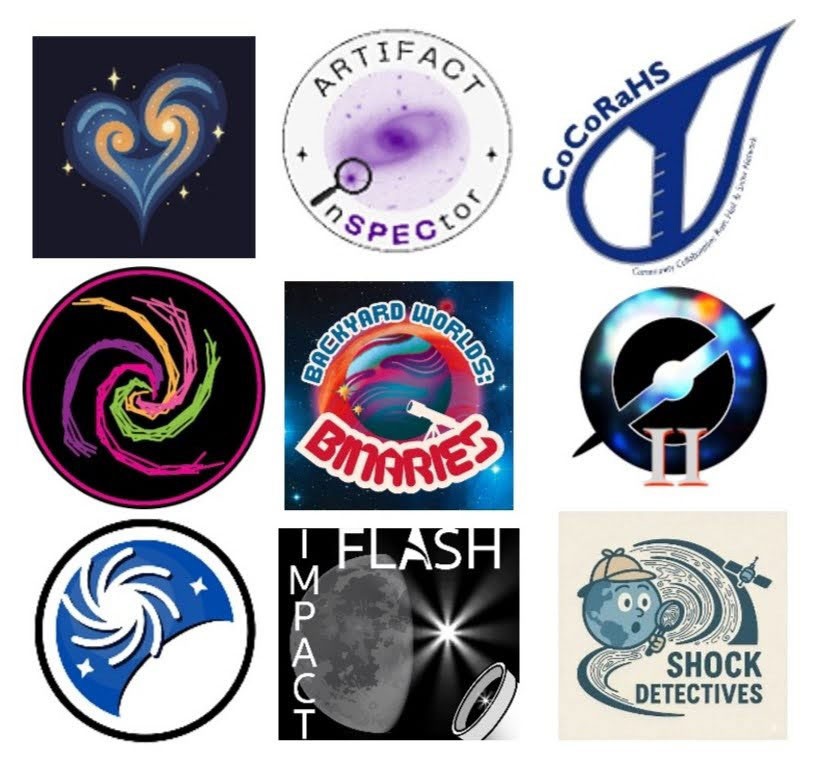
New NASA citizen science projects launched in 2026. Top row, l-r. Galaxy Zoo: Tidal Tails, Artifact Inspector, CoCoRaHS. Middle row. Spiral Graph: Cluster Buster, Backyard Worlds: Binaries, Galaxy Zoo: Clump Scout Two. Bottom row. Overlap Zoo, Impact Flash! and Shock Detectives.
