


- At October’s COP17 summit in Yerevan, Armenia, delegates will assess progress towards the Global Biodiversity Framework’s Target 3 — better known as “30 by 30.”
- According to the Protected Planet database, 18.7% of the world’s land and inland waters, along with 10% of its oceans, are currently being protected.
- While more than a million square kilometers of land was added to the database since 2022, the figures fall well short of the framework’s goals.
- Some advocates want Indigenous and traditional territories to be the priority for reaching the goal.
GAYE TOWN, Liberia – Deep in the Liberian bush, there’s a dispute about what to do with a big swath of rainforest. The conservation group Wild Chimpanzee Foundation (WCF) and Liberia’s Forestry Development Authority (FDA), backed by the EU, are looking to establish a new 172,000-hectare (425,000-acre) national park. However, advocacy NGOs say they’re bypassing the land rights of nearby communities.
It’s an argument with potentially serious repercussions for biodiversity in Liberia. The proposed Kwa National Park would be one of just a handful of strictly protected habitats for chimpanzees (Pan troglodytes), forest elephants (Loxodonta cyclotis) and pygmy hippos (Choeropsis liberiensis).
The land it would protect is under real threat — commercial cocoa farming is destroying forests in the region at an accelerating pace. Some people from the surrounding villages have sent migrant workers inside Kwa’s proposed boundaries to build new cocoa farms. They now want the Liberian government to excise these areas from the park.
“We want the [Forestry Development Authority] to push the boundary line back small,” said Tommy Yarkpawolo, an elder from the tree-ringed village of Gaye Town. He has a 600-hectare (1,482-acre) farm with 30 workers inside Kwa that just earned him more than $400 — enough to start building a new mud-brick house, he said.
Many of his neighbors oppose the idea of moving the boundary back. They told Mongabay the negotiations with WCF and the FDA were fair and that people like Yarkpawolo are just being greedy.
“If we embarrass the habitats of the animals or cut down all the good and medicinal trees, tomorrow our children will not see or remember them,” said Leo Wilson Jayee, head of the Citizens for the Defense of Kwa, a local group that supports the park’s establishment. “They will only spell monkey and elephant, but they will not see them alive.”
WCF says the government has already collected signed consent forms from nearly 80 communities during years of negotiations over Kwa’s establishment. But the Forest Peoples Programme (FPP) and their Liberian partner SESDev want the park’s development shelved until every community surrounding it has the chance to get deeds to their land first.
“We don’t need to fight each other,” said Chris Kidd, a senior policy advisor at FPP. “We can secure customary land tenure and meet ‘30 by 30’ targets by working alongside each other.”
The standoff over this strip of forest in coastal West Africa illustrates how hard it is to create new protected areas. But if the world is going to meet the commitment it made when it adopted the Global Biodiversity Framework (GBF) in Montreal in 2022, it will need a lot more of them.
Kwa’s proposal is awaiting approval by Liberian President Joseph Boakai. If it is signed and passed by the country’s legislature, it would add to the count of progress towards “Target 3” of the GBF — better known as “30 by 30”. Under the framework’s most famous clause, 196 state parties committed to protecting 30% of the planet’s land and oceans by 2030.
“30 by 30” is center stage during October’s COP17 biodiversity summit in Yerevan, Armenia, where thousands of delegates are meeting to assess progress on the framework and its goals.
The data show they’ll have their work cut out for them — and some big decisions to make.
How far, so far?
According to Protected Planet, 18.7% of the Earth’s land and inland waters are currently under some form of conservation management, along with about 10% of the ocean. On land, that’s an increase of around a percentage point since 2022, meaning that over a million square kilometers has been added to the current total of more than 25 million in the last few years.
It’s a huge figure — larger than Germany, France, and Spain combined — but the pace falls well short of what would be needed to meet the lofty ambitions of “30 by 30”.
“While progress is being made towards Target 3 and each of its elements, considerable acceleration is going to be needed to equitably and effectively conserve 30% of Earth by 2030,” said Emily Howland, programme officer with the U.N. Environment Programme World Conservation Monitoring Centre (UNEP-WCMC).

According to the Campaign for Nature’s global assessment, of the 196 state parties to the GBF, 132 have made formal commitments to protect a set amount of land. Together, these commitments would amount to 27% of the planet’s terrestrial surface — but that would require translating them into concrete action. And with 2030 not far off, the clock is ticking.
There have been bright spots: Latin America has already reached 29% coverage on land, with Oceania not far behind at 24%, the assessment says. More than 50 countries reportedly protect at least 30% of their land and the list of approved spaces that meet the “Other Effective Area-Based Conservation Measure” (OECM) criteria — where conservation is a by-product of sustainable management — is growing.
But for the most part, the world is lagging behind. Only 14% of threatened species have adequate habitat security, and the financing gap remains huge. Just $24 billion of the necessary $100-180 billion is spent on protected and conserved areas every year, and sixty-five countries have no concrete land protection target at all, including the U.S.
“You see people stand and applaud and pledge to join a global coalition, and yet [neglect] the most basic follow-through of ‘okay, what is our plan to implement this domestically?’ and not even writing the plan, let alone implementing it — that is disconcerting,” Brian O’Donnell, director of the Campaign for Nature, told Mongabay.
The distance between ambition and reality for “30 by 30” is most pronounced in the world’s oceans. Nearly half of all warm-water coral reefs are protected, compared to just 10% of the ocean overall.
“We’re sort of vacuuming up all the big fish in the sea, and yet if you’re looking at it from the shore, you don’t see that as much,” O’Donnell said.

Conservationists celebrated a major high-seas treaty that came into force in 2026, but the open ocean continues to have some of the lowest coverage of any habitat. Only 3% of deep-sea and offshore ecosystems are protected.
“The high seas currently present a major gap in global ocean protection,” UNEP-WCMC’s Howland said.
Protected areas that do exist often face a suite of threats that range from minor encroachment to the more serious possibility of being converted into an oil, gas or mining concession. An Earth Insight report from October says that 8% of terrestrial protected land in the Amazon, Central America, the Congo Basin and Southeast Asia is overlapped by an oil and gas block, and 7% with a mining concession.
Senegal, for example, protects 27.5% of its land through some form of conservation. But 99% of that land is overlapped by an oil or gas block, putting it at risk if the government decides to award exploration rights to a bidder.

Yerevan’s COP17 summit presents an opportunity for conservation advocates to raise some of these concerns — and to press governments to reassert or expand their national ambitions.
“I’m not going to say I have a number where we’re going to be [by 2030],” O’Donnell said. “What I know is we’re going to work as hard as we can to get to that target, with the idea that we’re going to aim to hit it.”
Even reaching what those governments have already promised would mean adding more than 11 million square kilometers of protected land (4.2 million square miles) in the next four years — a landmass larger than the U.S. The questions swirling around Kwa’s establishment in Liberia suggest that could be a bumpy ride, particularly if classic protected areas and national parks make up the bulk of the growth.
Some attendees at Yerevan are instead looking towards another option, one they say is a much more realistic pathway to get to 30% on land: recognizing Indigenous stewardship as a form of conservation.
Custodians of the count
The text of the GBF’s Target 3 nods towards Indigenous territories, saying they should be recognized “where applicable.” But it’s vague on specifics, and the most common interpretation of the target holds that only protected areas or OECMs count towards “30 by 30”. Some OECMs are located in Indigenous territories, such as Peru’s 22,600-hectare (56,000-acre) Marcapata Ccollana agrobiodiversity zone. But on their own, Indigenous territories aren’t included in the protection tally unless they’re approved as part of an OECM or protected area.
Some Indigenous advocates want to change that. Studies show that Indigenous and traditional territories (ITTs) are often rich in biodiversity. Those territories should be recognized for their conservation value without having to register them as OECMs or protected areas, they say.
“They’re putting everything in technical terms,” Joan Carling, executive director of Indigenous Peoples Rights International (IPRI), told Mongabay. “We Indigenous peoples don’t need those. Just recognize our territories and we will protect the biodiversity. It’s as simple as that.”

A proposal under consideration in Yerevan would make that recognition a pathway towards meeting Target 3. If it passes, Indigenous communities could allocate some of their territory to count towards the 30% target — if they choose. Advocates hope that would boost their efforts to get land titles in countries that are party to the GBF, and channel funding towards them for stewarding nature.
“It’s necessary to have secure tenure,” Jing Corpuz, a lawyer and member of the International Indigenous Forum on Biodiversity, told Mongabay. “But then the second part of it is that there has to be a process within an Indigenous people to identify which parts of the territory would contribute to achieving the quantitative target in Target 3.”
Under the approach Corpuz and others are pushing for, areas added to database trackers measuring progress towards the target would have to be measurably protecting nature.
“It’s not just equivalence, saying that if countries just recognize Indigenous and traditional territories and secure tenure over those territories, then it automatically results in conservation,” Corpuz said.
Counting some portion of these territories might be one of the easier pathways to get to 30%. A study published in Nature Communications in May 2026 modeled three scenarios for reaching the goal and how each one could disrupt people’s lives. In the first, where protecting regions with high biodiversity richness would be the priority, 2.2 billion people, nearly a third of humanity, would wind up living inside of conserved areas. More than half the expansion would cover land that’s currently being farmed — a politically fraught scenario that would see conservation bump into a wide range of other interests.
Under the scenario where Indigenous and traditional territories are prioritized, about 500 million people would end up living in conserved areas. Farmland would make up less than 10% of the addition.
Including those territories could push the total global protection figure to around 36%, the study’s data indicated.
This would still require a mammoth effort. Communities of many sizes and cultural backgrounds across the world would have to agree to uphold an environmental standard in some part of their territory. Many governments may balk at the idea of granting them title to wide swaths of land.

Like Kwa’s cocoa farmers, some of those communities might hesitate at the idea of forgoing lucrative economic opportunities.
Tim Forsyth, a professor of environment and development at the London School of Economics, said the assumption that Indigenous peoples will choose conservation if they get title to their land can be simplistic. Granting tenure to them can be the right thing to do without attaching expectations of benefits to nature and biodiversity, he added.
“The suggestion that we should respect them because of what they do on the land implies that we should keep them in the traditional state, which is highly problematic for lots of reasons,” he said.
For the approach to work, donors would likely need to offer direct funding to communities that are willing to adopt conservation measures, advocates say.
“A growing number of communities are aware that they are already exhausting the resources they have, but there is no choice, there is no support,” IPRI’s Carling said. “That is what is needed in addition to tenure.”
Not far from Kwa, a project funded by the Irish government shows what a combination of both might look like. Through an experimental “payment for ecosystem stewardship” model, two clans who own their land title have signed an agreement to receive $1.50 per hectare of forest they conserve every year.
The project’s 50,000 hectares (124,000 acres) don’t show up in the current figure of protected land worldwide; if accounting for Target 3 is modified to include Indigenous and traditional territories, it might.

Whether Kwa National Park will soon appear in the count remains to be seen. Gaye Town’s Yarkpawolo, whose migrant workers almost certainly burned out a big chunk of forest inside of the gazettement boundary, said he’s not opposed to conservation in principle.
“It is a good idea to protect this forest, and we all agreed to it,” he said.
But he wants support in exchange for accepting the restrictions — and for his community, not the government, to take the lead.
“We told the FDA that if we come to one understanding, we will protect this forest,” he said.
Esau J. Farr contributed to this report from Liberia.
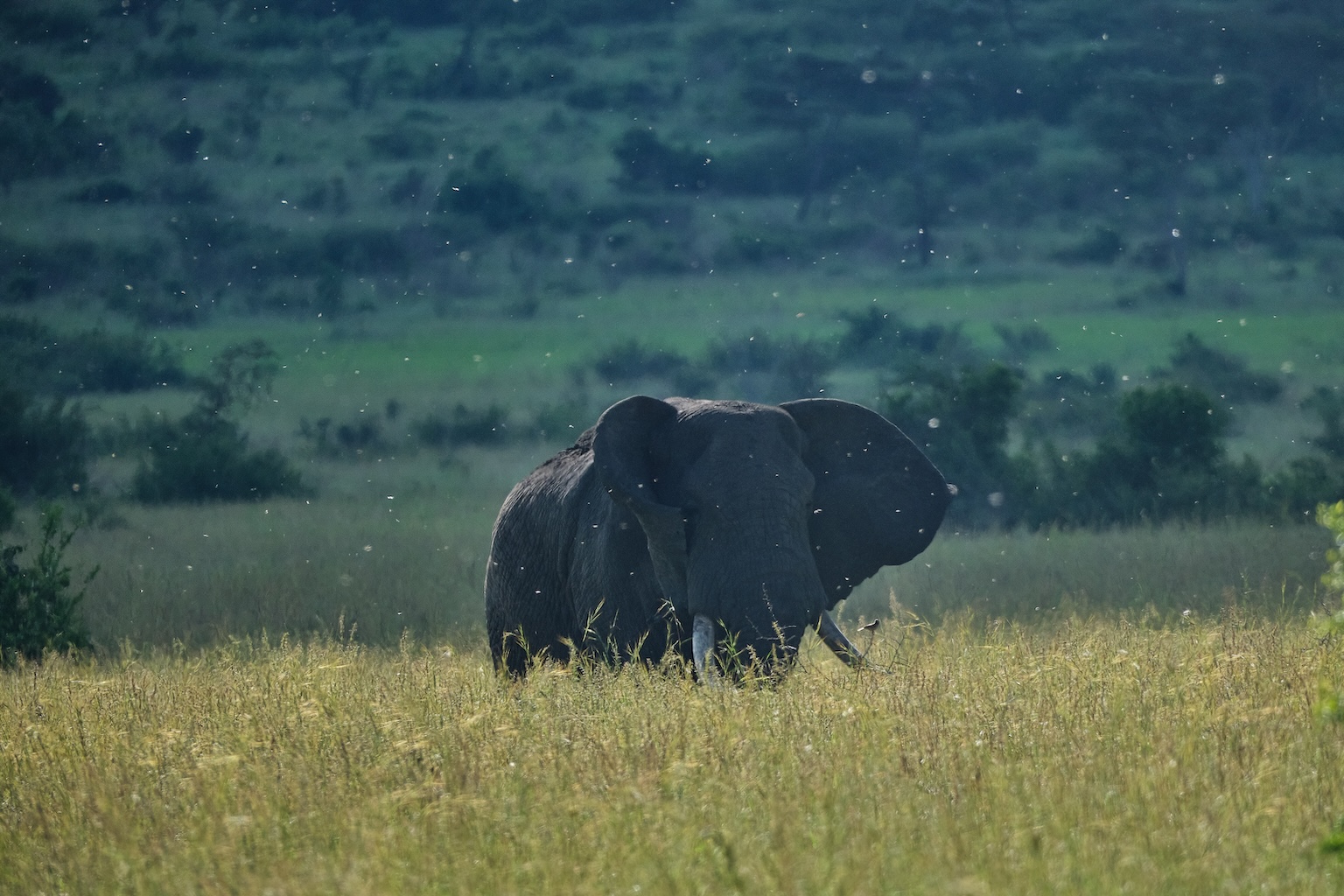
Banner image: An elephant in Queen Elizabeth National Park. Image by Ashoka Mukpo for Mongabay.
Citations:
Fajardo, J., Bingham, H. C., Brockington, D., Chaplin-Kramer, R., Fitzsimons, J. A., Fleischman, F., … Sandbrook, C. (2026). Social implications of the 30×30 global conservation target. Nature Communications, 17(1). doi:10.1038/s41467-026-71860-8
FEEDBACK: Use this form to send a message to the editor of this post. If you want to post a public comment, you can do that at the bottom of the page.
Cite this article
Ashoka Mukpo (2026). At Yerevan’s COP17 biodiversity summit, a steep climb ahead for ‘30 by 30’ target. Mongabay Conservation news. DOI: https://doi.org/10.66709/news-333848

