


The week before Israel’s parliamentary elections, Amir, an Israeli technology freelancer, traveled to the Greek island of Evia to view properties for sale. Amir had planned to purchase a holiday home for himself and his wife. (He asked to be identified only by his first name to discuss private matters.) However, the property could become their permanent residence if Israeli Prime Minister Benjamin Netanyahu’s far-right coalition stays in power after the Oct. 27 vote, he said.
“We’ve been talking about [leaving] for a long time,” Amir said. “Most people I know are waiting for the results of the elections to have that discussion on a more practical and serious level.”
Nearly one-fifth of Israeli voters are considering emigrating because of the country’s security and social situation, according to an Oct. 4 survey from the Hebrew University of Jerusalem. Other polls from this past summer showed similar results. The recent survey found that Israelis are deeply uncertain about the country’s future, with fewer than one-quarter of residents believing their children will live in a better reality.
Israelis have expressed feeling increasingly unsafe since the Oct. 7, 2023, Hamas attacks and amid Israel’s wars with Gaza, Lebanon, and Iran. The cost of living has skyrocketed, with food prices increasing by 20 percent in the last four years. Israeli society is also deeply polarized, with the secular liberal and religious-nationalist factions at odds. Netanyahu’s critics fear that his coalition, if victorious, will advance policies that favor the religious nationalists at the expense of other Israelis.
The latest polls show that it is highly possible that neither Netanyahu’s coalition nor the main opposition bloc will secure a parliamentary majority in the elections, which would yield a hung parliament and set the stage for coalition negotiations. If those efforts to secure a majority ultimately failed, Netanyahu—Israel’s longest-serving prime minister—would stay on as caretaker until a new vote can be held.
If thousands of people decide to emigrate based on the election’s outcome and aftermath, Israel could lose highly skilled workers in key sectors who are sustaining the economy and tend to belong to the country’s more secular factions. Such departures would unsettle the political balance among the remaining population, which would in turn lead to weaker internal opposition.
Many Israelis consider the upcoming parliamentary election—the first held since the Oct. 7 attacks, in which around 1,200 people were killed and 251 were taken hostage—the most important in the country’s history. Israel faces growing international isolation over its war in Gaza and rising settler violence in the West Bank. More than 74,000 people have been killed in Gaza, and much of the enclave has been destroyed since the war began.
Israeli society was polarized before the Hamas attacks in 2023. Earlier that year, Netanyahu’s government proposed a judicial reform bill that would have limited Supreme Court oversight of lawmaking and policy and, according to critics, destabilized Israeli democracy by undermining the balance of power. Thousands of Israelis took to the streets to protest the measure, creating deep rifts within the population. Ultimately, the court struck down the bill.
Such fissures only deepened after Oct. 7. Current and former Israeli military and defense officials accused Netanyahu of pursuing flawed strategies to address the hostage crisis, while the families of the hostages accused the government of inaction. Some pro-war Israelis supported extreme military pressure in Gaza, even as swaths of the population regularly protested the war.
Thousands of Israel Defense Forces (IDF) reservists have served hundreds of days in Gaza and Lebanon. Meanwhile, members of the ultra-Orthodox Jewish population—the country’s fastest-growing population group—have rarely completed military service in any capacity. In 2024, the Supreme Court ruled that Haredi men could no longer be exempted from conscription and ordered the military to begin drafting them. Yet ultra-Orthodox military service and workforce participation remain low, fueling resentment among other Israelis.
The cost of living has continued to rise, in part due to unaddressed structural issues such as high market concentration. Increased tax and utility fees have also led to cost increases, while other wartime costs have deepened the country’s debt. Israel’s tourism and construction sectors have been hit especially hard by the ongoing conflict and labor shortages resulting from conscription, as well as the suspension of work permits for Palestinians from the West Bank.
Taken together, these trends have worsened divisions between the nationalist and religious factions that support Netanyahu and his far-right allies and the more liberal, secular factions that want to see that coalition out.
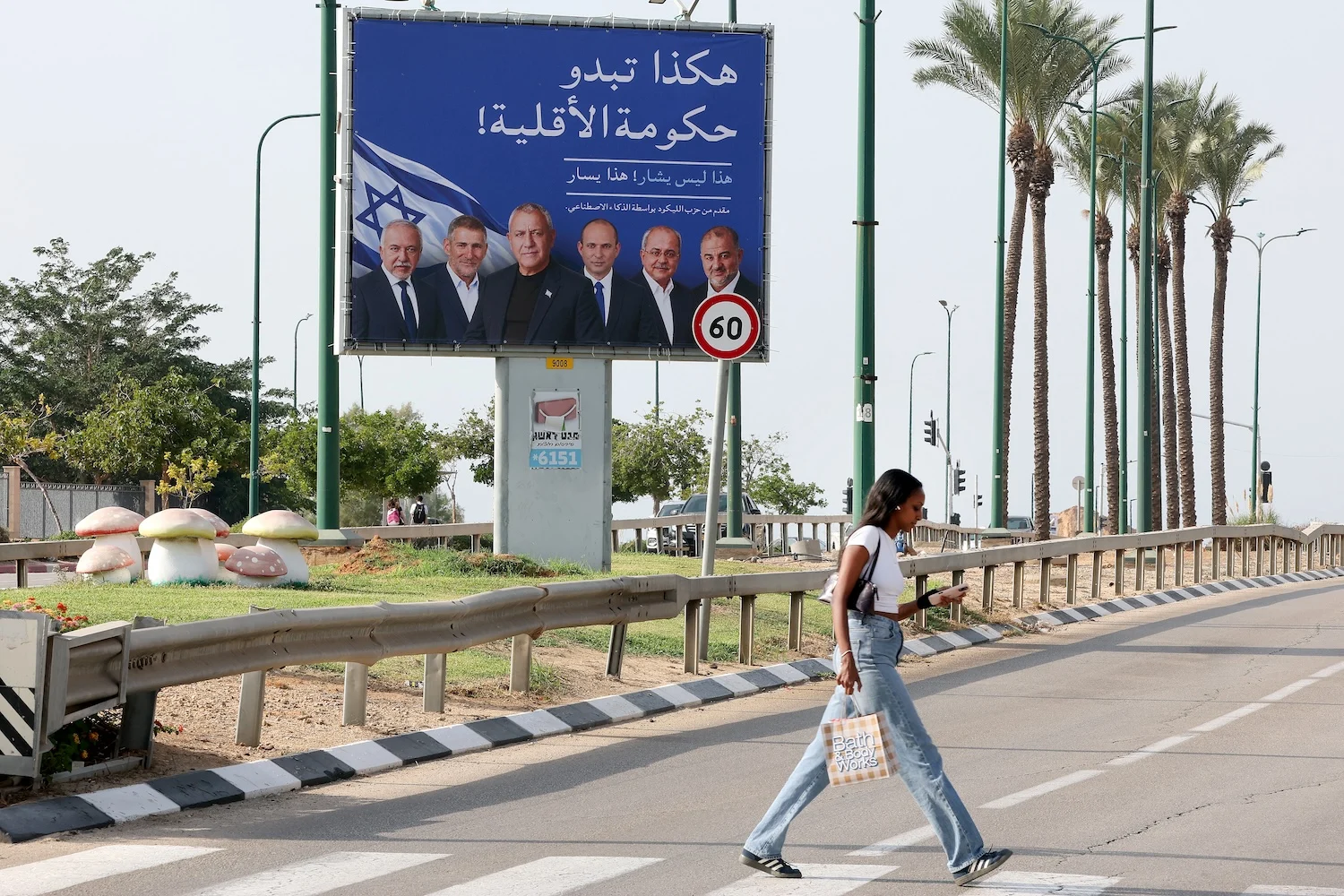
Netanyahu has served as Israel’s prime minister for nearly 19 years. His Likud party is polling neck-and-neck with Yashar, the party founded last year by Gadi Eisenkot, his former military chief of staff. Eisenkot has formed an alliance with three smaller parties, but this opposition bloc is likely to fall short of an outright majority. After the election, he could seek an agreement with Israel’s two predominantly Arab opposition parties to form a minority government, though the political viability of such a deal remains uncertain.
The opposition parties blame Netanyahu for the security failures that led to the Oct. 7 attacks and for failing to eliminate threats from Hamas, Hezbollah, and Iran. They agree on the need for an independent commission to investigate the Israeli leadership’s responsibility for the attacks and have pledged to enforce mandatory conscription for ultra-Orthodox men.
Israeli journalist Amir Tibon recently wrote in The Atlantic that a victory for Netanyahu could prompt an immediate “exodus of educated, highly skilled Israelis.” Tibon moved back to his home in the Nahal Oz kibbutz this month, three years after surviving the Hamas attacks. But he said that he and his wife “struggle to imagine any kind of future here if this government stays in power” and that many of his friends and relatives have already left Israel.
Indeed, after years of relatively stable migration patterns, nearly 270,000 Israelis left the country for at least three consecutive months between 2023 and 2025, according to an August study by Tel Aviv University. That amounts to roughly 90,000 departures annually—around 50 percent above the annual average for the preceding decade.
Researchers identified increased emigration among physicians, Ph.D. holders, engineers, and individuals with relatively high incomes. In the last three years, Israel experienced a “medical exodus,” with almost 1,400 doctors leaving for a period longer than 12 months—a 94 percent surge compared with a similar period between 2013 and 2015.
Lilach Lev Ari, a professor of sociology at Oranim College, surveyed Israelis who emigrated between 2023 and 2025. She said that 20 percent of respondents reported they would never move back to Israel, roughly double what Lev Ari found in studies from previous years. “What is unique about this cohort are the security considerations, the war, and particularly the socio-political situation in Israel,” Lev Ari told Foreign Policy.
The emigration of highly skilled workers isn’t unique to Israel, but its economy may be particularly sensitive to such trends because it relies heavily on high-quality human capital, especially in tech, health care, academia, and other knowledge-intensive sectors. Further, just 20 percent of Israel’s workers fund 93 percent of all income-tax revenue, according to the Shoresh Institution; half of the country’s earners are so poor that they do not pay any income tax.
“Risk is particularly acute in Israel, where a relatively small group of a few hundred thousand highly skilled people plays a disproportionate role in sustaining the country’s economy and essential institutions,” said Itai Ater, a business economics professor at Tel Aviv University. “The departure of even a fraction of this group could trigger a self-reinforcing dynamic: As more people leave, the country’s economic prospects and essential services deteriorate, giving others stronger incentives to leave and potentially setting off a much broader wave of emigration.”
Mass emigration among this largely liberal and secular cohort could shift Israel’s demographic and political balance toward religious-nationalist factions. Over time, that shift could influence policy on the Israeli-Palestinian conflict, civil liberties, judicial authority, and the relationship between religion and state. The erosion of a counterweight to hard-line forces could induce a perpetual feedback loop of polarization and further emigration.
Israeli activist Hagai Agmon-Snir and his wife left Israel for Italy this summer after decades of promoting inclusivity and equality in his home country. As a co-founder of the Jerusalem Intercultural Center, Agmon-Snir helped initiate talks between the LGBTQ and ultra-Orthodox communities, train thousands of police officers in nonviolent methods, and assist an initiative that taught tens of thousands of Israelis to speak Arabic.
Even though his quality of life in Israel was “excellent,” Agmon-Snir said he couldn’t ignore politics. “We left because Israel has become hopeless, and we felt the need to distance ourselves from that evil,” he said. He described his decision as “ideological emigration,” which he said is relatively rare compared with departures driven by fears “that Israel is going to collapse or … that their privileges are going to be lost.”
After Agmon-Snir’s story became public in an interview with Haaretz, he said that dozens of people reached out to learn more about his decision and ask for advice. He and his wife are returning to Israel to vote on Oct. 27, believing they can still help mitigate local injustices from abroad. “We chose to use our freedom and our capabilities to keep on fighting from outside the country with integrity,” Agmon-Snir said.
