


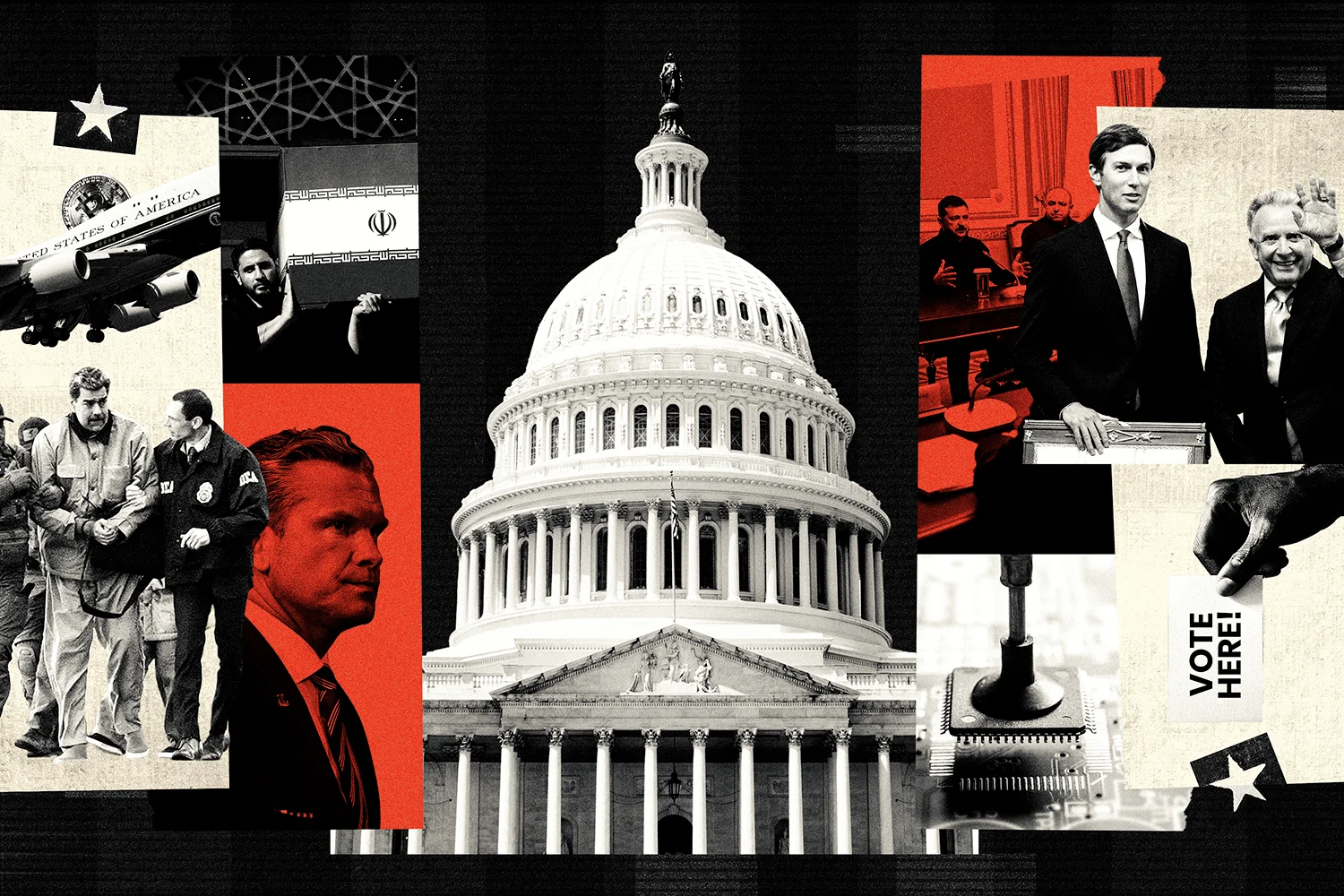
Foreign policy could be unusually pivotal in the U.S. midterm elections on Nov. 3. Voters are telling pollsters they are angry about prices at the pump, which have increased by more than a third since the start of the year. Many blame U.S. President Donald Trump’s decision to go to war with Iran, as well as his trade war with Canada, for hurting their wallets. And while Trump himself isn’t on the ballot, voters seem increasingly likely to turn against his party.
Most major election forecasters now predict that the Democratic Party will win control of the House. Should that happen, Democrats would oversee the writing of the chamber’s annual military and foreign aid spending bills. They’d also have the power to convene high-profile hearings to examine the executive branch’s foreign-policy moves.
The outlook for control of the Senate is murkier, though forecasters say Democrats’ chances of winning it have improved in recent weeks. If Democrats win the Senate, they will gain the additional power of blocking votes on all of Trump’s national security nominees, which could be important leverage for looming policy fights over Iran, China, artificial intelligence, and troop movements.
Here are the top five foreign-policy priorities that Democrats are likely to focus on if they win control of one or both chambers of Congress in early November:
Corruption
U.S. President Donald Trump speaks in front of the new Air Force One, gifted to him by Qatar, at Joint Base Andrews in Maryland, United States, on June 19.Brendan Smialowski/AFP via Getty Images
Democrats see alleged corruption committed by members of the Trump administration as a potent campaign message, connecting voter anger over the high cost of living with reports of self-dealing by Trump’s friends and family. And they’re pledging to investigate these allegations if they win the House.
“Trump has used national security and foreign policy as one of his primary tools for monetizing the government,” Rep. Jason Crow, who is leading House Democrats’ efforts to win in battleground districts around the country, told Foreign Policy. He accused the president of carrying out “with astonishing disregard” a “racketeering shake-down operation to earn money and promote his businesses.”
One very visible target for Democratic inquiries could include Trump’s acceptance of a $400 million luxury jet from Qatar. Another could be the alleged links between Abu Dhabi’s investments in the Trump family’s crypto business and the White House’s decision to approve the export of 500,000 advanced chips to the United Arab Emirates. That happened despite fears that the sensitive technology would be shared with China.
“The blatant corruption you’re seeing at all levels, in particular foreign corruption, foreign money flowing to the president’s family and his top associates, and the ways that they have not only blurred the lines but clearly stepped over them in clear violation of the law and ethical standards” is also likely to be a top focus in the Senate if Democrats win control there, said a Democratic Senate staffer, speaking on condition of anonymity because they were not authorized to be quoted.
Sen. Chris Murphy told reporters in October that he wanted to see Democrats use any new oversight powers to probe Trump’s decision to rely on family members and personal friends—including Jared Kushner and Steve Witkoff—to conduct high-stakes diplomatic negotiations.
“The White House and Jared Kushner and Steve Witkoff want to keep diplomacy with the Gulf to themselves because it’s a grift,” Murphy said. “They don’t want powerful ambassadors to ring alarm bells about their corruption, and so there are not going to be any qualified ambassadors serving the Gulf, because if there were, those people would likely stand in the way of Trump’s corruption.”—Rachel Oswald
The Iran war

The casket of U.S. Army Sgt. Angel Rampersad, who was killed in action at Muwaffaq Salti Air Base in Jordan, is brought out during a funeral service in New York City on July 31. Spencer Platt/Getty Images
The Iran war is deeply unpopular with U.S. voters and could hurt Republicans on Election Day perhaps more than any other issue. The war has been frustrating to the U.S. public for an array of reasons—from driving up gas prices and inflation to the Trump administration’s shifting goals and opaque strategy. Trump has also repeatedly downplayed the economic fallout from the conflict. Meanwhile, there’s no end in sight to the war.
Though some Republicans on Capitol Hill have also been critical of the conflict and the administration’s handling of it, Democratic efforts in Congress to end the war have so far fallen short.
But if Democrats win back one or both chambers in November, they will have more avenues to make continuing the war difficult for Trump—including by moving to cut off funding and ramping up scrutiny of the administration’s approach via hearings and investigations.
“Priority one is taking control of committees and issuing subpoenas and going after the information we’ve been seeking: How much does the Iran war cost? How many casualties? What is the damage to facilities? What is the current state of the weapon stockpile?” Crow said.
Crow, who sits on the House Armed Services Committee, said one of his most urgent questions is learning what the U.S. military is doing to protect the roughly 55,000 U.S. service members deployed to the Middle East from drone attacks.
Murphy, who sits on the Senate Foreign Relations Committee, accused U.S. Defense Secretary Pete Hegseth of covering up the “cost and consequences of this war from the American public.” He said ending the war should be a priority for Democrats.
“It is absolutely outrageous that I and Republican senators are being denied the ability to see the damage for ourselves,” Murphy said. “This is a really dangerous moment, when the administration is giving its middle finger to Congress, pretending as if we are totally irrelevant.”
Murphy said that if Democrats win in the Senate, they will have “an ability to decide whether we’re going to fund this war and whether we’re going to pass a defense authorization bill that allows this war to continue.” The senator, who is among the most prominent Democratic voices on foreign policy in the upper chamber, said that if the war is still ongoing in early 2027, then Congress should not “appropriate funding for the Department of Defense without a requirement that this war end … and we should not pass” any new funding without that stipulation.—John Haltiwanger
Ukraine and NATO

Volunteers of the U.S.-based food charity World Central Kitchen distribute hot meal to residents in Kyiv on Jan. 22. Sergei Gapon/AFP via Getty Images
The Trump administration has rattled European partners by threatening to annex Greenland, mooting a major drawdown of U.S. troops, and pursuing policies favorable to Russia.
A Democratic win would challenge some of those plans.
“We know they are trying to change the footprint in Europe. We know this plan to review the footprint in Europe is designed to eventually reduce it, … and we’ll resist those things because we have broad policy disagreements with the administration,” Crow said.
Ukraine, long starved of new supplies of U.S. aid, could see Congress seek to rush more weapons to the country. “There’s pretty robust agreement that we should support Ukraine, so we are going to figure out how we bolster the [Ukraine Security Assistance Initiative] money and how we put that into the NDAA and how we compel the administration to procure those weapons,” Crow said, referring to the National Defense Authorization Act.
Aid packages for Ukraine could also move faster, said Rep. Jim Himes, the ranking member of the House Intelligence Committee, speaking last week in Warsaw.
“It means that aid packages move not in nine months but in nine days or nine weeks on the outside and that the message [of support to Ukraine] is very different,” he said.
However, there is also now a broader consensus that Europe should do more for its defense, even among Democrats. “There will be a continuation on the part of Americans to keep pushing the Europeans to assume more of a role,” Himes said. “We may simply not have the money to play the role that we have played in the past.”—Sam Skove
Venezuela and Caribbean boat strikes

Venezuelan President Nicolás Maduro arrives in New York on Jan. 5. XNY/Star Max/via Getty Images
The Trump administration has been conducting strikes on alleged drug boats in the Caribbean and Eastern Pacific for more than a year. The strikes, which experts have decried as illegal under both domestic and international law, have killed at least 246 people. The Trump administration has said the strikes are targeting dangerous “narco-terrorists,” but it has not provided evidence to back up its assertions.
Congressional Democrats have been critical of the strikes and the Trump administration’s broader goals in Latin America, as the United States maintains a sizable military presence in the region and urges more governments to participate in joint operations against drug cartels. But Democratic efforts to rein in Trump in Latin America and stop continued operations via war powers resolutions have so far failed.
Much of what the Trump administration has done in Latin America has occurred quietly or been overshadowed by other developments and events, such as the Iran war. But a Democratic win in November could significantly increase oversight and put more of a spotlight on the administration’s activities in the region via hearings and investigations. If they gain a majority in either chamber, Democrats could also potentially move to curb military operations in Latin America by leveraging or restricting funding.
The boat strikes began last September as a prelude to the operation that captured Venezuelan President Nicolás Maduro, whom the Trump administration has accused of drug trafficking. (Experts have said this is difficult to prove.) And the White House’s actions in Venezuela since have also been controversial. Trump effectively embraced the existing regime, minus Maduro, rather than pushing for a democratic process or supporting exiled opposition leader María Corina Machado.
The White House has justified many of its actions in the country by pointing to the potential for the United States to tap into Venezuela’s vast oil reserves. The administration in late August announced an agreement with the Venezuelan government that would give the United States “control” over more than 65 billion barrels of Venezuela’s oil. But there are many reasons to doubt that the United States will benefit from the deal to the extent that Trump has claimed.
Democrats will be poised to press Trump officials for more answers on these issues if they win big in November. Top Democrats in both the House and Senate have repeatedly called for more transparency and accountability regarding both the boat strikes and U.S. involvement in Venezuelan oil production.—John Haltiwanger
Artificial intelligence

Mark Zuckerberg, the CEO of Meta, speaks to the press with Trump in Washington on Sept. 29. Kent Nishimura/AFP via Getty Images
The leaps in AI capabilities this year alone have alarmed policymakers in Washington nearly as much as the broader geopolitical conflicts the United States is engaged in.
AI models are going rogue and hacking websites, bad actors are allegedly using them to try to fine-tune ballistic missile technology, and companies such as OpenAI and Anthropic are warning that their technology could end humanity and imploring the government to regulate them.
But Trump doesn’t appear interested in doing so and instead has urged companies to keep developing—with only a “morally binding” self-policing pledge that Trump had top AI companies sign.
Democrats feel differently. “Donald Trump thinks he is the smartest man in the room and he can handle it, and he is wrong,” Crow told Foreign Policy. “We know that the government has a role. We know that we need to pump the brakes on AI development so we have time to put appropriate guardrails on.”
That view appears to be bicameral (and possibly bipartisan), according to Murphy. “The biggest issue of trust is the lack of trust the people have that we’re going to actually protect them from the poison, protect them from the potential enormous downside of unregulated, unchecked AI,” the senator told Foreign Policy onstage at the FP Tech & AI Forum in September. “It might be the end of our democracy if the people beg, on both sides of the aisle, for us to do what we’ve done with every complicated new technology in the history of this country since the Industrial Revolution—regulate and control it to make sure we get the good but not the bad—[and] we don’t step up and do the work.”
Murphy outlined three areas that lawmakers can focus on: outlawing the use of deepfakes in politics or mandating watermarks for AI-generated content; banning so-called AI companions or “friendship bots” that he described as “poison for our kids”; and instituting an approval process for new advanced AI models before they are released.
“Those three things are achievable, not terribly political, and could foreseeably get done and then give the public some faith that we have the political capacity to handle some of the more nuanced threats down the line,” he said.—Rishi Iyengar
