


- Nigeria has spent more than a decade trying to shift households away from traditional cooking fuels and has made impressive gains, yet the overall picture shows progress is “uneven.”
- Between 2020 and 2024, the country recorded Africa’s third-fastest growth in clean-cooking access, behind Côte d’Ivoire and Kenya. The number gaining clean cooking access each year averaged 5.4 million in the same time period.
- Yet 168 million Nigerians — more than two-thirds of the population — still cook with polluting fuels such as firewood, charcoal and kerosene.
- Nigeria is home to the world’s second-largest biomass-dependent population after India, according to a U.N.-World Bank assessment, and data show that household fuelwood consumption has risen almost every year between 2019 and 2023.
UYO, Nigeria — Before dawn, Happiness Emmanuel is already at the fire. She crouches beside a three-legged metal stand outside her home in Uyo city, southeastern Nigeria, splashing kerosene over damp firewood before striking a match. By sunrise, she is selling akara, a popular bean fritter, to commuters and schoolchildren stopping at her roadside stall.
Emmanuel’s wood-fired setup is a familiar sight across this oil-rich region and Nigeria at large.
The West African nation has spent more than a decade trying to shift households away from traditional cooking fuels such as firewood, charcoal and kerosene and by one measure it is succeeding. Between 2020 and 2024, an average of 5.4 million Nigerians a year gained access to clean cooking, more than in any other African country, according to the International Energy Agency (IEA). The share of the population with access rose by 2.3 percentage points a year, the third-fastest improvement on the continent after Côte d’Ivoire and Kenya.
Those gains have only just kept pace with the population growth. Nigeria, Africa’s most populous country, added about 4.8 million people a year between 2022 and 2025, according to Worldometer estimates.
In 2024, about 168 million Nigerians, nearly three in four people in the country, still cooked with polluting fuels, making Nigeria home to the world’s second-largest biomass-dependent population after India, according to the latest joint U.N. and World Bank tracking report on global energy access.
What’s more, the trend in actual fuelwood consumption is moving in the opposite direction. U.N. energy statistics show household fuelwood consumption has risen almost every year since 2019, reaching 34 million cubic meters in 2023, the latest year for which data is available.
Uneven progress
“Nigeria’s progress on expanding access to clean cooking has been uneven,” said Temilade Sesan, an energy transition researcher at the University of Ibadan in Nigeria. “Over the past decade, government policy has swung from handing out relatively low-cost cookstoves free of charge to relying on carbon financing schemes to offset the cost of prohibitively expensive technologies.”
In 2013, the country’s National Domestic LPG Expansion Strategy made cooking gas the centerpiece of the shift away from firewood and charcoal. The 2019 National Clean Cooking Policy recognized both gas and improved biomass cookstoves, which burn wood and charcoal more efficiently, as cleaner alternatives. In 2021, the government launched the Decade of Gas program to expand gas infrastructure and position gas as a transition fuel.
The World Health Organization recognizes LPG, electricity, solar power, natural gas, biogas and alcohol fuels such as ethanol as clean cooking options. They are considered clean, because they produce low levels of harmful air pollutants (specifically fine particulate matter and carbon monoxide) that meet strict indoor air quality standards at the point of use.
Yet despite producing large quantities of LPG as a by-product of its oil and gas industry, Nigeria only meets a proportion of its domestic demand. The rest is imported from the United States, Argentina and other African countries, the IEA says. That leaves households exposed to global price swings. When the closure of the Strait of Hormuz this year sent LPG prices soaring, the IEA said the fuel moved “beyond the reach of many households, especially in markets without state-set fuel pricing like Nigeria.”
Nigeria’s struggle reflects a wider regional one. Across sub-Saharan Africa, 23% of people had access to clean cooking in 2024. The number of people gaining access each year has risen from about 4 million in 2010 to an estimated 15 million in 2025, which would be a record. But the population is also growing at a rapid clip, from 24 million to 32 million a year over the same period. In two-thirds of the region’s countries, population growth is still outpacing progress, and the number of people without access reached about 1 billion in 2024.
Beyond keeping pace with a growing population, ensuring people are getting meaningful access is also a challenge.

Fuel stacking
On weekday mornings, markets and roadside corners in the suburbs of Lagos, Abuja, Uyo, Kano and other Nigerian cities offer a familiar scene: Bundles of firewood stacked high, sacks of charcoal piled onto wheelbarrows and women like Emmanuel tending to fires and hot pans.
Emmanuel, a mother of four, supports her family from what she earns here. “I spend ₦1,000 ($0.70) on firewood every day,” she says. “After other expenses, I still make some profit. If I use gas [to cook], I won’t see anything at the end of the day.”
LPG prices have risen sharply in Nigeria, with the cost of refilling a standard 12.5-kilogram cylinder more than tripling since 2019. The increase has been driven largely by the naira’s devaluation, which has driven higher costs of importing LPG and retail prices, as well as by higher transport costs since petrol subsidy were removed in 2023. In a country where 63% of the population lives in poverty, the rising cost has pushed more households back to dirtier fuels.
Five years ago, 53-year-old Eno Udofia, a healthcare worker in Uyo, saved enough to buy a small LPG cylinder. At first, she refilled it every month, supplementing gas with firewood. By the second year, she was refilling it every other month. Since April, she has not refilled it at all. Instead, she spends 2,000 Nigerian Naira (about $1.42) on firewood, which is enough to last a week.
“I use this now, every day. It’s cheaper,” she said, breaking slender pieces of wood for the evening’s cooking. “Gas has become too expensive and this is the option for now.”
In Kubwa, on Abuja’s outskirts, Nneka Tochi’s orange LPG cylinder sits empty in a corner of her kitchen. She last refilled it two months ago. Since then, she has returned to charcoal, which she uses to cook for her family and prepare boiled eggs and a kind of hibiscus drink for sale.
“Charcoal is a lot cheaper for me. I have not used gas for long, otherwise it would be hard for me to keep up,” she said.
Caroline Sawe, a research associate at the Stockholm Environment Institute and the University of York who specializes in air pollution and energy, said another factor constraining Nigeria’s transition to clean cooking has been weak infrastructure.
“Nigeria lacks an enabling environment for the expansion of LPG usage in households despite being a major producer and exporter of natural gas,” she told Mongabay by email. She said poor LPG distribution infrastructure, particularly in rural areas, has limited uptake.
Using electric cookstoves is equally difficult in a country that is home to the largest population without access to electricity. “Electric cookstoves in Nigeria [are] still a marginal technology, often accessible to the urban population, but still used by less than 5% of the urban population, and less than 1% in rural areas,” Sawe said. “Low electrification rates, grid unreliability and affordability remain the main barriers to adoption of clean cooking.”
Cost and limited availability means that households often don’t make a clean break but instead resort to using multiple fuels, a practice known as “fuel stacking.”

Access doesn’t equal sustained use
Climate activist David Terungwa, who leads the Abuja-based Global Initiative for Food Security and Ecosystem Preservation, said the seeming contradiction between Nigeria’s clean cooking figures and the reality stems partly from the difference between access and sustained use.
“Nigeria may rank relatively well on clean cooking access because millions of households have acquired LPG cylinders or have some form of access to electricity,” he said. “However, actual consumption patterns tell a different story.”
Households like Udofia’s that own a gas stove may use it only when they can afford to refill their cylinder, reverting to charcoal or firewood when prices rise.
A 2020 study in the north-central Benue state found that acquiring LPG or improved cookstoves did not necessarily mean households abandoned firewood. Instead, they switched between fuels depending on cost and availability, with some reverting entirely to biomass when gas became unaffordable. The researchers concluded that access to clean cooking technology alone does not guarantee sustained use.
The IEA told Mongabay that its clean cooking data are collected through independent surveys that capture a household’s primary cooking fuel rather than fuel stacking.
“A household is considered to have access to clean cooking if it cooks primarily with a clean cooking solution,” said Laura Cozzi, the agency’s director of sustainability, technology and outlooks, in an email. These solutions include biogas, electricity, ethanol, LPG, natural gas and advanced biomass cookstoves.
People and forests pay the price
The World Health Organization says household air pollution, much of which is generated by these polluting cooking fuels, is linked to around 2.9 million premature deaths worldwide annually, with women and children, who spend the most time cooking or near household fires, suffering the most.

In 2019, household air pollution was linked to an estimated 131,000 premature deaths in Nigeria, including more than 76,000 children under 5.
The environment is also affected as the use of firewood and charcoal puts pressure on the forests from where they are sourced. Nigeria’s forests have shrunk rapidly in recent years, under pressure from illegal logging and farming, and the year-round collection of cooking fuel has made that worse. Global Forest Watch estimates Nigeria lost about 240,000 hectares (593,000 acres) of natural forest in 2025, with agricultural expansion and wood harvesting among the principal drivers.
Most of the charcoal sold in the capital, Abuja, comes from the savannah woodlands of neighboring northern Nasarawa and Niger states, with more trucked in from Kogi, Benue and Taraba states. “Charcoal is a big problem for the forests in Benue, Niger and other parts of the north,” said Udoma Idong, a forest ecologist.
Many traders prefer charcoal from Niger state, prized for a hardwood variety they call “iron,” which burns longer and hotter, according to charcoal trader Aniago, who gave only one name. At her stall in Kubwa, the 48-year-old says demand has surged as LPG prices have climbed.
“More and more people buy charcoal these days,” she told Mongabay. A 25-kilogram (55-pound) bag sells for about 10,000 Nigerian Naira ($7.50). When she entered the business 21 years ago, a pickup truck carrying 40 bags cost just 12,000 Nigerian Naira ($9); today, a pickup carrying 50 bags costs nearly 485,000 Nigerian Naira (about $315). Prices fluctuate with inflation and the seasons, rising during the rainy months when kilns are harder to operate — but supply, she said, has never been a problem, since she buys from as many as 15 suppliers. “If I have more money, I can expand this business. There is profit,” she said.
Nigeria’s environment ministry and its climate change council did not respond to Mongabay’s requests for comment by the time of publication.
Speaking at a clean cooking forum in Abuja in June, the permanent secretary of the Federal Ministry of Environment, Salihu Usman, said the government was integrating electric cooking into the National Clean Cooking Policy to reduce dependence on firewood and charcoal.
He acknowledged that expanding clean cooking would require overcoming “affordability, inadequate infrastructure, limited consumer awareness and weak market development,” and said the ministry was developing funding proposals to attract public and private investment.
“This workshop comes at a critical moment in Nigeria’s development journey as we seek practical, inclusive, and sustainable solutions to address energy poverty, climate change, public health challenges, and environmental degradation,” he said.
At her akara stall, Emmanuel said she had never been offered a subsidized stove, a free LPG cylinder, or any alternative by a government or an NGO program. She said she would be happy to dump firewood if she had a better alternative.
“I will like to have a cookstove, but they [the government] don’t remember us,” she said.
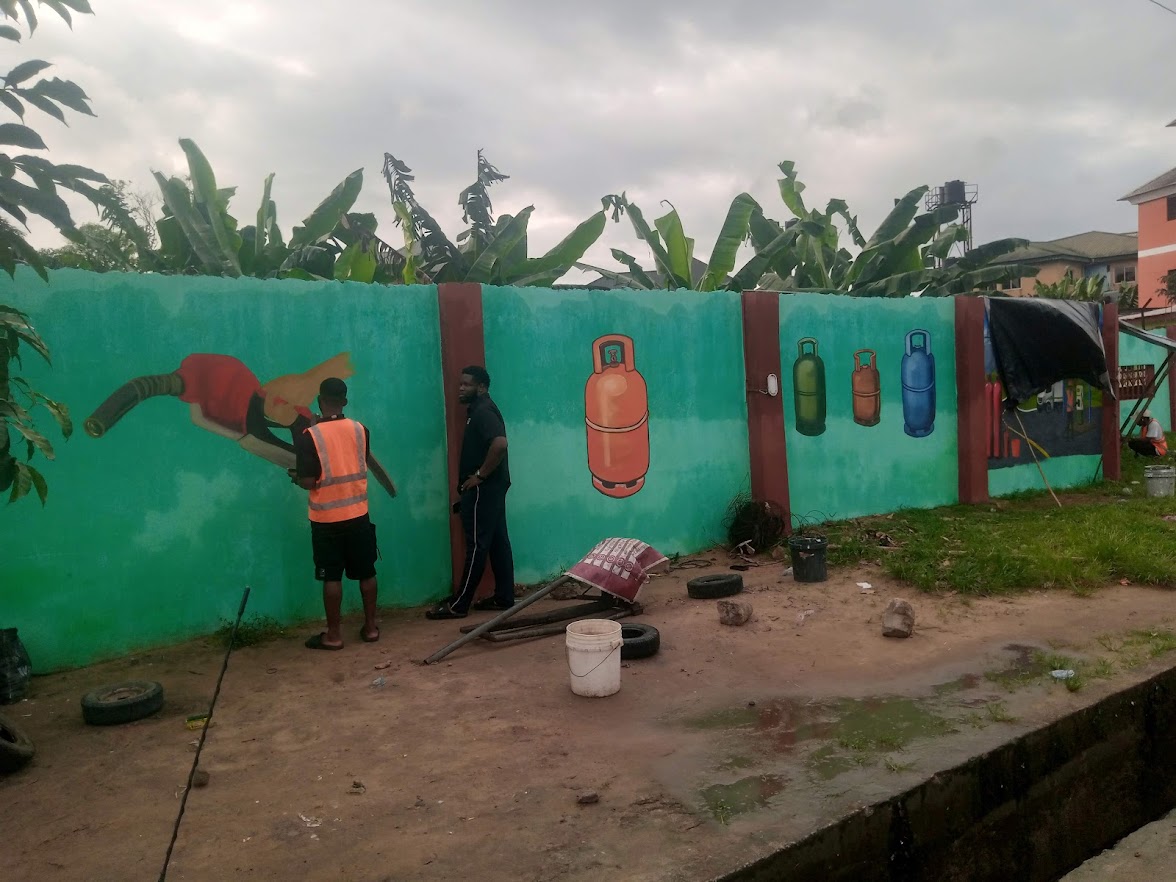
Banner image: An artist draws cooking gas cylinders on a roadside fence near a gas retail outlet in Uyo, Akwa Ibom State, where the use of LPG for cooking has risen in the last decade. Image by Ini Ekott for Mongabay.
Citations:
Jewitt, S., Atagher, P., & Clifford, M. (2020). “We cannot stop cooking”: Stove stacking, seasonality and the risky practices of household cookstove transitions in Nigeria. Energy Research & Social Science, 61, 101340. doi: 10.1016/j.erss.2019.101340
Slater, J., Palmer, E., Yetano-Roche, M., Eleri, E., & Malley, C. S. (2025). An estimation of the health and climatic impacts of household biomass consumption across Nigeria in 2018. Environmental Research: Health, 3(2), 025007. doi:10.1088/2752-5309/adb875
Clean cooking expands at record pace in Africa, but lags behind population growth
Feedback: Use this form to send a message to the author of this post. If you want to post a public comment, you can do that at the bottom of the page.
Cite this article
Ini Ekott (2026). 5 million Nigerians gain clean cooking access annually, but it’s not enough, experts say. Mongabay Conservation news. DOI: https://doi.org/10.66709/news-333820

