


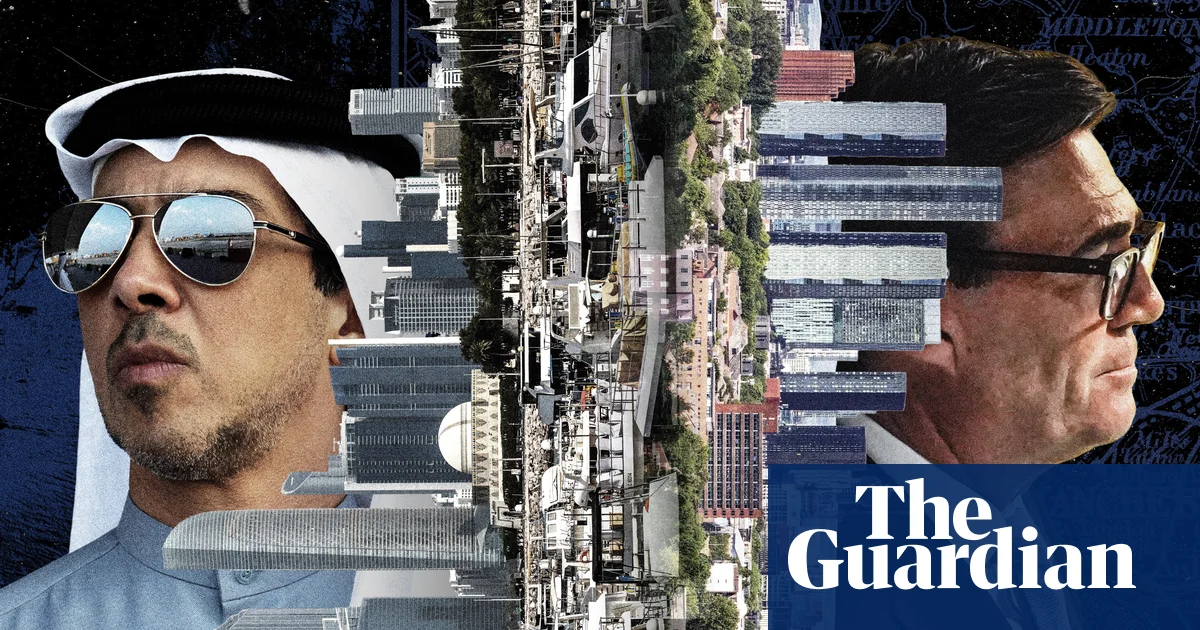
When Hosni Mubarak, Egypt’s long-ruling dictator, was toppled from power in the Arab spring protests of 2011, his downfall sent shock waves across the Middle East. It also helped change the face of modern Manchester.
Mubarak’s successor, the Muslim Brotherhood leader Mohamed Morsi, was a sworn enemy of the United Arab Emirates, whose rulers feared the advance of Morsi’s Islamism.
The UAE, a key western ally, was concerned that David Cameron’s UK government was not strong enough on the Muslim Brotherhood and warned ministers it could pull billion-pound arms deals if Britain did not act.
A secret Whitehall unit was hastily established to keep the oil-rich emirates on side. Lucrative investment deals were offered in private meetings later revealed by the Guardian.
One of these would turn Abu Dhabi’s now crisis-stricken ownership of Manchester City football club into a much deeper stake in the city itself.
Fifteen years after the Egyptian revolution, a Guardian analysis can reveal a stark rise in the amount of land and property owned by the UAE government or Emirati developers in Manchester over the past decade – extending to the size of 260 football pitches at its peak in 2023.
Manchester City’s owner, Sheikh Mansour bin Zayed al-Nahyan, has built an extensive portfolio outside the club, including the UK’s biggest indoor arena, an “upper-upscale hotel” that opened last month, a suite of apartment blocks and investment in world-leading university research through a firm run by Khaldoon al-Mubarak, the City chief executive.
The cheating scandal at Manchester City has put the spotlight on the wider influence of Abu Dhabi in the city, the growth of which helped power Andy Burnham to Downing Street.
Through interviews with key past and present local politicians and officials, new data analysis and an examination of public records spanning more than a decade, the Guardian can now tell the story of how the oil-rich state’s influence has grown, what it has meant for Manchester, and how it has fuelled concerns about the city becoming “a northern version of London”.
‘We were seeking a very significant investment’
Ten years ago, the sight of the murky-green Rochdale canal was a sign you had strayed too far out of Manchester’s lively Northern Quarter and should turn back. Now drinkers and diners gravitate to the area, pulled in by trendy waterside bars serving up £6.90 pints and an artisanal bakery where a single croissant costs £7.50.
That transformation began in summer 2013, when David Cameron’s government sought to defuse tensions with the UAE and asked Manchester city council to draw up three investment proposals for the super-rich emirates.
One of these resulted in a £1bn deal called Manchester Life, under which the council sold a prime slice of city centre land to Abu Dhabi for £5m to build 6,000 homes, along with a right of first refusal on other projects.
Richard Leese, the leader of Manchester city council at the time, told the Guardian: “That was a UK government-brokered deal and we were obviously seeking a very significant investment for what would in total have been a £1bn scheme.
“Housing development in and around the city centre and Ancoats in particular had stopped and been stopped for several years. At that time there were no [other] developers who were either willing or able to do it.”
In a press release, Leese hailed the partnership as a “world-class exemplar of regeneration” and “a platform for the delivery of more than 6,000 new homes”.
However, only 2,039 homes have been delivered by Manchester Life – a third of the total promised – with a further 2,839 homes being built by other developers. The total of 4,878 new properties is nearly 20% short of the 6,000 envisaged.
Despite the council’s longstanding policy of at least 20% of new developments being for social and affordable housing, only 8% of these 4,878 properties fell into that category – and none were provided by Manchester Life.
Food banks and luxury flats
A five-minute walk from the new Abu Dhabi-funded apartments, which are home to the city’s first Michelin-starred restaurant, the nave of a former Methodist church is stacked high with emergency food for those living on surrounding streets.
The short walk to the Etihad Stadium includes some of the poorest areas in the second most deprived local authority in England. Within only half a mile, there are four charity food banks or distribution sites, one of which has a plaque marking its opening by Burnham in 2021.
“It’s bound to cause resentment,” said Mark Blake, the chief executive of Manchester Central Foodbank, of the sudden influx of shiny apartments, expensive eateries and well-paid tenants. “When it’s in your face and is during a cost of living crisis it potentially could lead to some unrest. I think it should be a real concern.”
Parking has become a flashpoint, with reports of cars being vandalised after being left on council estate streets by those living or dining at the Abu Dhabi-funded properties. Tenants of the swanky apartments are encouraged to leave food to local food banks in donation boxes in each of the luxury blocks.
“People are feeling all these cultural divides that are played out through the proxy of housing and everyday issues around parking,” said Alan Good, a Lib Dem councillor for Ancoats and Beswick. “Residents tell me they look at the shiny new towers and there’s a resentment – a feeling that they’re not benefiting from what Manchester is benefiting from.”
Good said he felt Manchester was becoming a “northern version of London” as an “insane” property crisis compounded the misery for the city’s 20,000 people on the social housing register.
Dr Matthew Stallard, a University College London researcher and chair of trustees at Manchester Central Foodbank, said there was an uncomfortable disconnect between the city’s reputation nationally – with “Manchesterism” becoming a byword for a thriving metropolis with an eye on broader social benefits – and the reality for many in the city.
“If you look at central Manchester and all the skyscrapers and you go out in every direction by a mile and a half or two miles, you’re then in some of the most deprived neighbourhoods in the country. In Ancoats, it’s a very clear line where the money is and where the money’s not.”
Awkward questions
In summer 2016, Burnham was keenly aware of Greater Manchester’s housing crisis. He told the Salford Star that if elected, he would stop large property firms benefiting from multimillion-pound taxpayer-funded loans from the mayoral authority.
There were concerns, he said, that the Greater Manchester combined authority (GMCA) fund had “been used to provide loans to large companies, which should have used their own finance instead, and that is too focused on city centre and luxury schemes”.
Barely a year later, Burnham signed off a £55m loan to Jersey-registered property firms owned by Sheikh Mansour, scion of one of the world’s wealthiest families with a reported fortune of about £300bn.
GMCA said its loans fund was available to all developers who met the lending criteria and that the loans had been repaid in full. But these decisions are now being investigated by councillors on GMCA’s scrutiny committee.
There are awkward questions for Burnham, too. Weeks before the loans were approved, he enjoyed hospitality from City’s owners in a meeting that came to light only last week after disappearing from public records. The prime minister initially said he had had only one “significant” meeting with the club’s bosses – in 2021 – but a further five have since emerged.
Burnham said last week he had asked GMCA to conduct a “manual trawl of everything, as I want everything possible to be out there”. He added: “There’s no question about that – full transparency.”
There appeared to be little transparency, however, when it came to the council’s long-term relationship with Manchester City’s owners.
In December 2015, it signed a 10-year “collaboration agreement” with Abu Dhabi giving the emirates first refusal on land near the city centre. A specific clause in effect gagged the council’s democratically elected politicians from announcing the deal without written approval from Sheikh Mansour’s firm.
Other Manchester developers only discovered this years later. “It’s blatant partiality on a massive scale. It stinks,” said one property consultant. A council spokesperson defended the clause as “a standard agreement between two parties that ensures announcements or information releases are agreed by all parties”.
All of the property, now worth an estimated £350m, is ultimately owned by Sheikh Mansour via Jersey-domiciled subsidiaries, with the super-rich Emirati receiving the rent paid by the hundreds of mostly young professionals who live there.
The council said it had received nearly £3m as part of an undisclosed profit-sharing agreement and a further £17.6m in council tax. However, the precise return to the taxpayer – and the terms under which the deals were struck – remain unknown.
Leese, 75, stepped down as council leader after 25 years in December 2021, becoming honorary president at Manchester City two years later. When approached by the Guardian, he denied the Abu Dhabi deal was shielded from scrutiny and defended his appointment at Manchester City.
“This was something that happened after I retired from the council. Whether it would have been appropriate when I was on the council, I would have questioned that,” Leese said.
One senior former council officer, who worked in the property and development team, described the culture in this period as “Kremlin-like” or akin to “a medieval court” where officials could show “no dissent” towards the decisions of the Labour leadership.
“When you’ve got a council that’s 99% one party, there wasn’t really room for discussion,” they said, adding that they felt some senior leaders got “blinded by schmoozing around” with Abu Dhabi executives and others.
Leese denied he got too close to Manchester City, the team he supports, or gave them favourable treatment as council leader. “There are a lot of players in Manchester that the city council is close to,” he said.
“That’s the way the city works – in partnership.”
Manchester city council has strongly denied claims of a “sweetheart deal” with Abu Dhabi after researchers at the University of Sheffield concluded it had “sold the family silver too cheaply” by giving the land to Abu Dhabi at a cheaper rate than comparable developments.
The future No 10 North
In 2017, three years after the first Abu Dhabi deal and the year Burnham became Greater Manchester mayor, council leaders made another huge bet. They paid £42m for a hollowed out retail park next to the £1bn Manchester Life development, described at the time as the biggest ever land purchase in Manchester city centre.
Its price was at least six times higher per acre than the adjacent land sold for £5m to Sheikh Mansour – and it would later be identified as the permanent future home of Burnham’s No 10 North.
This former retail park was also a partnership with Abu Dhabi. Again, the terms were shielded from scrutiny as members of the public were excluded from council hearings – but inside the town hall, the fallout was significant.
A senior council property officer, Dominic Hayes, resigned abruptly in March 2018 over concerns about the deals the council was doing with Mansour’s group. He listed a series of complaints in an email to the council chief executive, Joanne Roney, who the previous year had succeeded the all-powerful Howard Bernstein when he retired after 29 years in charge.
In a tense meeting days after the resignation, a senior council figure, Eddie Smith, is said to have told colleagues that Hayes had thrown them “under a bus” and that the leadership was furious. According to contemporaneous notes by a colleague, seen by the Guardian, Smith said Hayes had made “not acceptable [and] possibly dangerous” criticisms of a Manchester City board member who was a key figure in the Manchester Life deal.
Smith is then said to have commented: “You don’t criticise the council’s relationship with the football club in this organisation and hope to survive.” Smith, who left the council in 2020, denies making the comment.
Yet Hayes’ concerns were serious enough to warrant an internal investigation into governance at the council. It found that anxieties about the council’s deal-making were not limited to just one officer.
A second senior employee told auditors they were concerned that the council had “overpaid” for the rundown retail park, according to an official record of the meeting. That officer raised concerns that the Abu Dhabi-led project was “driving the master planning for a site they didn’t own”.
When Burnham became prime minister in July, the site was tipped as the permanent home for No 10 North. As scrutiny of the Abu Dhabi link grew in October, these plans were quietly shelved.
‘The fragility of the Manchester model’
Council sources noticed a change of approach under Leese’s successor, Bev Craig, when she became council leader in December 2021.
Craig ordered a review of the Manchester Life deal to make sure it was “all legal, all above board”, she told BBC Radio Manchester this month, adding: “The answer was yes.”
One of the reviews commissioned by Craig, who succeeded Burnham this year as Greater Manchester mayor, was published in July. It found that while the deals with developers such as Abu Dhabi had delivered “significant benefits”, there were “weaknesses in documentation, monitoring and assurance”, particularly around the profit-sharing nature of these deals.
Prof Jonathan Silver, a University of Sheffield researcher who has analysed the Manchester Life deal, said the growing buy-up of land and property by Emiratis raised “major concerns about the fragility of the ‘Manchester model’ and its reliance on attracting flows of international finance, whatever the cost”.
Silver said there were “urgent questions” about what would happen to the hundreds of homes in the Manchester Life developments if Sheikh Mansour was forced or decided to sell Manchester City in light of the cheating scandal.
Leese remains confident the Abu Dhabi deals were a huge success for the city. Asked whether he would have handled the partnership any differently given the concerns raised by academics and others, he said: “No. Nothing that I can think of. It is a phenomenally good deal for Manchester.”
Additional reporting: Carmen Aguilar García and Michael Goodier
