


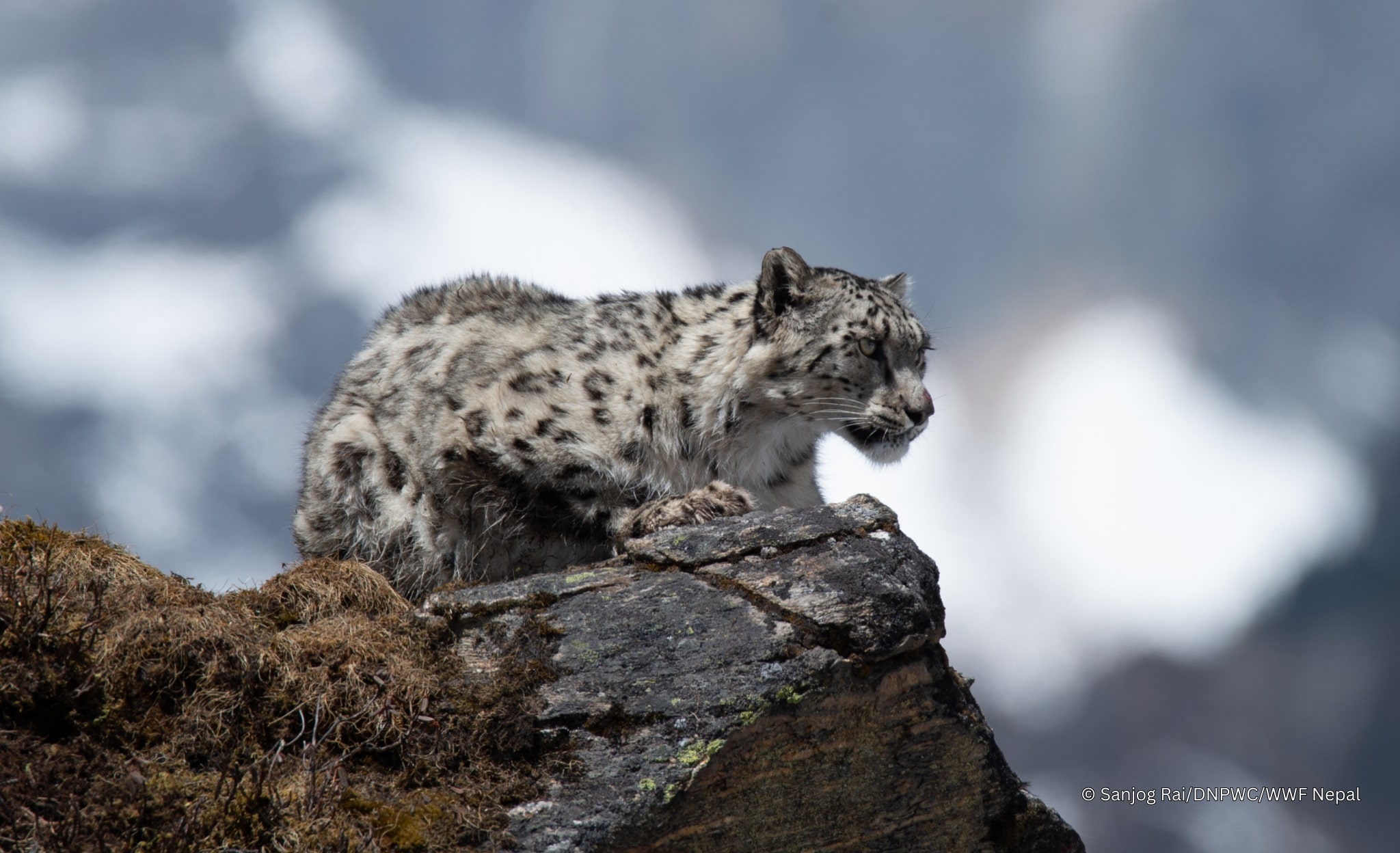
Snow leopards range across Asia’s rugged mountains, where they face mounting threats from climate change, declining wild prey, and retaliatory killings from local herders. Today, on Oct. 23, International Snow Leopard Day, we look back at recent Mongabay reporting highlighting how innovative science, climate-ready habitat, and community-centered conservation are helping these big cats share mountain landscapes with human neighbors.
A 2025 government survey found roughly 397 snow leopards living in Nepal. A separate study published earlier this year revealed that snow leopards (Panthera uncia), common leopards (Panthera pardus), and Himalayan wolves (Canis lupus chanco) all live together in Nepal’s Lapchi Valley. They coexist largely by targeting different prey species, Mongabay’s Liz Kimbrough reported. Wild blue sheep (Pseudois nayaur), for example, make up nearly half of the snow leopard’s prey.
Study lead researcher Narayan Prasad Koju told Mongabay that maintaining such wild ungulate populations is critical to preventing the predators from targeting livestock. “When wild prey declines, all three predators shift toward livestock, which triggers retaliatory killings and destabilizes the whole system.”
Community concerns about conservation
In an interview with Mongabay, Rodney Jackson, founder and board president of the U.S.-based Snow Leopard Conservancy, said conservationists must shift focus from counting the carnivores to addressing the immediate needs of herding families who lose livestock to the big cats.
“The cost is being borne by the communities,” Jackson told Mongabay’s Abhaya Raj Joshi, adding that ongoing human-wildlife conflict undermines trust from local communities who continue to struggle to live alongside the cats. Jackson called for community support, including camera-trap-triggered deterrents, an improved notification system for when snow leopards are near livestock, and fair financial relief for livestock losses, rather than costly population monitoring.
Climate-ready room to roam in Kyrgyzstan
In central Kyrgyzstan the 800,000-hectare (nearly 2-million-acre) Ak Ilbirs ecological corridor was recently established to give an estimated 300 snow leopards room to adapt as climate change alters their alpine habitats. The project was formalized under the U.N. Environment Programme’s (UNEP) Central Asian Mammals and Climate Adaptation project alongside local organizations, Mongabay’s Liz Kimbrough reported that the corridor uses climate projections through 2070 to safeguard habitats while integrating sustainable local livestock grazing.
“Projects like this are good for hope, because you can see changes at the policy level and changes in people’s mindsets on the ground,” Marten Hofman, associate program management officer with UNEP, told Mongabay.
Meanwhile, satellite tracking by WWF Nepal confirmed that snow leopards frequently cross international borders into India and China.
Banner image: A snow leopard photographed in Nepal. Image courtesy of WWF.
