


If you want a quintessential “It wouldn’t happen now” story, try this. Two months before Margaret Thatcher became prime minister in May 1979, a national Militant Entertainment Tour was organised by Rock Against Racism.
On 20 March 1979, it came to the West Runton Pavilion near Cromer, the (very) small town on the coastal edge of East Anglia. The bill mixed the black and white musicians in three bands then at their artistic peak – the post-punk maestros Gang of Four, the punk-reggae hybridists The Ruts, and Misty in Roots, the renowned reggae collective from Southall in west London – and thereby made a stark symbolic point: that the multiracial nature of large swathes of the UK was not to be decried or attacked, but actively celebrated.
The UK was then – and some of this may sound familiar – in a bitter, polarised state, seemingly locked into deep economic problems, amid rising fear about the neo-fascist National Front. The previous year, Thatcher had said – and this may feel familiar, too – that British people “were really rather afraid that this country might be rather swamped by people with a different culture.” Amid such a grim political atmosphere, RAR and the musicians who supported it felt duty-bound to try pulling their audiences away from such toxicity, and point out that what we now call diversity was something to be celebrated.
Nearly half a century on, the lack of any comparable cultural response to this country’s equally unsettling current state seems quite remarkable. There is, then, a vacant cultural-political space – and look what has now come along to fill it. GB News, that bracingly rightwing TV channel whose regular faces include Nigel Farage, the Reform MP Lee Anderson and the party’s failed byelection candidate Matt Goodwin, is about to launch a music radio station.
According to its promotional blurb, it will be “dedicated exclusively to artists from Great Britain and Northern Ireland”, with tagline “all British, all day”. By way of further explanation, one of its presenters, the black GB News host Nana Akua, says that “It’s easy to forget how this country has shaped the global music landscape” – a strange point instantly disproved by a mention of any number of artists (such as those four fairly successful fellas from Liverpool). But here, perhaps, is the strangest thing of all: according to GB Media, every track on the station’s playlist will be an “artist from Great Britain or Northern Ireland, or where the main proportion of the band is British.”
after newsletter promotion
This sparks no end of questions. Does anyone in the ordinary world actually perceive music like this? Will someone frantically be employed to sift through Wikipedia, finding out whether this or that band fits the “main proportion” criterion? What will happen in the case of, say, the Gallagher brothers, who self-identify as Irish – and should, therefore, be excluded for the same reasons as U2, CMAT and Fontaines DC? Should the Jimi Hendrix Experience be ruled in or out, given that the two supporting members of the trio were respectively from Ealing and Folkestone? And to get into the real nitty-gritty, how exactly are the programmers defining “British”?
We all know the jaw-dropping conversations taking place in GB News-adjacent circles about national identity. The Tory-to-Reform defectors Robert Jenrick and Suella Braverman see Englishness as an ethnic identity. If this definition wins out, which is quite conceivable, what will happen then? A playlist cull that will leave little apart from the musical equivalent of sliced white bread?
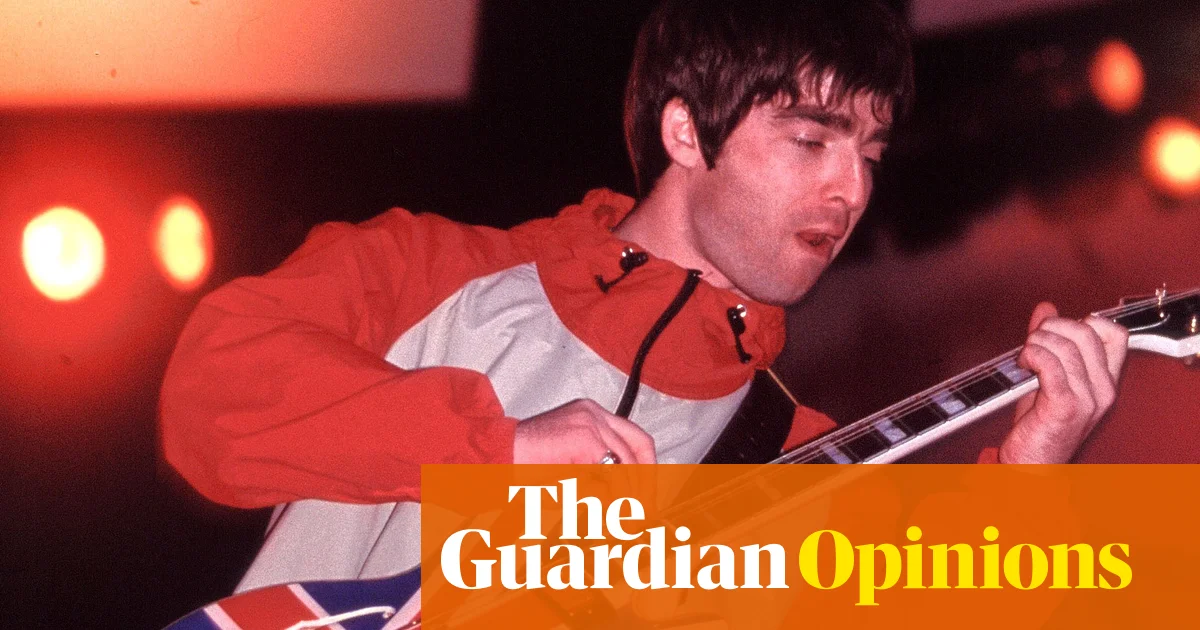
There are more fascinating questions to ask. There has been an on-off debate about whether Britpop was partly responsible for Brexit. As the writer of a book about that cultural wave, I have always clung on to the idea that because its nationalistic(ish) animus was focused on the US, and the demographics of Leave voters do not map on to the Britpop generation, no one had any case to answer. But this latest development brings on a slight pang of unease. In retrospect, the large-scale whiteness of Britpop was, as we say these days, rather problematic. On a musical level, it accounts for its chronically limited range of influences and inputs, which led to it burning out pretty quickly. But it also left it open to what might turn out to be a belated act of appropriation: whatever music the new station plays, I would imagine that Oasis, Blur, Pulp et al will be an integral part of its output. Put another way, the Farage-ist tanks are now surely heading for Britpop’s metaphorical lawn.
Inquiries to a couple of music lawyers established that musicians cannot stop radio stations that possess the relevant licences and pay the required royalties from playing their material. Self-evidently, however, they could quite easily express their displeasure at the prospect of being part of a constant Farage-ist soundtrack. In the excellent new Oasis documentary, Don’t Look Back in Anger, Noel Gallagher rightly says that his band was never “a rightwing thing … All are welcome. It’s we and us.” In the context of GB Music Radio, he should translate that into something slightly more specific. So should the already embattled Ed Sheeran, Adele, what remains of the Rolling Stones, the former members of Dire Straits and everyone else who is – and isn’t – mentioned in the station’s launch statement. The music all of them make, after all, is founded on precisely the kind of cultural mixing that so many voices associated with GB News take against.
Oh, and one last thing. This message needs to be out there in the fabric of people’s lives, not only pouring out of their phones, but arriving in their towns. The West Runton Pavilion was demolished in 1986. But imagine some modern equivalent of Militant Entertainment pitching up on the Essex coast, the old Nottinghamshire coalfield, the seaside towns of Kent, or any number of Reform’s supposed heartlands. Is that really now as inconceivable as it seems?
